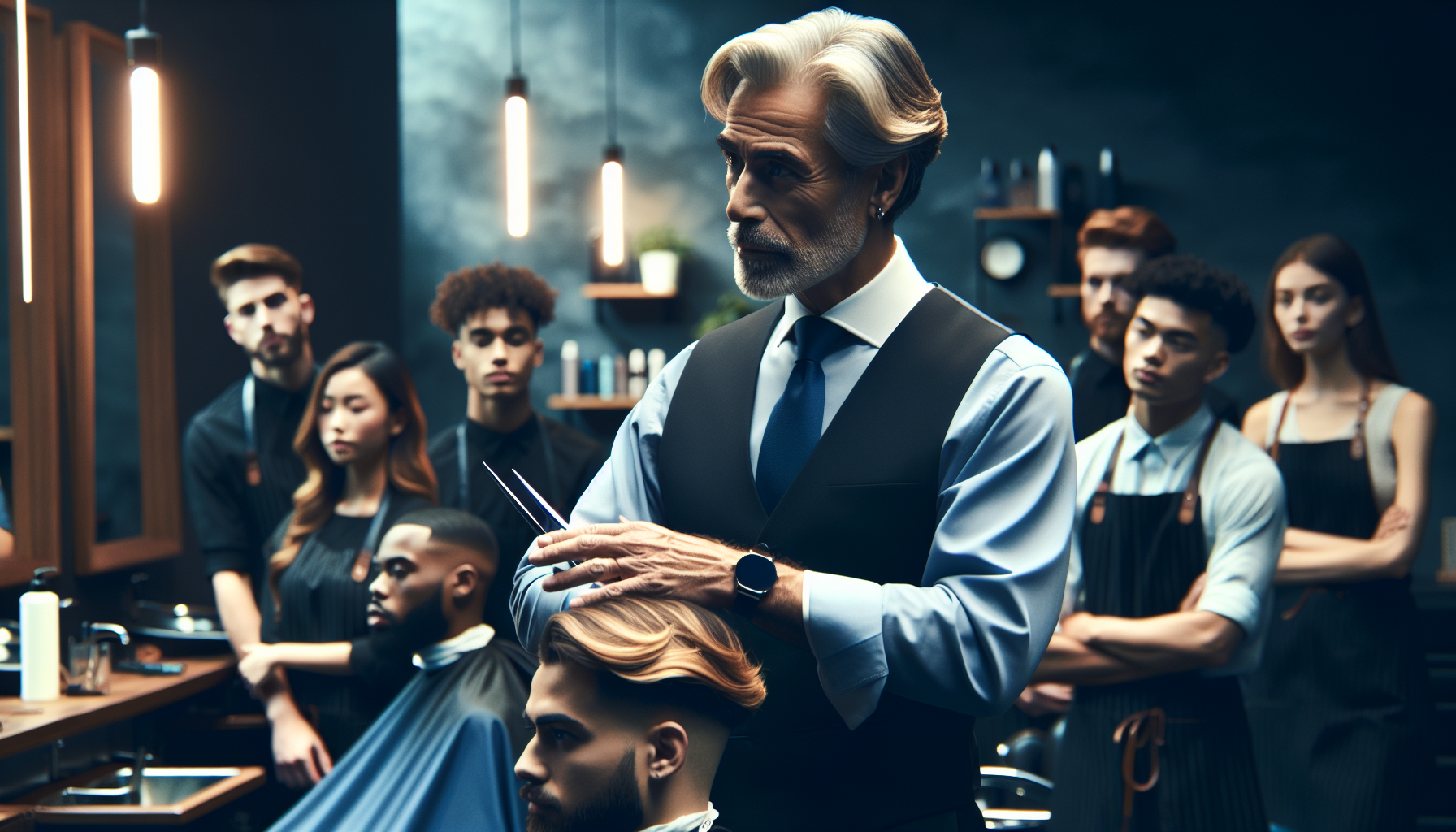
Master Certificate Level 6-7 Leadership Beauty Industry Barbering & Grooming

Diploma in Men's Hairdressing & Grooming Artistry

Leadership Level

6 Subjects
30 Chapters
180 Lessons
500 Marks

LAPT — London Academy of Professional Training

Diploma in Men's Hairdressing & Grooming Artistry
Master Certificate Level 6-7
  • BE-BAG-L
  • Leadership Stage
  • 500 total marks
  • Pass: 325 marks (65%)
  • Validity: Lifetime
Enrol Now View Brochure
AwardMaster Certificate
Global LevelLevel 6-7
Total Marks500
Pass Mark325 (65%)
Subjects6
Chapters30
Classes180

About This Certification

Who Is This For?

This is designed for experienced barbers and hairdressers currently in supervisory roles, aspiring to expand their leadership capabilities and business acumen within the beauty industry.

Course Curriculum

6 subjects • 30 chapters • 180 classes
01
Marketing and Branding
5 chapters • 30 classes • 50 marks • 25h
Understanding the Basics of Marketing in Men's Grooming 6 classes
1.1 Explore Key Marketing Principles in Men's Grooming
## Lesson Overview This lesson focuses on the key principles of marketing and branding specifically tailored for the men's grooming industry. By exploring topics such as target audiences, brand identity, and digital marketing strategies, students will gain insights essential for their future careers as grooming professionals. The activities aim to reinforce practical applications of these concepts, enhancing their understanding and skills needed to create effective marketing campaigns. ## Delivery Tips Begin the class by introducing the importance of marketing within the grooming industry and sharing relevant statistics or trends related to male grooming. Consider using visual aids and real-world examples to illustrate key points. Encourage active participation by inviting students to share their thoughts and experiences throughout the lesson. Group discussions and peer feedback are valuable for reinforcing concepts and fostering collaboration. ## Common Misconceptions Students may believe that marketing is solely about advertising products. Emphasize that marketing encompasses a broader range of activities, including understanding consumer behavior, building relationships, and crafting compelling brand narratives. Additionally, clarify that branding isn't just about aesthetics; it's about creating an emotional connection with clients. ## Discussion Prompts 1. How have societal changes influenced men's grooming trends? 2. In what ways can understanding consumer behavior enhance your marketing effectiveness? ## Timing Breakdown - Lesson Introduction: 5 minutes - Individual Exercise: 15 minutes - Group Exercise: 20 minutes - Pair Activity: 10 minutes - Wrap-Up Discussion: 10 minutes Total: 60 minutes ## Differentiation For students needing additional support, offer examples of successful branding in the grooming industry. For advanced students, challenge them to analyze case studies of failed marketing campaigns and discuss what could have been done differently. ## Assessment Guidance Assess students based on their participation in discussions, the creativity of their marketing ideas, and their understanding of key concepts reflected in their exercises. Providing feedback on their brainstorming activities will help guide their learning. ## Extension Activity As an extension activity, students can create a mock marketing plan for their own grooming brand. This plan should include detailed analyses of their target audience, branding strategies, and digital marketing approaches. Encourage them to present this plan to the class for constructive feedback and discussion.
1.2 Identify Target Markets and Customer Profiles
## Lesson Overview This lesson focuses on the importance of identifying target markets and developing customer profiles within the context of men's hairdressing and grooming. By understanding who their customers are, students can tailor their marketing strategies to better meet the needs of distinct groups. The objective is to engender a solid grasp of demographic, psychographic, and segmentation concepts while enabling students to apply these concepts to real-world scenarios. ## Delivery Tips Engage students with real-life examples from the men's grooming industry to enhance relatability. Consider using visuals, such as infographics or case studies, that illustrate successful marketing strategies targeting specific markets. Encourage group discussions and ensure that all students participate. ## Common Misconceptions Some students might believe that the broader the target market, the better. This misconception overlooks the effectiveness of tailored engagement strategies for specific segments. Additionally, students may confuse demographics with psychographics, thinking they mean the same thing, when in fact they provide different insights into customer behavior. ## Discussion Prompts - Discuss how demographic factors like age and income influence purchasing decisions in grooming products. - Explore why psychographic information, such as values and lifestyle, is crucial in marketing strategies. ## Timing Breakdown - Introduction to target markets: 10 minutes - Individual exercise on identifying target markets: 15 minutes - Group discussion on target markets: 10 minutes - Introduction to customer profiles: 10 minutes - Pair exercise on creating customer profiles: 20 minutes - Presentations and debrief: 15 minutes ## Differentiation For advanced students, introduce more complex case studies for analysis or encourage them to create marketing strategies based on their customer profiles. For students needing support, provide additional templates with guiding questions or work in smaller groups to ensure understanding. ## Assessment Guidance Assess student understanding through their participation in discussions, the quality of their target market identification, and the detail in their customer profiles. Consider using a rubric to evaluate their presentations based on clarity, depth, and engagement. ## Extension Activity As an extension, students could choose a specific grooming product and develop a full marketing plan that includes clearly identified target markets and customer profiles. This could culminate in a presentation to simulate a pitch to a potential investor or client.
1.3 Develop a Unique Brand Identity for Grooming Services
## Lesson Overview This lesson focuses on developing a unique brand identity for grooming services. Students will learn about the elements that make up brand identity and how to communicate a unique value proposition to attract and retain customers. The class is designed to foster creativity in brand development while building essential marketing skills. ## Delivery Tips Encourage students to think critically about the brands they admire, and how these brands communicate their identity. Use real-world examples to illustrate successful branding strategies in the grooming industry. Facilitate group discussions and ensure that every student contributes to the brainstorming sessions. ## Common Misconceptions Students may believe that brand identity only consists of visual elements such as logos and colors. Emphasize that brand identity also includes intangible aspects such as customer service, ambiance, and values associated with the brand. Clarify the difference between unique value propositions and generic marketing claims. ## Discussion Prompts - What elements do you notice first when encountering a new brand? - How can understanding customer demographics enhance brand identity development? ## Timing Breakdown Allocate 5 minutes for introductions and the lesson overview. Spend approximately 15 minutes on the group brainstorming activity, followed by 10 minutes for the individual UVP creation. Reserve 15 minutes for presentations and discussions on the UVPs developed by students. Finally, leave room for a 10-minute debrief on brand identity's importance in the grooming industry. ## Differentiation Provide more structured templates for students who may need guidance during the brainstorming process. Offer advanced students the opportunity to analyze and critique existing brand identities in the grooming industry, comparing them to their own ideas. ## Assessment Guidance Evaluate student participation in group discussions and the creativity of their brand identity concepts. Review their unique value propositions for clarity, conciseness, and relevance to target demographics. Provide constructive feedback to help them refine their ideas. ## Extension Activity As an extension, students could create a marketing campaign for their grooming service, including social media posts, print advertisements, and promotional materials that align with their newly developed brand identity. This can be a longer-term project that reinforces their learning as they combine branding and marketing strategies.
1.4 Craft Effective Marketing Messages for Men's Grooming
## Lesson Overview In this lesson, students will learn how to craft effective marketing messages specifically tailored for the men's grooming sector. The focus is on understanding the target audience, defining a unique selling proposition (USP), crafting compelling messages, utilizing digital platforms, and evaluating marketing message effectiveness. These concepts are essential in developing successful marketing strategies in the competitive grooming landscape. ## Delivery Tips To ensure effective delivery, start with an engaging introduction that highlights the importance of marketing in the grooming industry. Use real-life examples and case studies to illustrate the content. Incorporate multimedia, such as videos or infographics, to keep students engaged. Encourage active participation through discussions and hands-on activities. Be flexible with timing based on the students' engagement levels and understanding. ## Common Misconceptions Some students may believe that marketing messages can be generic and not tailored to audience segments. Emphasize the importance of personalization in marketing. Another misconception might be that a unique selling proposition is not necessary in a saturated market. Clarify that a strong USP is essential to differentiate the brand and build loyalty. ## Discussion Prompts 1. How do you think understanding your audience can shape your marketing strategy? 2. In what ways can a strong USP influence consumer purchasing decisions? These prompts can be used to facilitate deeper discussions among students to enhance understanding. ## Timing Breakdown - Lesson Introduction: 10 minutes - Understanding Your Audience Activity: 15 minutes - Unique Selling Proposition: 15 minutes - Message Crafting Activity: 15 minutes - Digital Platform Discussion: 15 minutes - Conclusion and Q&A: 10 minutes Overall, aim for a 90-minute class with flexibility in the timing of each section. ## Differentiation To support diverse learners, consider providing additional resources, such as articles or videos, for further exploration. Offer scaffolded activities that gradually build on previous knowledge, allowing students to work at their own pace. Group and peer interactions can also support collaborative learning and peer feedback. ## Assessment Guidance Assess student understanding through participation in activities and the quality of crafted marketing messages. Provide constructive feedback that highlights strengths and areas for improvement. Consider using a rubric to evaluate presentations based on creativity, clarity, and audience engagement. ## Extension Activity As an extension, encourage students to develop a complete marketing campaign for a grooming product they are passionate about. This campaign should include a marketing message, a defined USP, and strategies for each digital platform, culminating in a presentation to the class.
1.5 Analyze Competitor Strategies in the Grooming Industry
## Lesson Overview This lesson focuses on analyzing competitor strategies within the grooming industry, emphasizing the importance of competitor analysis in marketing and branding. Students will learn to evaluate competitors’ strengths, weaknesses, unique selling propositions, and marketing strategies. This essential skill prepares students to make informed strategic recommendations to improve brand positioning. ## Delivery Tips Begin by introducing the concept of competitor analysis, showcasing relevant examples from the grooming industry. Use visual aids such as charts or slides to highlight key differences in competing brands. Encourage student engagement through open discussions and collaborative activities, allowing them to express and develop their ideas freely. ## Common Misconceptions Students may confuse direct and indirect competitors, viewing only brands that offer similar products as competitors. It’s important to clarify that indirect competitors also affect market dynamics, including lifestyle brands or alternative grooming options. Additionally, some may underestimate the impact of USPs in effectively attracting and retaining customers. ## Discussion Prompts 1. How can a strong brand reputation create barriers for new entrants in the grooming industry? 2. In what ways can a brand effectively utilize customer feedback to identify market gaps and enhance its offerings? ## Timing Breakdown - Introduction (5 minutes) - Group activities (20 minutes) - Class discussions (15 minutes) - Wrap up and feedback (5 minutes) Altogether, ensure that you reserve enough time for interaction during the activities and debriefings to absorb insights. ## Differentiation Adapt the activities according to student skill levels. For instance, provide more structured templates for those who need guidance, while encouraging advanced students to explore deeper analytical techniques independently. This can be achieved by allowing time to delve into more complex case studies in groups. ## Assessment Guidance Evaluate students based on their participation in discussions, the depth of analysis presented during group activities, and their ability to articulate insights clearly. Utilize formative assessments such as exit tickets asking for one key takeaway from the lesson, ensuring understanding of the core concepts. ## Extension Activity Assign students to follow a grooming brand over a month, tracking their marketing efforts and analyzing changes in consumer engagement. Students can present a report summarizing their observations and recommending potential strategies based on their findings.
1.6 Implement Digital Marketing Tactics for Grooming Businesses
## Lesson Overview This lesson focuses on implementing digital marketing tactics specifically tailored to grooming businesses. Students will explore the importance of digital marketing, social media engagement, SEO techniques, and email marketing strategies. ## Delivery Tips Begin the lesson with a discussion on the impact of digital marketing in today's grooming industry. Utilize real-life examples of successful grooming brands to illustrate key points. Encourage active participation through group discussions and interactive activities, stressing the relevance of each topic to their future careers. ## Common Misconceptions Some students may believe that digital marketing is only about social media. Emphasize that SEO, email marketing, and maintaining a website are equally important. Clarify that digital marketing is not a one-size-fits-all strategy and must be tailored to different businesses based on their unique audiences. ## Discussion Prompts - Ask students how they currently use social media and if they see it as essential for their careers. - What are some common mistakes businesses make in their digital marketing efforts? ## Timing Breakdown - Introduction to Digital Marketing – 10 mins - Social Media Tactics – 10 mins - SEO Techniques – 10 mins - Email Marketing – 10 mins - Group activities as described – 15 mins each - Reflection and discussions – 10 mins Overall, the lesson can be effectively taught in a one-hour block. ## Differentiation Tailor activities and discussions based on students' varying levels of familiarity with technology. Provide extra support or resources for students needing more guidance. Offer advanced students opportunities to explore more complex SEO strategies or digital analytics. ## Assessment Guidance Assess students based on their participation in the activities and contributions to discussions. Use rubrics for group presentations to ensure a fair evaluation of collaborative work, focusing on creativity and relevance in their marketing plans. ## Extension Activity Encourage students to create a mock social media post based on one of the services they researched. They can use graphic design tools to develop visuals and captions that effectively communicate their message. Present these posts to the class for feedback.
Target Market Identification and Persona Development 6 classes
2.1 Explore the Concepts of Target Market in Men's Grooming
## Lesson Overview This lesson focuses on the concept of target markets within the men's grooming industry. It aims to equip students with the necessary skills to identify and understand demographic and psychographic factors that influence grooming choices, thereby laying the foundation for successful marketing strategies in their future careers. ## Delivery Tips 1. Start with an engaging discussion on why understanding target markets is crucial. Use real-world examples from grooming brands that effectively target their consumer base. 2. Encourage students to share their insights and experiences related to grooming products and services. 3. Use visual aids to illustrate demographic trends and psychographic factors, making the concepts more tangible. ## Common Misconceptions - Some students may believe that all men have similar grooming needs; emphasize the diversity within the male population based on demographics and psychographics. - Others might think that marketing only deals with sales tactics, not realizing the importance of understanding customer behavior and preferences. ## Discussion Prompts - How do cultural variations impact target markets in men's grooming? - In what ways can grooming professionals use customer personas to enhance brand loyalty? ## Timing Breakdown - Introduction to Target Markets: 10 minutes - Overview of Demographics and Psychographics: 15 minutes - Practical Activities: 90 minutes (45 minutes for both individual and pair exercises, 20 minutes for group activities, 25 minutes for debriefing) - Wrap-up Discussion: 10 minutes ## Differentiation - Provide additional resources and articles for advanced learners who want to delve deeper into niche markets. - For slower learners, offer simplified profiles and examples to aid in understanding foundational concepts. ## Assessment Guidance - Evaluate student participation and engagement in activities. - Assess the quality and creativity of customer personas created by pairs or groups. Consider how well they synthesized the information into a cohesive representation of their target market. ## Extension Activity Encourage students to research a successful men's grooming brand and prepare a case study presentation that focuses on how the brand understands and targets its market. This can help reinforce their learning and encourage analytical skills.
2.2 Analyze Demographic and Psychographic Segments
## Lesson Overview This lesson focuses on analyzing demographic and psychographic segments to optimize marketing strategies in the men's hairdressing and grooming sector. By understanding these facets, students will learn how to create customer personas that can effectively target specific market segments. ## Delivery Tips - Begin the lesson by discussing the importance of demographics and psychographics in marketing. Use real-world examples from the grooming industry to illustrate points. - Encourage active participation during the debrief sessions to foster deeper understanding. - Use multimedia resources such as videos or articles that showcase effective marketing in grooming. ## Common Misconceptions - Students may confuse demographics with psychographics, believing that both provide the same information. Emphasize that demographics are quantifiable data while psychographics are qualitative insights. - There is often a belief that customer personas are rigid. Highlight that they are evolving and should adapt based on market changes. ## Discussion Prompts - Why is it important to combine demographics with psychographics when developing marketing strategies? - How can understanding consumer behaviors lead to innovation in product offerings? ## Timing Breakdown - Introduction and overview of concepts: 10 minutes - Individual demographic data activity: 15 minutes - Pair activity on customer personas: 20 minutes - Group presentations: 15 minutes - Final debriefing and discussion: 10 minutes ## Differentiation - For advanced students, require them to incorporate data visualization into their persona presentations. - For students needing support, provide additional resources or templates for demographic and psychographic analysis to streamline their work. ## Assessment Guidance - Assess student understanding through their presentations of customer personas and participation in discussions. - Use a rubric that evaluates clarity in persona creation, depth of analysis, and engagement in the activities. ## Extension Activity - As an extracurricular task, ask students to conduct interviews with individuals from their target demographic to refine their customer personas further. They should prepare a report based on the insights gained and share it in the next class.
2.3 Identify Market Trends and Consumer Needs
## Lesson Overview This lesson focuses on identifying market trends and consumer needs related to men's hairdressing and grooming. Students will explore how social and cultural influences shape consumer behavior, learn to adapt to evolving market demands, and develop effective marketing strategies to meet consumer expectations. The activities are designed to foster practical skills and critical thinking. ## Delivery Tips Encourage students to engage actively in discussions, particularly during the group activities. Use prompts to foster dialogue around their findings in market research and consumer assessments. Allow students to share personal insights or experiences from their own encounters in salons or grooming environments for a relatable context. ## Common Misconceptions Students may presume that market trends are static and do not require regular monitoring. Clarifying that trends can shift rapidly due to cultural changes or technological advances is essential. Additionally, some may underestimate the importance of consumer needs beyond mere services offered, such as salon ambience or personalized experiences. Ensure to highlight these areas during discussions. ## Discussion Prompts - How do you think emerging products, like natural or sustainable options, will change consumer demands? - In what ways can technology enhance client interactions in our industry, considering today's trends? ## Timing Breakdown - Introduction to market trends and consumer needs: 10 minutes - Explanation of group activities: 5 minutes - Student exercises (Research, Pair discussions, Group activities): 60 minutes - Wrap-up and sharing session: 15 minutes Each section should be paced to allow ample time for discussions and reflections. ## Differentiation Offer different resources based on students’ varying levels of experience, such as beginner articles or advanced industry reports. Implementing role-play can accommodate students who may struggle with theoretical discussions as it allows them to practice hands-on skills. ## Assessment Guidance Monitor participation during group discussions and presentations, evaluating the quality of insights provided. After activities, review individual reflections or summaries to assess understanding of market trends and consumer needs. Consider implementing peer assessments for collaborative activities to enhance accountability. ## Extension Activity As an extension, students can create a mock marketing campaign based on their findings of current trends and consumer needs. This campaign can include social media strategies, unique service offerings, and promotional materials. Presenting this campaign as a group would also foster teamwork and critical pitch skills.
2.4 Develop Detailed Customer Personas for Men's Grooming
## Lesson Overview This lesson on developing detailed customer personas for men's grooming will equip students with crucial insights into their target audience. The class will explore not only the importance of demographic information but also delve into psychographic profiling. By the end of this lesson, students will be able to create comprehensive customer personas tailored to different segments of the grooming market. ## Delivery Tips Start by defining customer personas in an engaging manner, perhaps using relatable examples from popular grooming brands. Discuss real-world applications such as how brands like Manscaped or Harry's target specific demographics. Encourage students to think critically about the characteristics that define various consumer segments. Utilize multimedia resources, such as videos or infographics, to make the lesson more dynamic. ## Common Misconceptions Students might confuse customer personas with general target market descriptions. Emphasize that personas are detailed representations, not just stats. Another misconception could be that demographic data alone is sufficient without considering psychographic factors. Clarify that understanding customer motivations and interests is key to effective marketing. ## Discussion Prompts Engage students with prompts about the potential limitations of customer personas. For example, discuss how bias in persona assumptions could impact marketing strategies. Ask students to consider how they might adapt their personas over time based on emerging trends in grooming products or shifts in consumer behavior. ## Timing Breakdown - Introduction to customer personas: 10 minutes - Group exercise (Create a Persona): 15 minutes - Role Play Activity: 20 minutes - Feedback Analysis: 15 minutes - Persona Presentation: 10 minutes - Class discussion and conclusion: 10 minutes ## Differentiation For advanced students, challenge them to consider merging multiple personas into a more complex market segment. For those who may struggle, provide templates for persona development to guide their creation process, focusing more on facilitated group discussions. ## Assessment Guidance Assess students based on their participation in activities, their engagement in discussions, and the quality of the personas they develop. Encourage peer feedback as a method of assessment, fostering a collaborative learning environment. ## Extension Activity For those who finish early or wish to explore further, consider having them research an emerging trend in men's grooming and create a persona that embraces this trend. This could encompass new sustainability practices, grooming tech innovations, or shifts in consumer priorities such as body positivity.
2.5 Illustrate Persona Examples with Case Studies
## Lesson Overview In this lesson, students will explore the critical role of target personas in effective marketing strategies within the men’s hairdressing and grooming industry. They will learn the fundamental elements that constitute personas and discover how successful brands have leveraged persona development to enhance client satisfaction and brand loyalty. ## Delivery Tips Encourage an interactive and collaborative classroom environment. Use real-world examples and foster discussions that relate to students' experiences. Consider inviting a guest speaker from the grooming industry to provide insights into persona development in practice. ## Common Misconceptions Many students may believe that personas are only simplified representations of customers. It’s essential to clarify that effective personas are based on thorough market research and detailed data. Additionally, some may assume that demographic data alone is sufficient; emphasize the importance of psychographic insights for a well-rounded persona. ## Discussion Prompts 1. How can understanding different personas impact the services you offer? 2. In what ways can gathering feedback enhance the development of effective personas? ## Timing Breakdown - Introduction to Target Personas (5 min) - Case Study Analysis Overview (5 min) - Group Workshop on Persona Creation (20 min) - Debrief and Discussion (10 min) - Wrap-up and Evaluation (5 min) Total: 45 min ## Differentiation Accommodate different learning styles by offering both visual and textual resources. Encourage advanced students to explore more complex personas or those from niche markets. Provide additional support for students who may struggle with gathering and interpreting data. ## Assessment Guidance Observe group discussions and presentations to assess students' understanding of persona elements. Use peer feedback during the debrief to encourage constructive criticism among students. Create a rubric that evaluates the depth of analysis in group personas and the relevance to the target market. ## Extension Activity Encourage students to conduct interviews with actual clients or potential clients to gather data for more refined personas. Alternatively, have them create marketing campaigns based on their developed personas, focusing on how they would communicate effectively with each segment.
2.6 Apply Persona Insights to Marketing Strategies
## Lesson Overview This lesson focuses on applying customer persona insights to marketing strategies within the context of men's hairdressing. Students will learn how to understand and create customer personas, craft targeted marketing messages, and evaluate the effectiveness of their strategies. ## Delivery Tips Encourage active participation through group discussions and activities. Use real-world examples from successful men's grooming brands to illustrate concepts. Incorporating visuals such as charts or persona templates can enhance understanding. ## Common Misconceptions Students may assume that customer personas are rigid or permanent. Emphasize that these personas should be dynamic and evolve based on collected data and customer feedback. Additionally, some may think targeted messages should only appeal broadly; clarify that effective messages must resonate on a personal level. ## Discussion Prompts - How do you think social media influences the marketing strategies for different customer personas in men's grooming? - In what ways can we gather data to refine our customer personas over time? ## Timing Breakdown - Persona Creation Workshop: 15 minutes - Marketing Message Crafting: 20 minutes - Debriefing and class discussion: 10 minutes Total Time: 55 minutes ## Differentiation For advanced students, provide case studies of successful men's hairdressing brands. Have them analyse why certain strategies worked well. For those who need more support, offer templates and sentence starters to assist in crafting marketing messages. ## Assessment Guidance Assess students based on their participation in group activities and the relevance of their crafted marketing messages to the personas. Consider using peer assessments for feedback during the sharing sessions. ## Extension Activity As an extension, students can conduct interviews or surveys with actual customers to gather data and refine their personas further. They can then present adjusted marketing strategies based on real customer input.
Creating a Unique Brand Identity in Barbering 6 classes
3.1 Understanding Brand Identity in Barbering
## Lesson Overview This lesson on "Understanding Brand Identity in Barbering" focuses on the critical aspects of how barbers present themselves and their services through brand identity. Students will learn how to create a cohesive image that resonates with clients, differentiates from competition, and enhances customer loyalty. ## Delivery Tips When introducing the concept of brand identity, use real-life examples from successful barbershops. Encourage students to discuss what they perceive about each brand's identity through its visual elements and client interactions. Foster an atmosphere where students feel comfortable sharing their ideas and experiences. ## Common Misconceptions Students may believe that brand identity solely involves aesthetics like logos and colors. Clarify that it's a holistic approach, including context, experience, and emotional connection. They may also underestimate the importance of personal branding in their career. ## Discussion Prompts During the exercises, prompt discussions on the emotional impact of brands. Ask students how specific brands make them feel and why that matters. Consider discussing how brand identity might shift based on target clientele, local culture, etc. ## Timing Breakdown - Introduction to Brand Identity: 10 minutes - Group Activity (Brand Identity Brainstorm): 15 minutes - Individual Reflection (Personal Brand Reflection): 20 minutes - Class Discussion & Review: 10 minutes ## Differentiation Modify the activities based on student levels. On simpler exercises, provide templates or examples. Advanced students can research and present case studies of successful barber brands, focusing on their unique identity. ## Assessment Guidance Assess students through their participation in group discussions and the quality of their brand identification and reflection exercises. Evaluate personal brand statements for clarity, creativity, and cohesiveness. ## Extension Activity As an extension, students can create mood boards representing their personal brand identity using magazines, digital tools, or drawings. This visual representation can then be used to discuss their branding strategy in future classes.
3.2 Analyzing Successful Barbering Brands
## Lesson Overview This lesson introduces students to the critical aspects of analyzing successful barbering brands, focusing on their identity, key characteristics, marketing strategies, and branding elements. Students will engage in practical exercises that reinforce their understanding of how effective branding can elevate the barbering profession. ## Delivery Tips To enhance engagement, begin by presenting a few case studies of successful barbering brands. Utilize visual aids such as images and videos to illustrate branding techniques. Encourage students to share their personal experiences related to branding, which will help create a relatable context for the lesson. ## Common Misconceptions Students may believe that branding is only about aesthetics, such as logo design and shop decor. Clarify that branding encompasses the entire customer experience, including values, storytelling, and emotional connections. Emphasize that effective branding should resonate with both the target audience and the community. ## Discussion Prompts - How do successful barbering brands maintain consistency in their messaging across different marketing channels? - What role does community engagement play in building a barber brand’s reputation? ## Timing Breakdown - Introduction: 10 minutes - Exercise one: 15 minutes - Group activity: 20 minutes - Pair activity: 10 minutes - Role play presentations: 15 minutes - Closing discussion: 10 minutes Total: 80 minutes. ## Differentiation For students needing additional support, provide templates or outlines for brand identity analysis. Encourage advanced students to explore niche barbering brands or emerging trends in men's grooming. Allow students to work in mixed-ability groups to promote peer learning. ## Assessment Guidance Evaluate students based on their participation in group discussions and the depth of their analysis during exercises. Consider creating a rubric that assesses creativity, teamwork, and the ability to apply branding concepts. Peer feedback during presentations can also be a valuable assessment tool. ## Extension Activity As an extension, encourage students to create a social media mockup campaign for their own barber brand, utilizing graphics or digital tools. This will deepen their understanding of how to effectively use online platforms to enhance brand visibility.
3.3 Defining Your Barbering Brand Values
## Lesson Overview This lesson focuses on defining brand values in the context of barbering, helping students understand how these values impact their business identity and customer relationships. Emphasizing reflection and collaboration among students, the lesson encourages active participation in identifying and articulating brand values. ## Delivery Tips Encourage students to explore their personal experiences and the barbershops they admire. Foster a space for open discussion so they feel comfortable sharing and debating ideas. Use real-world examples and encourage students to think critically about the brand values of successful barbershops and how they attract their clientele. ## Common Misconceptions Students may confuse brand values with marketing strategies or feel that brand values are irrelevant to barbering. Reinforce that values are foundational to every aspect of the business and influence everything from customer interactions to marketing approaches. Additionally, students might think that creating a value statement is a one-time task; remind them it is a living, evolving part of their brand. ## Discussion Prompts 1. How can your personal values align with your barbering brand values? 2. What role do brand values play in attracting and retaining customers in your opinion? ## Timing Breakdown - Core Value Brainstorming: 15 minutes - Crafting a Brand Value Statement: 20 minutes - Value Communication Role Play: 10 minutes - Social Media Strategy Mapping: 15 minutes Total Duration: 60 minutes ## Differentiation For students who need additional support, provide handouts with examples of existing brand value statements. Encourage advanced students to develop more complex statements or explore the consequences of disregarding brand values in business. ## Assessment Guidance Observe group discussions and presentations to assess understanding of the concepts. Review students' brand value statements for clarity and alignment with identified core values. Use peer feedback as part of the formative assessment process. ## Extension Activity Assign students the task of creating a comprehensive marketing plan that incorporates their brand values. This can include sample social media posts, promotional strategies, and customer engagement tactics that align with their brand's identity.
3.4 Crafting a Unique Brand Story
## Lesson Overview This lesson emphasizes the importance of storytelling in branding, especially within the context of barbering. It covers how personal connections through storytelling can enhance client loyalty and differentiate a brand in a competitive market. Students will learn the key components of a compelling brand story and explore methodologies for crafting and communicating their unique brand narratives. ## Delivery Tips Encourage students to share their experiences and insights in class discussions. Utilize examples of successful brand stories from within the hairdressing industry to demonstrate the concept's applications. Facilitate discussions that help students internalize the core values of their own narratives. ## Common Misconceptions Students may think storytelling is only for larger brands, not understanding its power in local businesses. They may also believe storytelling must follow a strict formula. Emphasize that authenticity is key and that personal experiences can lead to impactful storytelling. ## Discussion Prompts 1. Why do you think personal stories resonate deeply with clients? 2. How can barbers incorporate their unique backgrounds into their brand stories? ## Timing Breakdown - Overview and Introduction (5 minutes) - Key Components Discussion (10 minutes) - Exercises (45 minutes total) - Debrief and Sharing Insights (20 minutes) ## Differentiation Provide different levels of storytelling frameworks for students at varying stages of understanding. Advanced students can delve deeper into narrative techniques while beginners can focus on simple, relatable stories. Use pair and group activities to encourage collaboration among different skill levels. ## Assessment Guidance Monitor participation in exercises and discussions to gauge understanding. Encourage students to submit their written strategies or reflections on their narratives for feedback. Assess the clarity, creativity, and authenticity of narratives shared during role-play sessions. ## Extension Activity As an extension, ask students to create a short video or social media post narrating their brand story. This can be a practical way to integrate visual storytelling and leverage digital platforms effectively.
3.5 Designing Visual Elements for Your Brand
## Lesson Overview This lesson focuses on the visual aspects of branding, specifically tailored to men’s hairdressing and grooming artistry. Students will learn the importance of logos, color schemes, typography, and imagery in establishing a memorable brand identity. By the end of the lesson, students should be able to articulate how these visual elements contribute to brand recognition and loyalty. ## Delivery Tips Ensure students are engaged by encouraging open discussions about brand visuals they encounter in their daily lives. Utilize examples from well-known barbering brands to illustrate the impact of visual elements. Interactive activities such as group discussions or paired exercises can maintain student interest and foster collaboration. ## Common Misconceptions Students may believe that creating a strong brand only involves the logo or colors. Clarify that all elements (typography, layout, imagery) must work together cohesively to create a strong brand identity. Also, address any misunderstandings regarding color psychology; not all colors are universally interpreted the same way. ## Discussion Prompts - What brands do you believe have strong visual identities, and why? - How does the visual aspect of branding influence your choice of barbershops? ## Timing Breakdown - Introduction to brand visuals: 10 minutes - Color psychology discussion: 10 minutes - Typography importance overview: 10 minutes - Logo design fundamentals: 15 minutes - Group activities: 30 minutes - Conclusion and debrief: 10 minutes ## Differentiation Provide additional resources or visual examples for students who may struggle with concepts. For advanced students, challenge them to create more complex branding strategies or case studies on successful barbershop brands. ## Assessment Guidance Assess students based on their participation in activities, the creativity of their designs, and their ability to articulate their choices during presentations. Consider peer reviews during group activities as additional assessment hooks. ## Extension Activity Encourage students to create a branding portfolio that includes their logo, color schemes, typography selections, and visuals that represent their barbershop's brand identity. They can showcase their work in a class exhibition or digital format.
3.6 Implementing Brand Identity in Client Experience
## Lesson Overview This lesson focuses on the importance of brand identity in creating a coherent client experience within the context of barbering. The key objectives include understanding the components of brand identity, how to implement these elements into client experiences, and strategies for gathering feedback to refine brand messaging. Emphasizing community engagement as a vital part of brand identity will also be explored. Students will learn to apply these concepts through collaborative and practical classroom activities. ## Delivery Tips Engage students by using examples from successful barbershops that have strong brand identities. Encourage them to share personal experiences with brands they admire or dislike. Use multimedia presentations to visually represent brand elements and client experiences. Breaking students into small groups fosters collaboration and allows for a diverse exchange of ideas. Monitor group dynamics to ensure inclusiveness in discussions. ## Common Misconceptions One common misconception is that brand identity is only about visuals (logos and colors) and does not encompass service experience or atmosphere. Stress that brand identity integrates every aspect of how a client interacts with the business. Another misconception is that client engagement and feedback are only necessary after services, not as a continuous process for brand development. ## Discussion Prompts - Discuss how a well-defined brand identity can influence customer loyalty in barbering. - Explore examples of brands that have failed due to inconsistent messaging and how these lessons apply to barber shops. ## Timing Breakdown - Introduction to Brand Identity: 10 minutes - Interactive Activities: 60 minutes total (15-20 minutes each for 4 activities) - Debriefing and Discussion: 15 minutes - Summary and Q&A: 10 minutes Ensure that each section is allocated sufficient time for engagement without rushing. ## Differentiation Consider varying the difficulty of the activities according to student knowledge levels. For more advanced learners, challenge them to analyze case studies and develop alternative brand strategies. For those needing additional support, provide templates and guided questions during activities to scaffold their learning. ## Assessment Guidance Evaluate students based on participation in activities, understanding of brand identity concepts discussed, and their ability to create consistent messaging through practical tasks. Utilize peer feedback during group activities to encourage collaborative learning and self-reflection. ## Extension Activity Assign students to create a branding proposal for their own barbershop or for a fictional one, integrating all elements discussed in class. This proposal should include visual branding, community engagement strategies, and a plan for client feedback. Present these proposals in the next class to build presentation skills and confidence.
Digital Marketing Strategies for Men’s Grooming Services 6 classes
4.1 Understanding Digital Marketing for Men’s Grooming
## Lesson Overview This lesson focuses on understanding digital marketing specifically tailored for men’s grooming. Students will learn about different digital marketing channels, the importance of creating engaging content, and the use of analytics to improve marketing strategies. By the end of the lesson, students should grasp how to effectively connect with the male demographic in the grooming sector to enhance brand visibility and customer engagement. ## Delivery Tips Encourage active participation among students by allowing them to share personal experiences with grooming services. Create an interactive classroom environment where discussions can flow freely, ensuring that quieter students have the opportunity to contribute. Use real-life examples of successful digital marketing campaigns in the grooming industry to illustrate concepts. ## Common Misconceptions One common misconception is that digital marketing is only about social media. In reality, it encompasses various channels, including email marketing, SEO, and PPC. Another misconception is that engaging content must always be highly polished or professional; however, authentic and relatable content can often yield better engagement from the target audience. ## Discussion Prompts - How have you seen digital marketing change in the grooming industry over the years? - What are some common mistakes businesses make when marketing to men? ## Timing Breakdown - Introduction to Digital Marketing: 5 minutes - Key Digital Marketing Channels: 10 minutes - Creating Engaging Content: 10 minutes - Activities: 35 minutes (15 for group activity, 20 for individual activity) - Wrap-Up and Q&A: 10 minutes Total: 1 hour 10 minutes ## Differentiation Provide different content creation topics based on students' interests and career goals in grooming. For students who may struggle with writing, encourage visual content creation using tools like Canva for graphic designs or infographics. Offer resources for research to support their ideas. ## Assessment Guidance Assess students' understanding through their participation in group discussions and the quality of their drafted content. Provide feedback that highlights their strengths and areas for improvement in their marketing strategies and content creation. ## Extension Activity For students who wish to explore digital marketing further, encourage them to develop a full digital marketing plan for a fictional grooming business, incorporating elements such as budget allocation, channel strategies, content calendar, and measurement metrics.
4.2 Identifying Target Audiences in Men’s Grooming
## Lesson Overview This lesson focuses on identifying target audiences in men's grooming through understanding demographics, behavioural patterns, and psychographic factors. Students will learn to create detailed client profiles that inform digital marketing strategies in the grooming industry. ## Delivery Tips Begin the lesson with a brief introduction to the importance of knowing your audience in any business, especially in men’s grooming. Utilize real-world case studies from successful grooming brands to illustrate points. Encourage active participation and discussions during exercises to foster a collaborative learning environment. ## Common Misconceptions 1. **All clients are the same**: Students may assume that all male clients behave identically without recognizing the diversity within demographics. Emphasize that different age groups and backgrounds have unique preferences. 2. **Demographics are the only factor**: Some students might think demographics alone determine client preferences. Clarify that behaviour and psychographics also play a significant role in shaping client needs. ## Discussion Prompts - How might societal trends influence the grooming habits of different demographics? - In what ways can we adjust our marketing strategies based on behavioral insights? ## Timing Breakdown - Introduction to demographics (10 mins) - Group activity on demographic profiling (15 mins) - Role-play client behaviour (20 mins) - Class discussion and debrief (15 mins) - Wrap-up and key takeaways (10 mins) ## Differentiation To accommodate different learning styles, consider providing additional resources for visual learners, such as infographics that illustrate demographic data. For auditory learners, ensure discussions are inclusive and that students can articulate their thoughts. For kinesthetic learners, the role-play and group activities provide hands-on experience. ## Assessment Guidance Evaluate students based on their participation in group activities and role-plays. Consider using peer assessments and self-reflections to encourage deeper analysis of their learning experiences. ## Extension Activity Assign students to research a successful men’s grooming brand and prepare a presentation on how they identify and target their audiences. Focus should be on the brand's strategies related to demographics, behaviours, and psychographics.
4.3 Crafting a Unique Brand Voice in the Digital Space
## Lesson Overview This lesson focuses on the concept of brand voice in the digital marketing space, specifically tailored for the context of men’s grooming and hairdressing. Understanding how to craft a unique brand voice enables students to differentiate their services from competitors and build deeper emotional connections with their audience. The activities designed for this lesson reinforce the core components of brand voice, utilizing both analysis and creative application to solidify students' understanding. ## Delivery Tips Encourage students to think critically about existing brands, asking them to consider how these brands evoke a certain image or impression through their communication style. Incorporate multimedia examples, such as videos or social media posts, to facilitate discussion and make the concepts tangible. ## Common Misconceptions A common misconception is that brand voice is just about catchy slogans or marketing jargon. Emphasize that brand voice encompasses the entire personality of a brand, including its tone, vocabulary, and style, and must be reflected consistently across all platforms. ## Discussion Prompts Engage students with prompts such as: "How can a brand’s voice influence customer loyalty?" or "What are some potential pitfalls when attempting to establish a brand voice?" These questions will encourage critical thinking and can lead to rich discussions in class. ## Timing Breakdown Allocate the majority of the lesson time to practical exercises, ensuring students have sufficient opportunity to engage in both individual and group work. Begin with a brief lecture (10 minutes) to introduce brand voice concepts, followed by the exercises, which should take up about 35 minutes in total. Reserve the last 10 minutes for debriefing and discussion. ## Differentiation For students who may struggle with the analysis or creative aspects, provide templates and exemplars to guide their thought processes. Offering one-on-one support during group work can also help students remain engaged and productive in a collaborative setting. ## Assessment Guidance Assess students based on their participation in group activities and the quality of their contributions during presentations. Consider providing a rubric focusing on clarity of voice, creativity in developing the style guide, and overall engagement in discussions. ## Extension Activity For students seeking further challenge, encourage them to research and create a social media campaign that embodies their developed brand voice. This can help them put into practice the principles learned in class while exploring digital marketing strategies in depth.
4.4 Utilizing Social Media to Enhance Visibility
## Lesson Overview This lesson aims to equip students with essential skills in utilizing social media to enhance visibility in the men's grooming industry. The focus is on understanding the fundamental concepts of social media marketing, creating engaging content, building a community, leveraging influencer partnerships, and tracking performance. By the end of the session, students should be able to effectively integrate social media strategies into their marketing plans. ## Delivery Tips Engagement with the content is crucial. Encourage students to share personal experiences with social media, and highlight examples of successful grooming brands. Utilize multimedia presentations to showcase compelling social media campaigns. Foster an interactive environment where questions and discussions are welcomed. ## Common Misconceptions Some students may believe that social media marketing is solely about posting content. Clarify that it’s also about interactions, community building, and analytics. There is often confusion about which platforms to focus on; emphasize that knowing the target audience is key to platform selection. ## Discussion Prompts - How does visual content influence customer perception in grooming? - Can social media replace traditional marketing methods, or should they coexist? ## Timing Breakdown 1. **Introduction to Social Media Marketing** - 10 minutes 2. **Creating Engaging Content** - 15 minutes 3. **Building a Community** - 10 minutes 4. **Utilising Influencer Marketing** - 15 minutes 5. **Tracking and Analysing Performance** - 10 minutes 6. **Exercises** - 60 minutes ## Differentiation For students who may struggle with creative tasks, provide templates and examples. For advanced learners, encourage them to come up with innovative social media tactics or campaigns that challenge the typical approaches. ## Assessment Guidance Evaluate student participation during discussions, the quality of their exercise outputs, and their ability to articulate concepts related to social media marketing strategies. Consider implementing a peer review for group exercises to foster collaborative learning. ## Extension Activity Assign students to create a mock social media campaign for a new grooming product. They should identify their target demographic, select appropriate platforms, and develop a week-long content plan including types of posts and engagement strategies. This can be presented as a final project to cap off the course.
4.5 Creating Engaging Content for Digital Platforms
## Lesson Overview This lesson focuses on creating engaging content for digital platforms in the context of men’s hairdressing and grooming artistry. The core areas covered include understanding the audience, visual content creation, utilizing different formats, incorporating storytelling techniques, and developing engagement strategies. Each aspect is designed to equip students with the necessary skills to effectively market their services. ## Delivery Tips Begin the lesson with a brief introduction to the significance of digital marketing in the grooming industry. Use real-life examples to illustrate how successful brands connect with their audience. Engage students in discussions about their personal experiences and observations in the field. Utilize visual aids and examples throughout the lesson to keep students motivated and interested. ## Common Misconceptions 1. **Visual Content is Optional:** Some students may believe visual content isn't critical. Stress that visuals significantly enhance engagement and connect with audiences emotionally. 2. **Storytelling is Just for Fiction:** Clarify that storytelling is a versatile marketing tool applicable in businesses, especially when building connection with customers. ## Discussion Prompts - In what ways can understanding demographics shape our marketing strategies? - How can brands use visual content to differentiate themselves from competitors? - What role does emotional connection play in customer loyalty? ## Timing Breakdown 1. Introduction (10 minutes) - Overview of key concepts. 2. Audience Persona Activity (15 minutes) - Individual exercise. 3. Visual Content Workshop (20 minutes) - Group brainstorming session. 4. Storytelling Pair Activity (10 minutes) - Pair sharing experience. 5. Engagement Strategy Role Play (15 minutes) - Practical application. 6. Review & Discussion (10 minutes) - Wrap up and key takeaways. ## Differentiation For students who need additional support, consider providing templates for audience personas or visual content brainstorming sheets. Advanced students may challenge themselves to create more complex content strategies or explore analytics tools to measure engagement effectiveness. ## Assessment Guidance Assess students based on their participation in activities, creativity in content creation, and engagement strategies outlined in their role plays. Provide constructive feedback on how their content could engage the target audience effectively. ## Extension Activity Encourage students to implement their planned visual content piece using tools like Canva or Adobe Spark, and present it to the class in a follow-up session. This will reinforce practical skills and allow for peer feedback.
4.6 Analyzing Digital Marketing Metrics for Growth
## Lesson Overview This lesson focuses on understanding and analyzing digital marketing metrics specific to the context of men's grooming services. Metrics such as website traffic, conversion rates, and social media engagement are discussed in depth, emphasizing their importance in refining marketing strategies. ## Delivery Tips Begin the lesson by framing the significance of metrics in the digital age. Utilize real-life examples from the grooming industry to illustrate key points. Ensure that students are comfortable using tools like Google Analytics and social media analytics. Incorporate interactive discussions to keep engagement high. ## Common Misconceptions Students may believe that all digital marketing metrics are equally important or that they only apply to larger businesses. It is crucial to clarify that specific metrics can vary in relevance based on business type and target audience, especially in niche markets like men's grooming. ## Discussion Prompts - "Which metric do you believe has the most immediate impact on customer engagement and why?" - "How do you think understanding these metrics could aid in the retention of clients in the grooming sector?" ## Timing Breakdown - **Introduction (5 mins)**: Briefly introduce the concept of digital marketing metrics. - **Instruction (15 mins)**: Explain specific metrics and tools used in the grooming industry. - **Activities (35 mins)**: Implement the practical exercises (individual and pair work). - **Debriefing (15 mins)**: Conduct a class discussion on insights and experiences from activities. ## Differentiation For students who may struggle with analytical tools, offer additional support through guided tutorials or one-on-one assistance. Advanced students can be challenged to research additional lesser-known metrics that might apply to grooming services. ## Assessment Guidance Assess student understanding through their participation in activities and class discussions. Consider using a rubric that evaluates their ability to analyze metrics and apply them to marketing strategies effectively. ## Extension Activity As an extension, have students create a mock digital marketing campaign for a fictional grooming business, outlining the specific metrics they would track and how they would interpret them to improve their marketing strategies.
Advanced Customer Relationship Management and Retention Strategies 6 classes
5.1 Understanding Advanced CRM Concepts
## Lesson Overview This lesson focuses on understanding Advanced Customer Relationship Management (CRM) within the context of the hairdressing industry. Students will learn how to leverage data-driven strategies and CRM tools to foster better client relationships, enhance customer satisfaction, and drive retention. ## Delivery Tips Encourage students to actively participate in discussions and share their experiences related to marketing and client management. Use real-world examples where possible, and consider inviting a guest speaker from the industry who can share insights about CRM implementation in their salon. ## Common Misconceptions Many students may believe that CRM is solely about technology and data collection, rather than the interpersonal relationships that are foundational in the beauty industry. Emphasize that data is a tool to enhance personal interactions, not replace them. Additionally, some may think that personalized communication only means addressing a client by name; clarify that it includes remembering specific preferences and past interactions. ## Discussion Prompts - How can leveraging customer feedback change the way salons operate? - In what ways can CRM tools help build trust with clients? ## Timing Breakdown - Introduction to Advanced CRM Concepts: 10 minutes - CRM Tools and Technologies Discussion: 15 minutes - Data Analysis for Retention Activity: 20 minutes - Personalised Communication Strategies Overview: 15 minutes - Group Activities: 30 minutes ## Differentiation For students who may struggle with data analysis, provide additional resources or simplified data sets. Pair these students with more advanced peers during practical activities to ensure that they can contribute. Consider offering varied tasks within group work to match different skill levels, such as presenting or designing materials. ## Assessment Guidance Utilize formative assessments through group presentations and role-play activities. Observe students' engagement and understanding during discussions and ensure they can articulate CRM techniques effectively. Provide constructive feedback focusing on both their analytical and interpersonal communication skills. ## Extension Activity Encourage students to create a CRM strategy plan for a fictitious salon that outlines how they would implement personalized communication tactics, data analysis methods, and client retention strategies based on the lessons learned. This could be presented as a project in subsequent classes.
5.2 Exploring Customer Journey Mapping
## Lesson Overview In this class, students will explore the concept of customer journey mapping, focusing on the various stages a client experiences in the hairdressing industry. Through practical activities, students will learn how to identify touchpoints in the customer journey and how to create actionable strategies that cater to customer needs. ## Delivery Tips Make use of group dynamics to encourage participation. Use visual aids to explain the different stages of the customer journey. Facilitate discussions by asking open-ended questions, and encourage students to share personal experiences in their hairdressing encounters to create relatable context. ## Common Misconceptions A common misconception is that customer journey mapping is purely a visual exercise. Emphasize that the mapping is a tool for analysis and strategy formation, not just an aesthetic representation. Additionally, highlight that customer journey mapping is an ongoing process that requires constant updates based on feedback and market trends. ## Discussion Prompts Encourage students to discuss the importance of emotional responses in the customer journey. Questions such as 'How do emotions influence a customer's decision-making process?' can stimulate deeper discussions on the psychological aspects of customer experiences. ## Timing Breakdown - Introduction (5 minutes): Overview of customer journey mapping. - Group Activity (15 minutes): Mapping awareness touchpoints. - Pair Activity (20 minutes): Creating a customer journey map. - Class Debrief (10 minutes): Sharing insights and discussion. Total time: 50 minutes. ## Differentiation Consider pairing students with varying skills to facilitate knowledge sharing. For students needing more guidance, provide additional templates or examples. Enhance learning for advanced students by encouraging them to analyze multiple customer journeys or explore digital mapping tools. ## Assessment Guidance Assess students based on their participation in group activities, the quality of their customer journey maps, and their ability to engage in discussions. Use peer feedback to enhance critical thinking and analytical skills. ## Extension Activity Encourage students to select a real or fictional hairdressing business and create a detailed customer journey map incorporating digital touchpoints such as social media and online reviews. This can be an individual assignment to be completed by the next class.
5.3 Implementing Data-Driven Retention Strategies
## Lesson Overview In this lesson, students will explore the significance of data-driven strategies in retaining salon customers. They will learn how to leverage customer data analytics to anticipate client needs, develop tailored retention strategies, and engage effectively with customers through feedback mechanisms. The lesson aims to equip them with the tools necessary to measure the effectiveness of their strategies and adapt to the evolving landscape of customer loyalty in the grooming industry. ## Delivery Tips Encourage students to actively participate in discussions and share their insights from personal experiences in salons. Utilize visual aids such as charts and infographics to illustrate customer data trends. Incorporate real-world examples of successful retention strategies from well-known salons, which can make the content relatable and engaging. ## Common Misconceptions One common misconception about data-driven retention strategies is that they only benefit larger salons with extensive resources. Emphasize that even small salons can implement retention strategies based on customer insights. Another misconception is the belief that feedback mechanisms burden customers; instead, stress that soliciting feedback shows clients their opinions are valued and helps salons improve. ## Discussion Prompts - What data points do you think are most indicative of client loyalty? - How can personalizing services enhance customer retention? ## Timing Breakdown - Introduction to data analytics (10 mins) - Exercises on data interpretation (15 mins) - Group brainstorm on tailored strategies (20 mins) - Role play on feedback mechanisms (15 mins) - Discussion and debrief (10 mins) - Wrap-up and Q&A (10 mins) ## Differentiation Provide advanced students with more complex datasets to analyze, while offering simpler, guided summaries to those needing extra support. Consider pairing students so they can share knowledge and skills, fostering collaborative learning. ## Assessment Guidance Monitor student participation during activities and discussions to gauge their understanding. Collect written reports and feedback responses to assess individual comprehension of customer retention strategies, and provide constructive feedback to enhance learning experiences. ## Extension Activity Challenge students to create a short marketing campaign that includes a retention strategy based on defined KPIs. They can present their campaigns to the class for peer evaluation, fostering creativity and practical application of the concepts learned.
5.4 Developing Personalized Customer Experiences
## Lesson Overview In this lesson on Developing Personalized Customer Experiences, students will learn about the importance of personalisation in marketing and branding, particularly within the realm of Men's Hairdressing and Grooming. Key concepts will include collecting and analysing customer data, creating tailored offers, and implementing feedback mechanisms. This lesson aims to equip students with the skills to enhance customer experiences and foster loyalty through a more targeted approach to service delivery. ## Delivery Tips Engage students by starting with real-world examples of brands that excel in personalisation. Use visual aids such as slides featuring successful campaigns and customer testimonials. Encourage group discussions to allow students to share their ideas and connect the concepts to their experiences in the industry. ## Common Misconceptions - Some students may believe personalisation is only for large businesses when, in fact, even small salons can leverage data to improve customer experiences. - Another misconception may be that feedback is always negative; it’s important to remind students that positive feedback is just as valuable for understanding customer preferences. ## Discussion Prompts - What are the ethical considerations in collecting and using customer data? - In what ways can personalisation lead to both increased satisfaction and potential customer frustration? ## Timing Breakdown - Introduction to Personalisation (10 minutes) - Group Activity: Customer Persona Creation (15 minutes) - Role Play: Feedback Mechanisms (20 minutes) - Debrief and Class Discussion (15 minutes) - Summary and Q&A (10 minutes) Total: 70 minutes ## Differentiation For students who may struggle with the concepts, provide case studies with guided questions to help them understand customer segmentation. Advanced students can be challenged to create a comprehensive marketing plan that integrates all aspects of personalisation. ## Assessment Guidance Monitor group discussions and presentations to assess understanding of key concepts. Use peer feedback forms to allow students to evaluate their own and others' participation and comprehension during role plays. ## Extension Activity As an extension, students could research a local salon and analyse its use of personalisation strategies. They would present their findings, discussing what is working well and what could be improved.
5.5 Enhancing Customer Loyalty Through Engagement
## Lesson Overview In this lesson, students will understand the significance of customer engagement and loyalty in the hairdressing and grooming industry. The session will cover key concepts such as personalized communication, customer feedback systems, and loyalty programmes, providing students with practical skills to enhance customer relationships and drive business growth. ## Delivery Tips To effectively engage students, incorporate real-life examples and case studies from successful hairdressing businesses that utilize customer engagement strategies. Use interactive activities that allow students to role-play various scenarios. Ensure that students understand the practical implications of these concepts by relating them to their personal experiences in the service industry. ## Common Misconceptions 1. **Customer engagement is a one-time effort**: Many students may think that engagement only happens during the appointment and does not require ongoing effort. Clarify that consistent communication builds loyalty. 2. **Loyalty programmes are not necessary for small businesses**: Some students might believe that loyalty programmes are only for large companies. Discuss how any business, regardless of size, can implement a successful programme that caters to their clientele. ## Discussion Prompts 1. How does customer engagement impact the overall success of a hairdressing business in today's market? 2. In what ways can technology assist in enhancing customer engagement and loyalty? ## Timing Breakdown - Introduction to customer engagement (10 minutes) - Overview of personalized communication strategies (10 minutes) - Exploring feedback systems (10 minutes) - Group activity: Design a loyalty programme (20 minutes) - Role-play exercise (15 minutes) - Debrief and discussion (10 minutes) Total Duration: 75 minutes ## Differentiation Adapt activities for students with diverse learning needs by providing clear examples of customer engagement techniques. Use visual aids for students who learn better through imagery. Allow students to work in pairs or groups to facilitate peer-to-peer support. ## Assessment Guidance Assess students based on their participation during role-play activities and group presentations. Focus on their ability to apply the concepts learned to real-life scenarios. Consider using peer assessments for group work to encourage collaborative learning. ## Extension Activity As an extension, ask students to create a marketing plan that integrates customer engagement and loyalty strategies. This could focus on a specific demographic or community they wish to serve, allowing for creativity while reinforcing the lesson’s core concepts.
5.6 Measuring and Analyzing CRM Effectiveness
## Lesson Overview This lesson focuses on measuring and analyzing Customer Relationship Management (CRM) effectiveness, with an emphasis on understanding and interpreting key metrics. By the end of the session, students should possess a foundational understanding of various CRM metrics, data collection techniques, the importance of customer feedback, and how to utilize data-driven strategies for retention. ## Delivery Tips - Start the lesson with a brief overview of CRM and its significance in the grooming industry. - Use real-life examples relevant to men's hairdressing to illustrate the metrics discussed, such as retention rates or customer satisfaction scores. - Encourage interactive discussions throughout the lesson to keep the students engaged and motivated toward learning. ## Common Misconceptions - Students may confuse customer retention with customer acquisition—clarify that retention refers to keeping existing customers, while acquisition is about attracting new ones. - There might be a belief that all feedback is negative—emphasize the value of positive feedback in identifying strengths and opportunities for further growth. ## Discussion Prompts - How do CRM metrics influence daily operations in a hairdressing context? - In what ways can customer feedback directly affect service offerings in the industry? ## Timing Breakdown - Introduction to CRM Metrics: 15 minutes - Data Collection Techniques Overview: 10 minutes - Group Activity on Customer Feedback: 20 minutes - Discussion and debrief on retention strategies: 15 minutes - Conclusion and Q&A session: 10 minutes ## Differentiation - For advanced students, introduce complex metrics like Customer Lifetime Value (CLV) and how they tie into CRM practices. - For students who require more support, provide templates and examples to guide their activities, ensuring clarity on expectations. ## Assessment Guidance - Monitor participation in discussions and group activities as a form of formative assessment. - Collect and review the surveys designed in class as a summative assessment to understand their grasp of quality feedback design. ## Extension Activity - As an extension, students can create a presentation on a chosen CRM metric and its implications for a specific grooming business, detailing how it would influence customer interactions and overall satisfaction.
02
Team Leadership and Development
5 chapters • 30 classes • 100 marks • 30h
Understanding Team Dynamics in the Barbering Environment 6 classes
1.1 Identifying Key Components of Team Dynamics in Barbering
1.2 Analyzing Roles and Interactions in a Barber Shop Team
## Lesson Overview This lesson focuses on understanding the various roles within a barber shop team, the importance of effective communication, and how these dynamics impact service delivery. Students will explore collaboration strategies and build a positive team culture that enhances morale and customer satisfaction. ## Delivery Tips Begin with an engaging introduction that outlines the significance of team roles and interactions. Use real-life examples from barber shops to illustrate points. Ensure that activities are interactive and encourage participation. Utilize visuals such as role charts or flow diagrams to represent team structures. ## Common Misconceptions Students may believe that only barbers contribute to service delivery, overlooking the essential roles of receptionists, apprentices, and support staff. Address this by highlighting how each role is interconnected. Additionally, some may think that communication is only about verbal exchanges; emphasize that non-verbal cues and active listening are equally important. ## Discussion Prompts Ask students to share their previous experiences working in teams. What challenges did they face? How can understanding roles and communication improve those experiences? Facilitate a conversation around the implications of negative interactions and how they can be mitigated. ## Timing Breakdown Allocate approximately 5 minutes for introductions, 20 minutes for the role identification activity, 20 minutes for the communication scenarios, and 15 minutes for debriefing discussions. This leaves room for transitions and any additional insights that arise during discussions. ## Differentiation Support students who may struggle with abstract concepts by providing concrete examples or case studies of barber shops. Consider pairing stronger students with those needing assistance during group activities. Encourage advanced students to lead discussions or propose additional collaboration strategies. ## Assessment Guidance Assess student understanding through participation in activities and the quality of discussions. Consider assigning a reflective piece at the end of the lesson where students articulate what they learned about roles and interactions. This assessment would provide insight into their grasp of the concepts taught. ## Extension Activity For students wanting to delve deeper, assign a project where they must create a presentation on effective team dynamics observed in successful barber shops, including interviews with professionals in the field. They could explore how different shops implement team-building strategies and overcome communication barriers.
1.3 Exploring Communication Styles and Their Impact on Team Cohesion
## Lesson Overview This lesson aims to explore various communication styles and their impact on team cohesion, specifically within the context of men's hairdressing and grooming teams. Students will learn about the characteristics of assertive, aggressive, passive, and passive-aggressive styles, and how recognizing these styles can improve their teamwork. ## Delivery Tips Begin the lesson with a brief overview of communication styles, followed by engaging activities that allow students to reflect, role-play, and discuss. Encourage open dialogue and personal sharing to build trust in the classroom. Use real-life barbering scenarios to make the lesson relatable. ## Common Misconceptions - **Assertiveness is Aggressiveness**: Students may confuse assertive communication with aggression; clarify that assertiveness is about respectful expression of needs and opinions. - **There’s a 'Right' Style**: Be sure to emphasize that each style has its role and can be effective in different situations. Encourage students to be versatile rather than strictly adopting one style. ## Discussion Prompts - Discuss the potential consequences of poor communication styles in a barbershop environment. - How can recognizing fellow team members' communication styles enhance empathy and teamwork? ## Timing Breakdown - Introduction to Communication Styles (10 min) - Communication Style Reflection Activity (15 min) - Role-Playing Scenarios (20 min) - Group Discussion (15 min) - Feedback Roundtable (10 min) - Debrief and Closing (10 min) ## Differentiation Provide different scenarios for varying skill levels in the role-play activity. Offer additional support for students who may struggle with self-reflection by using guiding questions during discussions. Consider visual aids for students who benefit from additional context. ## Assessment Guidance Assess students based on participation in activities, the depth of their reflections, and engagement in discussions. Consider using a rubric that emphasizes teamwork, communication effectiveness, and adaptability. ## Extension Activity Students who are interested can create a visual representation or poster of communication styles in the barbering context. This can include examples, scenarios, and tips for effective communication. Encourage them to present their work to the class.
1.4 Understanding Conflict Resolution Strategies in the Barbering Environment
## Lesson Overview This lesson focuses on understanding conflict resolution strategies within the barbering environment. Participants will gain insights into the nature of conflict, explore various conflict styles, and learn practical techniques for resolution. Through engaging activities, students will develop skills in self-awareness, teamwork, and effective communication. ## Delivery Tips To kick off the lesson, start with a brief discussion about personal experiences with conflicts in the workplace. Encourage open sharing to set the tone for a safe learning environment. Use real-life examples from the barbering industry to illustrate points and ensure relatability. When introducing each activity, clarify objectives and expected outcomes to guide students effectively. ## Common Misconceptions One common misconception might be that conflict is inherently negative. Highlighting that conflict can lead to growth and improvement when managed correctly will help change this perception. Additionally, clarify that avoiding conflict does not resolve the underlying issues, rather it often exacerbates them. ## Discussion Prompts - How can we create an environment where conflicts are openly discussed? - What are the long-term benefits of effective conflict resolution in a team? ## Timing Breakdown Allocate time for each segment of the lesson, including a 5-minute introduction, 45 minutes for activities (with breaks in between if needed), and 10-15 minutes for a final discussion to wrap up key learnings from the exercises. ## Differentiation Be mindful of diverse learning styles and needs: consider pairing students strategically for role-plays, allowing for varied participation levels. For students who may struggle with verbal communication, offer writing or drawing options for expressing thoughts on conflict and resolutions. ## Assessment Guidance Monitor students' engagement and understanding during activities. Provide constructive feedback on their role-plays and listening skills, focusing on the application of the learned techniques. Encourage self-reflection through the reflection worksheet for personal assessment. ## Extension Activity As an extension, encourage students to form small groups to conduct a mini-research project on conflict resolution theories and present findings to the class. This deepens understanding and reinforces the importance of theoretical frameworks in real-world applications.
1.5 Developing Leadership Skills for Effective Barber Shop Management
## Lesson Overview This lesson focuses on developing essential leadership skills in the context of barber shop management. Students will explore various leadership styles, effective communication, team collaboration, conflict resolution, and cultivating a positive work culture. Each component serves to prepare future barbershop managers to lead their teams effectively, enhancing both employee engagement and customer satisfaction. ## Delivery Tips Start the lesson by introducing the importance of leadership in a barber shop setting. Engage students with questions about their own experiences with leadership, whether as team members or in prior positions. Use real-world examples to illustrate the impact of different leadership styles on team dynamics and performance. Be prepared to facilitate active discussions, encouraging students to share insights throughout the session. ## Common Misconceptions Students may believe that effective leadership is only about authority and control. It's important to clarify that leadership also involves empowerment, collaboration, and nurturing a positive environment. Additionally, there may be misconceptions regarding conflict resolution, with some assuming that avoiding conflict is preferable to addressing it openly and constructively. ## Discussion Prompts - How does each leadership style uniquely affect team dynamics in a barber shop? - In what ways can effective communication be incorporated into daily routines to improve team relations? ## Timing Breakdown - Introduction to Leadership Styles: 10 minutes - Group Exercise on Leadership Styles: 15 minutes - Building Communication Skills Discussion: 5 minutes - Role-Play Activity: 20 minutes - Team Collaboration Strategies: 10 minutes - Conflict Resolution Techniques: 10 minutes - Closing Discussion on Positive Work Culture: 10 minutes ## Differentiation To support diverse learning needs, consider mixing group compositions to include varied skill levels in both group and role-play activities. Provide additional resources or one-on-one support for students who may struggle with concepts. Encourage advanced students to lead discussions or research additional leadership models that could apply to barbershop management. ## Assessment Guidance Evaluation can include participation in group activities, performance during role-plays, and contributions to class discussions. Consider using a rubric to assess understanding of leadership concepts and effective communication. Encourage self-assessment where students reflect on their own leadership styles and areas for improvement. ## Extension Activity For students who wish to delve deeper, assign a reflective essay on their personal leadership style. Students can analyze how their style aligns with their values and influences their teamwork and communication within a barber shop context. Alternatively, students can develop a leadership workshop proposal aimed at enhancing team collaboration in a real or hypothetical barber shop.
1.6 Implementing Team Development Practices for Enhanced Barbering Services
## Lesson Overview In this lesson on team development practices for enhanced barbering services, students will explore vital concepts including understanding team dynamics, essential team development practices, roles and responsibilities, and enhancing communication and collaboration. Each student will have the opportunity to engage in classroom activities that reinforce these concepts through practical, real-world applications within a barbering context. ## Delivery Tips When delivering this lesson, start with a brief introduction that outlines the importance of team dynamics in the barbering industry. Use accessible examples from well-known teams or companies to illustrate key concepts. Maintain an encouraging atmosphere where students feel comfortable to express their thoughts and share experiences from past team interactions. Incorporate multimedia resources, such as videos or case studies, to provide diverse perspectives on team dynamics and communication practices. ## Common Misconceptions Students may believe that team dynamics only refers to the interpersonal relationships among members, overlooking the impact of roles and responsibilities on overall team performance. Additionally, some may think that communication only happens in formal settings, not realizing the value of informal interactions. Address these misconceptions by emphasizing the holistic view of team functions. ## Discussion Prompts Encourage students to reflect on their previous team experiences and consider: - How do you think your role impacted team dynamics? - What communication practices have you found most effective in previous situations? Such prompts will encourage deeper analytical thinking regarding real-life applications of the concepts taught. ## Timing Breakdown Allocate approximately 10 minutes for the introduction to key concepts. Spend 15 minutes on the 'Team Dynamics Role Play' exercise, followed by a group discussion. Next, devote 20 minutes to the 'Effective Communication Workshop.' Reserve the last 15-20 minutes for a conclusion and solidification of learning through discussion or a Q&A session. This will ensure a balanced approach to theory and practice. ## Differentiation Consider the varying skill levels of your students, and be prepared to adjust the complexity of scenarios and discussions accordingly. For students needing more support, provide clear examples and simplified tasks. Conversely, challenge advanced learners with more complex team dynamics scenarios or leadership roles within their groups. ## Assessment Guidance Formative assessments can take place during discussions and group activities, providing real-time feedback on student understanding. Observe participation levels and the application of concepts during exercises to gauge overall grasp of material. Additionally, consider a reflective piece that prompts students to articulate their learnings post-lesson. ## Extension Activity As an extension, students could create a team development plan tailored to their own barbering team or a fictional scenario. This plan should incorporate their learnings from the lesson and outline strategies for improving team dynamics, clearly defined roles, and effective communication methods.
Effective Communication and Conflict Resolution 6 classes
2.1 Understanding Communication Fundamentals
## Lesson Overview This lesson focuses on understanding the fundamentals of communication essential for effective leadership in men's hairdressing and grooming artistry. It covers key components of communication, the importance of active listening, non-verbal communication, and the adaptability of messages according to the situation and audience. ## Delivery Tips Begin the lesson with an engaging introduction that emphasizes the value of communication in the hairstyling profession. Incorporate real-life examples from the grooming industry to illustrate concepts. Encourage students to share their own experiences to foster a collaborative learning environment. Use visuals or role-playing scenarios to reinforce key ideas, making sure to keep the atmosphere light and interactive. ## Common Misconceptions Some students may think that communication only involves verbal exchanges or that listening is merely a passive activity. Clarify that effective communication encompasses a wide range of methods, including non-verbal signals, and that active listening is an engaged process, requiring effort, skills, and practice. ## Discussion Prompts - How can poor communication impact a grooming business? - What are some examples of non-verbal communication you have encountered in your professional experiences? ## Timing Breakdown - Introduction to Communication: 10 minutes - Components of Effective Communication: 15 minutes - Active Listening Skills Discussion: 10 minutes - Non-Verbal Communication Activity: 15 minutes - Wrap-Up and Reflection: 10 minutes Total: 60 minutes ## Differentiation To support diverse learners, provide alternative role-play scenarios that cater to varying skill levels. Offer additional resources, such as articles, videos, and examples, for those who may benefit from more detailed explanations. Encourage students who grasp concepts quickly to help peers during exercises, enhancing collaborative learning. ## Assessment Guidance Assess student understanding through observations during group activities and discussions. Encourage self-reflection and peer feedback after exercises to reinforce learning outcomes and identify areas for improvement. Consider short quizzes or reflective writing assignments after the lesson to reinforce key concepts. ## Extension Activity Invite students to keep a communication diary for one week, documenting instances of effective and ineffective communication they encounter. Encourage them to reflect on how these experiences relate to the concepts discussed in class and prepare to share insights in the following session.
2.2 Identifying Barriers to Effective Communication
## Lesson Overview This lesson focuses on identifying barriers to effective communication within team dynamics. Recognizing these barriers allows leaders to implement strategies that facilitate better understanding and collaboration among team members. By engaging students in practical activities, they will actively explore various types of barriers and learn to equip themselves with tools to manage them successfully. ## Delivery Tips Encourage a safe and open environment where students feel comfortable sharing their experiences with communication barriers. Use real-life examples to illustrate points and make the concepts more relatable. Direct students to think critically about their past experiences and challenge them to formulate solutions to these barriers. Utilize multimedia tools or short videos that showcase scenarios of communication breakdown to initiate discussion. ## Common Misconceptions - Some students may believe that barriers only arise from language differences. It's important to highlight other types, such as emotional and cultural barriers. - Students might think that communication barriers are insurmountable. Reinforcing that strategies do exist to overcome these barriers can shift their mindset positively. ## Discussion Prompts 1. How can cultural differences impact communication in a team setting? 2. Share an experience where a misunderstanding led to a conflict. What could have been done differently? ## Timing Breakdown - Introduction to communication barriers: 10 minutes - Group activity (Barrier Identification Brainstorm): 15 minutes - Break and transition: 5 minutes - Role-playing scenarios: 20 minutes - Class debrief and reflection: 10 minutes Total: 60 minutes. ## Differentiation For students who may struggle with group dynamics, assign them specific roles within their groups to encourage participation. Provide background materials for students who may need extra support in identifying barriers and their implications. For advanced students, challenge them to create their own scenario cards for role-play. ## Assessment Guidance Observation during the group activities and role-plays can provide insights into each student's understanding of communication barriers. Encourage peer feedback post-activity to facilitate deeper reflection. You could also administer a short quiz at the end of the lesson to evaluate each student’s grasp of the concepts discussed. ## Extension Activity As an extension, challenge students to observe communication within their own workplaces or during their training and identify barriers they encounter. They should prepare a short report or presentation on their findings and potential solutions to these barriers. This real-world application reinforces classroom lessons and encourages lifelong learning.
2.3 Mastering Active Listening Techniques
## Lesson Overview This lesson focuses on mastering active listening techniques, particularly as they relate to team leadership and development in the context of men's hairdressing and grooming artistry. Understanding how to engage fully with clients and team members is crucial for building relationships and ensuring satisfaction in a service-based industry. ## Delivery Tips To effectively deliver this lesson, emphasize the real-world applications of active listening within hairdressing settings. Use relatable scenarios, allowing students to practice with role-playing activities that simulate conversations with clients or team members. Encourage students to put aside distractions by teaching them environmental and mental strategies for creating an optimal listening atmosphere. ## Common Misconceptions Some students may believe that listening is simply about being quiet while the other person speaks. Clarify that active listening is an engaged, dynamic process, involving interaction through verbal affirmations and non-verbal cues. Additionally, they might think that distractions are only external; therefore, it’s essential to educate them about mental distractions and biases. ## Discussion Prompts 1. Can you recall a time when you felt truly listened to? What made that experience stand out? 2. How does a leader's listening ability impact team morale and performance in the workplace? ## Timing Breakdown Allocate time wisely during the class. Reserve 10 minutes for introduction and explanation of concepts, 30 minutes for practical exercises (15 minutes each for the two activities), and allow 15 minutes for debrief and discussions. Utilize the remaining time for addressing questions and reinforcing key takeaways. ## Differentiation Recognize that students may have varied listening skills. For those needing additional support, offer more practice with guided paraphrasing and pairing with stronger listeners. Challenge advanced students with scenarios that require complex interpretations and feedback. ## Assessment Guidance Use informal assessment during the exercises by observing student interactions and providing feedback. Collect reflections from their debrief answers to understand their progress in active listening. ## Extension Activity Encourage students to observe and journal their own listening habits in real-world settings outside the classroom. They should note instances where they employed active listening techniques, the impact it had on conversations, and areas for improvement.
2.4 Utilizing Non-Verbal Communication Cues
## Lesson Overview The lesson on utilizing non-verbal communication cues is crucial for future leaders, particularly in the context of team leadership and development within men’s hairdressing and grooming artistry. Non-verbal communication encompasses body language, facial expressions, gestures, posture, eye contact, and silence. As research suggests, a significant portion of interpersonal communication is non-verbal, making it imperative for leaders to master both sending and interpreting these cues to foster a productive and cohesive team environment. ## Delivery Tips When delivering this lesson, consider incorporating multimedia resources such as videos demonstrating different types of non-verbal communication in real-life scenarios. Engaging students through role plays will help solidify their understanding and allow them to practice in a safe environment. Encourage an open atmosphere where students feel comfortable experimenting with and discussing non-verbal behaviors. ## Common Misconceptions A common misconception is that non-verbal communication is secondary to verbal communication and can be ignored. In reality, many individuals may prioritize non-verbal signals over spoken words. Additionally, students might underestimate the power of silence in communication, not realizing that pauses can convey contemplation or disagreement. Emphasizing these points can help clarify their importance. ## Discussion Prompts Encourage students to think critically about their own non-verbal communication styles. Discussion questions could include: - What types of non-verbal communication do you notice in your daily interactions? - How do cultural differences influence non-verbal communication in your interactions? ## Timing Breakdown The lesson can be structured with 10 minutes devoted to introducing the concept of non-verbal cues, 20 minutes for activities, and 10 minutes for debriefing and discussion. This timing allows for effective exploration while ensuring students can apply what they've learned. ## Differentiation To support diverse learning styles, consider modifying activities to suit visual, auditory, and kinesthetic learners. For example, visual learners may benefit from videos, while kinesthetic learners can engage through role-play scenarios. Providing written summaries can also help reinforce the lessons. ## Assessment Guidance Assess learners through their participation in activities and class discussions. Observe their ability to identify and utilize non-verbal communication effectively. Consider giving feedback on their engagement and understanding of non-verbal cues throughout the exercises. ## Extension Activity Encourage students to observe non-verbal communication in a real-world context. For a more extended project, have students keep a journal of their observations over a week, detailing specific interactions and the non-verbal cues they noted. This can lead to deeper insights and discussions about the subtleties of communication.
2.5 Strategies for Constructive Conflict Resolution
## Lesson Overview In this class, we dive into constructive conflict resolution strategies, emphasizing understanding conflict within teams and fostering empathy. Students will learn communication techniques, the importance of addressing conflicts promptly, and steps to effectively resolve disputes. By participating in practical exercises, they will develop skills that facilitate a healthier team dynamic. ## Delivery Tips Encourage a supportive atmosphere where students feel safe to share their experiences and insights. Remind them that conflict, when managed appropriately, is a normal and healthy part of team interactions. Use examples that are relatable to the hairdressing and grooming industry to illustrate key points. ## Common Misconceptions - **Conflict is always negative:** Clarify that while conflict can lead to discomfort, it can also drive innovation and enhance teamwork. - **Empathy weakens authority:** Discuss how demonstrating empathy can actually strengthen leadership effectiveness by building trust and respect. ## Discussion Prompts - How have past conflicts affected team dynamics in your experience? - Can you recall a time when a conflict led to a positive outcome? ## Timing Breakdown - **Introduction to Conflict Resolution (10 mins)**: Brief overview of conflict dynamics in teams. - **Practical Exercise 1 (Active Listening Role Play) (15 mins)**: Focus on communication skills. - **Practical Exercise 2 (Identifying Common Goals) (20 mins)**: Group activity emphasizing collaboration. - **Practical Exercise 3 (Empathy Mapping) (10 mins)**: Individual reflection on perspectives. - **Practical Exercise 4 (Creating Solutions Together) (15 mins)**: Collaborative brainstorming of solutions. - **Wrap Up and Reflection (10 mins)**: Discuss lessons learned and apply them to real-life scenarios. ## Differentiation For students who need additional support, consider pairing them with a mentor during activities to provide guidance. More advanced students can take on leadership roles within group exercises to facilitate discussions and ensure everyone participates. ## Assessment Guidance Evaluate student participation during group discussions and activities. Consider using a rubric that assesses their ability to communicate effectively, show empathy, and collaborate with peers. ## Extension Activity As an extension, invite students to observe a real-life team meeting in a salon setting where conflict may arise. Following the observation, have them write a reflective piece on how conflict was handled and suggest constructive resolution strategies based on what they learned in class.
2.6 Applying Communication Skills in Leadership Scenarios
## Lesson Overview In this lesson, we will focus on the critical role of communication in leadership. Students will explore effective strategies for conveying messages, bridging communication barriers, and fostering an environment conducive to open dialogue. Understanding both verbal and non-verbal communication cues will empower future leaders to enhance team collaboration and resolve conflicts constructively. ## Delivery Tips Begin the lesson with a brief discussion about the importance of communication in leadership, highlighting real-world examples. Encourage students to share their experiences with communication in their personal lives or work environments. Utilize interactive activities to reinforce key concepts, ensuring students remain engaged and actively participating throughout the lesson. ## Common Misconceptions Students may believe that communication is solely about the words spoken, overlooking the impact of tone and body language. Another common misconception is that active listening simply involves hearing what someone says, rather than engaging with and understanding their message. Emphasize the importance of holistic communication, including non-verbal cues and empathy. ## Discussion Prompts - Have you ever encountered a communication barrier in a team setting? How did it affect the outcome? - In what ways can leaders create an atmosphere where team members feel comfortable expressing their ideas and concerns? ## Timing Breakdown - Introduction to Communication in Leadership: 10 minutes - Group Activity (Communication Breakdowns): 15 minutes - Active Listening Role Play: 20 minutes - Debrief and Discussion: 10 minutes Total Duration: 55 minutes ## Differentiation For students who may struggle with communication activities, provide additional support by pairing them with more confident peers. Offer visual aids or handouts that outline key communication strategies. For advanced learners, challenge them to develop comprehensive communication strategies for hypothetical team scenarios. ## Assessment Guidance Observe students during the group activities and role plays to assess their understanding of communication barriers and active listening. Consider using quick formative assessments, such as exit tickets, where students can summarize what they learned and how they will apply it in their future leadership roles. ## Extension Activity Encourage students to create a personal communication strategy, outlining how they will implement active listening and overcome communication barriers in their work. This could involve setting specific goals for future team interactions and identifying resources for further improvement in their communication skills.
Cultivating Leadership Skills for Grooming Professionals 6 classes
3.1 Understanding Leadership Styles in Grooming
## Lesson Overview This lesson introduces future grooming professionals to various leadership styles, providing them with a foundational understanding of how these styles affect team dynamics and workplace culture. By examining autocratic, democratic, transformational, and situational leadership, students will learn the significance of adapting their leadership approach to various scenarios encountered in the grooming industry. The goal is to create a comprehensive and engaging environment where students can reflect on their personal leadership preferences while gaining insights from their peers. ## Delivery Tips Engage students by sharing relatable anecdotes from the grooming industry that illustrate the impact of different leadership styles. Encourage open discussions and foster an environment where students feel comfortable sharing their thoughts and experiences. Use visual aids such as charts showing the characteristics and benefits of each leadership style to enhance understanding. Additionally, utilize videos of industry leaders discussing their leadership philosophies to inspire students. ## Common Misconceptions Students might confuse leadership with authority and not recognize that effective leadership often involves collaboration and empowerment rather than unilateral decision-making. Emphasize that leadership styles can be fluid and situation-dependent rather than fixed traits. Some may also believe that autocratic leadership is the only way to achieve results, failing to see the value in participative or transformational approaches. ## Discussion Prompts 1. How do different leadership styles reflect the values of a grooming establishment? 2. In what scenarios might an autocratic approach be more beneficial than a democratic one? This discussion can help students analyze the nuances of each leadership style. ## Timing Breakdown - Introduction to Leadership Styles: 10 minutes - Activity 1 (Leadership Style Reflection): 10 minutes - Group Discussion on Reflections: 5 minutes - Introduction to Role-Playing: 5 minutes - Activity 2 (Role-Playing Leadership Styles): 15 minutes - Group Discussions on Role Plays: 10 minutes - Debrief and Q&A: 5 minutes This structure allows for both explanation and hands-on activities, fostering a thorough understanding of the content. ## Differentiation Consider splitting students into groups based on their familiarity with leadership concepts. More experienced students can take leadership roles during activities, helping guide discussions while less experienced students can focus on learning through observation and participation. Provide additional resources for students who may need extra support or clarification on leadership styles. ## Assessment Guidance Assess students through their participation in activities and discussions. Encourage self-assessment by having students reflect on their engagement and learning from the exercises. Consider having each student submit a brief written reflection on what they learned about leadership styles and how they plan to apply these insights in their future careers. ## Extension Activity As an extension activity, students can research a prominent leader in the grooming industry, analyze their leadership style based on the concepts learned in class, and prepare a short presentation. They can then discuss how these qualities can be emulated in their practices as future grooming professionals.
3.2 Identifying Personal Strengths for Leadership
## Lesson Overview This lesson focuses on identifying and leveraging personal strengths within the context of leadership in the grooming industry. By participating in various activities, students will engage in self-reflection, skills assessment, and explore ways to foster a team culture that celebrates individual strengths. ## Delivery Tips As you guide the lesson, encourage an inclusive and safe environment where students feel comfortable sharing their strengths and vulnerabilities. Use icebreakers to foster openness early on. When conducting group activities, remind students to be respectful and supportive of one another’s contributions. ## Common Misconceptions One misconception is that effective leadership only derives from hierarchical power or charisma, whereas true leadership is more about empowerment and collaboration. Clarify that strengths can come from a range of attributes, including empathy, communication, and technical skills. ## Discussion Prompts During your debrief sessions, consider prompts like: “Can you think of a time when a leader in the grooming industry inspired you? What qualities did they possess?” and “How can understanding personal strengths create a more positive work environment?”. These questions help connect the theory to real-life experiences. ## Timing Breakdown Plan to allocate time for each segment of the lesson as follows: Introduction (5 minutes), Personal Strengths Reflection (15 minutes), Role Reversal Leadership Simulation (20 minutes), Debrief and Discussion (10 minutes). Adjust timing based on the flow of engagement and the number of students. ## Differentiation For students who may struggle with self-reflection, provide guided templates or examples of strengths. Consider pairing them with peers for the reflection activity to promote shared learning. Leverage visual aids for those who learn better through seeing concepts illustrated. ## Assessment Guidance Assess students’ understanding through their participation in reflection and role-play activities. Provide feedback on how effectively they leveraged their strengths within the simulations. Encourage them to set goals for further improvement in these areas. ## Extension Activity As an extension, ask students to research a prominent leader in grooming and prepare a brief presentation on how that leader exemplifies effective use of personal strengths. This can deepen their understanding of applied leadership concepts in the industry.
3.3 Communicating Effectively with Your Team
## Lesson Overview This lesson focuses on the crucial role effective communication plays in team leadership and development within the grooming profession. Emphasis is placed on practical skills such as active listening, non-verbal communication, providing constructive feedback, and encouraging open dialogue among team members. ## Delivery Tips Start the lesson by engaging students in a discussion about their experiences with team communication. Use real-world examples from the grooming industry to highlight the importance of effective communication. Encourage students to share their thoughts during activities and facilitate discussions that reinforce key concepts. ## Common Misconceptions - Students may believe that communication is solely about speaking clearly rather than recognizing the importance of listening and non-verbal cues. - Some may think that feedback is only important for evaluative purposes, rather than as a tool for growth and positivity. ## Discussion Prompts 1. How can effective communication improve client satisfaction in grooming? 2. In what ways can you implement non-verbal communication techniques when interacting with clients or team members? ## Timing Breakdown - Introduction to communication concepts: 10 minutes - Active Listening Role Play: 15 minutes - Non-Verbal Communication Exercise: 20 minutes - Class discussion and debrief: 15 minutes ## Differentiation For students needing additional support, provide prompts or sentence starters during role plays to help guide their responses. Encourage advanced students to apply their skills in more complex scenarios, such as handling difficult client interactions. ## Assessment Guidance Assess student understanding through their participation in role plays and group exercises. Offer feedback based on their engagement with active listening and non-verbal communication techniques. Consider using peer assessments to highlight the importance of teamwork. ## Extension Activity As an extension, ask students to observe a grooming session (if possible) or a relevant video and take notes on both verbal and non-verbal communication cues. They should present their observations in groups, highlighting effective communication practices and areas for improvement.
3.4 Motivating and Inspiring Team Members
## Lesson Overview This lesson focuses on the essential aspects of motivating and inspiring team members in the context of men’s hairdressing and grooming. Participants will learn about the importance of motivation, techniques to foster a positive culture, the role of effective communication, and the impact of positive reinforcement. ## Delivery Tips To create an interactive learning environment, encourage open discussions and sharing of personal experiences related to team dynamics. Use real-life examples from the grooming industry to illustrate key points. Ensure all participants feel comfortable contributing by fostering a respectful space for dialogue. ## Common Misconceptions Some may believe that motivation is solely the responsibility of the leader, while it requires engagement from all team members. Additionally, there might be an assumption that motivation can be achieved through financial incentives alone, neglecting other motivational factors such as recognition and personal growth. ## Discussion Prompts - What are the most effective ways to motivate a grooming team and why? - How can leaders balance individual needs with team goals in motivating their members? ## Timing Breakdown - Introduction (5 minutes): Briefly discuss the objectives of the lesson. - Exercise 1 (Understanding Motivations) (10 minutes): Individual reflection and pair discussion. - Exercise 2 (Role-Playing Communication) (15 minutes): Small group role-play and feedback. - Wrap-up Discussion (10 minutes): Share insights and lessons learned from exercises. ## Differentiation Consider participant backgrounds when forming pairs or groups. For participants less familiar with team dynamics, provide additional support by guiding discussions and offering examples. For advanced participants, challenge them to tackle more complex motivation scenarios in their role-plays. ## Assessment Guidance Assess understanding through participation in discussions and exercises. Consider a reflective journal where participants summarize what they have learned about team motivation, aiming to articulate personal insights and how they will apply them in practice. ## Extension Activity Participants can research and present on various motivation theories, such as Maslow's Hierarchy of Needs or Herzberg's Two-Factor Theory. These presentations can foster deeper understanding and application within their grooming teams.
3.5 Managing Conflicts in a Grooming Environment
## Lesson Overview This lesson focuses on understanding and managing conflicts that may arise in the grooming environment, emphasizing practical conflict resolution techniques, the impact of unresolved conflicts, and fostering a positive workplace culture. The goal is to equip students with the skills needed to navigate conflicts effectively and contribute to a harmonious working environment. ## Delivery Tips 1. Start the lesson by discussing the common sources of conflict in grooming environments. Use real-life examples to illustrate points. 2. Emphasize active listening and effective communication throughout the exercises. Model these behaviors to set an example for students. 3. Encourage participation by creating a safe space for sharing experiences. Remind students that conflicts are a normal part of any workplace. 4. Use relevant videos or case studies to highlight the impact of unresolved conflict and the benefits of fostering a positive culture. ## Common Misconceptions - *Conflict is inherently negative*: Many students may view conflict as solely a negative experience. Discuss how conflict can lead to growth and improved relationships if managed well. - *Talking it out will always solve the problem*: It's important to explain that communication may not always lead to resolution but is a vital part of conflict management. ## Discussion Prompts - What personal experiences have you had with conflict in a workplace setting? - How can understanding team dynamics reduce conflicts? ## Timing Breakdown - Introduction (10 minutes) - Active Listening Role-Play (15 minutes) - I Statement Writing Exercise (10 minutes) - Conflict Scenario Analysis (20 minutes) - Positive Workplace Culture Brainstorm (15 minutes) - Conclusion and feedback (10 minutes) Total: 80 minutes ## Differentiation Provide additional support to students who may struggle with public speaking by allowing them to share their ideas in small groups before presenting to the whole class. Adjust the complexity of conflict scenarios based on students’ levels of experience in the grooming field. ## Assessment Guidance Assess students based on their participation in activities, their ability to articulate feelings using 'I' statements, and their contribution to group discussions. Consider a follow-up assignment where students can reflect on how they would manage conflicts in their future careers. ## Extension Activity Encourage students to develop a conflict resolution guide for their future workplaces, incorporating techniques learned in class. They can also role-play various scenarios outside the classroom to gain more confidence in real-life situations.
3.6 Applying Leadership Skills in Real-World Scenarios
## Lesson Overview This lesson focuses on applying leadership skills within the context of a grooming and hairstyling environment. It exposes students to various leadership styles, the importance of effective communication, conflict resolution, and evaluating team dynamics. The goal is to reinforce concepts and skills that are crucial for emerging leaders in this field. ## Delivery Tips Begin the lessons with engaging discussions about why leadership is important in the grooming industry. Use real-life examples to illustrate how different scenarios require different leadership approaches. Encourage students to share their own experiences and perspectives throughout the lesson to build relatability. Incorporate visual aids such as charts demonstrating leadership styles and communication techniques to enhance understanding. ## Common Misconceptions Some students may believe that leadership is solely about authority and decision-making power. Emphasize that true leadership encompasses collaboration, empathy, and shared goals. There could also be the misunderstanding that conflict is always negative; clarify that conflict can be a catalyst for growth and better communication when resolved constructively. ## Discussion Prompts - What leadership style do you think suits your personality? - How could you adapt your style to address team conflict? - Can you think of a time when poor communication impacted your work? What could have been done differently? ## Timing Breakdown - Introduction (5 minutes) - Leadership Styles Simulation (15 minutes) - Effective Communications Workshop (10 minutes) - Class Discussion & Debrief (10 minutes) - Closing Remarks (5 minutes) Total: 45 minutes ## Differentiation For students who may struggle with communication, consider providing sentence starters for giving feedback or discussing experiences. For advanced students, challenge them to analyze real-life case studies of leadership in grooming and how those leaders navigated specific challenges. ## Assessment Guidance Assessment can be conducted through observation during group activities and the quality of engagement during discussions. Consider using peer evaluations to assess how well students practiced active listening and provided feedback in the communication workshop. ## Extension Activity Encourage students to reflect on their own leadership style by maintaining a reflective journal throughout the course. Ask them to document experiences applying their learning into practice, along with any challenges faced and how they were overcome. This will help solidify the concepts and enhance their self-awareness as leaders.
Building and Sustaining High-Performance Teams 6 classes
4.1 Understanding Team Dynamics in High-Performance Settings
## Lesson Overview This lesson focuses on understanding team dynamics in high-performance settings, highlighting the critical components that contribute to a team's success. Students will explore roles within high-performance teams, the significance of communication styles, and strategies for building trust and collaboration. The lesson culminates in practical exercises that reinforce these concepts through active participation. ## Delivery Tips To facilitate this lesson effectively, set a positive and open classroom environment that encourages discussion and participation. Clearly explain the objectives of each exercise before students engage and provide guidance for group dynamics during collaborative tasks. Encourage students to reflect on their experiences during debrief sessions to reinforce the learning aspects. ## Common Misconceptions One common misconception is that high-performance teams do not require much communication since team members are skilled. In reality, effective communication is crucial for coordinating efforts and addressing challenges. Additionally, students may believe that all team members should be equal, overlooking the importance of defined roles in enhancing efficiency and ensuring accountability. ## Discussion Prompts Engage students in discussions by asking open-ended questions about their experiences in teams, such as: "What qualities do you believe are essential for effective teamwork?" and "How can diverse communication styles be a strength within a team?" These questions can help deepen their understanding of team dynamics. ## Timing Breakdown Plan for approximately 10-15 minutes for introductory discussions followed by 60 minutes dedicated to practical exercises. Allow time for each group to present their findings, followed by a debrief session that consolidates learning points. A flexible approach to timing will accommodate thorough discussions and ensure all exercises are completed effectively. ## Differentiation Be prepared to adapt activities for students with different learning styles or needs. For instance, provide additional support through paired work for students needing more guidance or adapt scenarios to reflect their interests. Additionally, consider using visual aids or hands-on materials to support diverse learning preferences. ## Assessment Guidance Use student participation and understanding during practical exercises and discussions as formative assessment tools. Observe how well students engage in group activities, communicate their ideas, and reflect on their experiences. Consider a short reflective piece as a summative assessment to gauge their understanding and ability to apply concepts about team dynamics. ## Extension Activity For students ready to dive deeper into team dynamics, assign a group project that requires them to collaboratively solve a real-world problem in the hairdressing or grooming industry. This can reinforce concepts learned in class while providing practical application of teamwork in their field.
4.2 Identifying Key Roles and Responsibilities for Team Effectiveness
## Lesson Overview In this lesson, students will explore the importance of identifying key roles and responsibilities within a team to enhance effectiveness. Understanding individual contributions, the dynamics of teamwork, and the advantages of clearly defined roles will form the basis of their learning. The session will include interactive exercises that encourage collaboration and examination of real-world scenarios in the context of men's hairdressing. ## Delivery Tips Begin with a brief introduction to the concept of team roles and their impact on teamwork. Ensure that students understand the unique attributes that each role brings to the table. Use examples from the hairdressing industry to make the content relatable. Encourage open discussion and engagement throughout the lesson. ## Common Misconceptions 1. **Role rigidity**: Some students may believe that roles are fixed and not flexible. It’s important to clarify that while roles are defined, they can evolve based on the team's needs and members' strengths. 2. **Individual contribution over team collaboration**: Students might think that personal success is more important than collaborative achievement. Emphasize how individual strengths contribute to the team’s overall goals. ## Discussion Prompts 1. What happens when team members do not understand their roles? 2. How can role flexibility lead to better problem-solving within a team? ## Timing Breakdown - Introduction: 10 minutes - Team Role Identification Exercise: 15 minutes - Debrief of Exercise: 10 minutes - Role Play Scenarios: 20 minutes - Final Discussion & Wrap-up: 10 minutes Total: 75 minutes ## Differentiation Adapt exercises for different skill levels by providing scenario cards with varied complexity in the role-play. Groups can be mixed to include both experienced and less experienced members. Additionally, offer students who may struggle with verbal communication the option to express their thoughts in written form during discussions. ## Assessment Guidance Evaluate student participation and engagement in group discussions and role plays. Use peer feedback on each other's performance to foster a sense of accountability and reflection. Observing interaction dynamics will provide insights into students' understanding of collaborative roles. ## Extension Activity For students who complete the lesson early, consider having them write a reflective journal on how understanding team roles can impact future workplace environments, specifically in the grooming industry. This could serve as a practical application of what they've learned and how it relates to their career aspirations.
4.3 Fostering Open Communication for Enhanced Collaboration
## Lesson Overview In this lesson, students will explore the vital concept of open communication and its impact on team collaboration. The aim is to help students understand the dynamics of effective communication, identify barriers, and learn techniques to enhance communication within teams, particularly in the context of hairdressing and grooming artistry. The lesson will culminate in practical exercises that allow students to experience and practice open communication strategies. ## Delivery Tips Start the lesson by introducing the concept of open communication, highlighting its importance in team settings. Use real-life examples relevant to the beauty industry to help the students connect and engage. Ensure to create a safe environment where students feel comfortable sharing their thoughts and experiences. Monitor group activities closely and provide support to ensure everyone is participating. ## Common Misconceptions It's important to address the misconception that communication is solely about speaking. Emphasize that listening, understanding body language, and providing feedback are equally crucial. Additionally, clarify that open communication doesn’t mean agreeing with everyone but rather respecting differing opinions. ## Discussion Prompts Encourage students to think critically by asking them about their personal experiences with communication in teams. Possible prompts include: "Have you ever felt that your input wasn’t valued? How did that affect team dynamics?" and "Can you think of a time where open communication led to a breakthrough in a project?" ## Timing Breakdown - Introduction to Open Communication (10 minutes) - Learning Techniques for Enhancing Communication (15 minutes) - Group Exercise on Communication Barriers (20 minutes) - Reflection and Debrief (10 minutes) - Discussion and Q&A Session (15 minutes) ## Differentiation Be mindful of varying communication styles and comfort levels among students. Pair quieter students with more outgoing peers during exercises, and encourage students who may struggle with verbal communication to express their thoughts in written form. Use visual aids and handouts to support diverse learning preferences. ## Assessment Guidance Assess participation during group activities and the effectiveness of communication in the role plays. Offer constructive feedback and encourage self-assessment among students regarding their communication effectiveness with peer evaluations. ## Extension Activity For an additional activity, assign students to create a communication plan for a hypothetical team project, focusing on strategies to enhance open communication. This plan can include regular meetings, feedback channels, and ways to celebrate communication successes. Encourage them to present their plans in class for further learning opportunities.
4.4 Implementing Strategies for Conflict Resolution and Cohesion
## Lesson Overview This lesson focuses on implementing strategies for conflict resolution and fostering team cohesion within the context of team leadership in Men's Hairdressing and Grooming Artistry. Understanding conflict dynamics is crucial for aspiring leaders in this field, as they often work in team-oriented environments. The lesson covers the origins of conflict, effective resolution strategies, and techniques for building a cohesive team. ## Delivery Tips Begin with a brief introduction to conflict in teams, emphasizing its natural occurrence. Use real-life examples related to hairdressing teams to illustrate points. Engage students by conducting discussions on their own experiences with team conflict. Facilitate the exercises, ensuring that students remain focused and productive during activities. Provide clear instructions and reinforce the importance of active participation. ## Common Misconceptions Some might believe that conflict is inherently negative and should be avoided entirely. Clarify that conflict can serve as a catalyst for growth and innovation if handled correctly. Additionally, emphasize that conflict resolution is not about winning or losing but finding a solution that works for all parties involved. ## Discussion Prompts 1. How can conflict be beneficial in team settings? 2. What personal strategies do you currently use or might use in the future to resolve conflicts? ## Timing Breakdown - **Introduction**: 10 minutes - **Active Listening Practice**: 15 minutes - **Role-Playing Conflict Scenarios**: 20 minutes - **Team Cohesion Building**: 15 minutes - **Framework Creation**: 20 minutes - **Debrief & Discussion**: 10 minutes ## Differentiation Consider the varied learning styles in your class: visual learners may benefit from diagrams representing conflict resolution frameworks, while kinesthetic learners may engage more through role-playing exercises. Provide additional support for students who may struggle with verbal communication during presentations. ## Assessment Guidance Assess students through their participation in exercises, their ability to engage in constructive discussions, and the quality of their conflict resolution frameworks. Encourage peer evaluation during presentations to promote constructive feedback. ## Extension Activity Encourage students to research famous leaders in the hairdressing industry and analyze their conflict resolution styles. Students can present their findings in a follow-up session, linking historical examples to contemporary practices in their field.
4.5 Cultivating Leadership Skills to Drive Team Success
## Lesson Overview This lesson focuses on the essential leadership skills required to cultivate high-performance teams in the context of men's hairdressing and grooming artistry. Students will explore various leadership styles, the role of communication in leadership, and methods to motivate and engage team members. The ultimate goal is to promote a positive team culture, which is crucial for achieving team success. ## Delivery Tips Encourage students to share personal experiences related to team dynamics and leadership. Use real-world examples from the grooming industry to illustrate points and make them relatable. Invite guest speakers if possible, such as respected leaders within the industry, to provide insights and inspire students. ## Common Misconceptions Some students may believe that leadership is solely about giving orders or being authoritative. It's important to clarify that effective leadership also involves listening, empathy, and collaboration. Additionally, clarify that different situations may require different leadership styles. ## Discussion Prompts 1. What qualities do you think make an effective leader in the grooming profession? 2. How does recognizing individual contributions impact team dynamics? 3. Share a time when effective communication made a difference in a team setting. ## Timing Breakdown - Introductory Discussion (10 minutes) - Individual Exercise: Leadership Style Reflection (15 minutes) - Role Play Activity: Communication Role Play (20 minutes) - Debrief and Discussion (15 minutes) ## Differentiation Students with varying levels of experience can be paired to provide support and mentorship during activities. For students who need additional challenges, consider asking them to identify specific leadership strategies used by well-known grooming professionals and analyze their effectiveness. ## Assessment Guidance Assess students based on their participation in activities and their ability to articulate their understanding of leadership within teams. Encourage constructive peer feedback during role play observations to foster a supportive learning environment. ## Extension Activity As an extension, students can create a presentation on the leadership styles found in successful hairdressing teams. They should include examples of how these styles are applied in practice and their impact on team performance.
4.6 Evaluating and Sustaining Team Performance Over Time
## Lesson Overview This lesson addresses the vital aspects of evaluating team performance and sustaining high effectiveness over time. The objectives include understanding evaluation metrics, identifying strategies for high performance, exploring team dynamics, and implementing effective feedback mechanisms. The skills acquired are essential for leaders in the field of Men's Hairdressing and Grooming Artistry, where team collaboration directly influences service quality and client satisfaction. ## Delivery Tips Begin the lesson by engaging students with a real-life example of a successful team in the grooming industry. Encourage discussions on what makes these teams effective. Utilize multimedia resources, such as videos or articles, to showcase various team dynamics in action. Following discussions, introduce practical exercises where students can apply theoretical knowledge in simulated team settings. ## Common Misconceptions A common misconception is that quantitative metrics alone can measure team success. Remind students that qualitative factors, such as morale and cohesion, are equally important. Another misconception is that feedback is only necessary during formal evaluations; in reality, ongoing feedback promotes continual development and engagement. ## Discussion Prompts 1. How does individual performance contribute to team success? 2. In what ways can team leaders proactively address poor team dynamics? ## Timing Breakdown - Introduction and overview: 10 minutes - Activity 1 (Team Performance Assessment): 15 minutes - Debrief for Activity 1: 5 minutes - Activity 2 (Feedback Mechanism Role Play): 20 minutes - Debrief for Activity 2: 10 minutes - Conclusion and Q&A: 10 minutes Total: 70 minutes ## Differentiation Consider the varying experience levels and learning styles of students. Provide additional resources for advanced learners while offering more structured guidance for those who may need it. Opportunities for peer coaching and mentoring can also enhance the learning experience for all students. ## Assessment Guidance Use observational assessment during the role-play and group activities to evaluate participation and understanding. Written reflections after the exercises can provide insight into students' thought processes and improvements. ## Extension Activity For students looking to deepen their understanding, assign a project where they design a comprehensive team evaluation plan, incorporating both quantitative and qualitative metrics. Ask them to present their plans to the class, fostering discussion on the viability and relevance of their methods.
Innovation and Change Management in Men's Grooming 6 classes
5.1 Understanding the Role of Innovation in Men's Grooming
# Lesson Overview This lesson explores innovation in men's grooming, focusing on technological advancements, consumer behavior, and future trends. Students will learn about the evolution of the men's grooming industry and how they can adapt practices to incorporate new trends and innovations. # Delivery Tips Engage students with multimedia presentations that showcase innovations in grooming. Use product demonstrations and guest speakers from the industry if possible. Consider incorporating interactive elements like live polls to gauge student opinions on various grooming trends. # Common Misconceptions Students may believe that innovations are only limited to products and tools rather than considering holistic approaches to service, client engagement, and sustainability practices. Ensure students recognize this broader context. # Discussion Prompts - How has consumer demand changed in recent years regarding grooming products? - In what ways can grooming professionals lead in sustainable practices in the industry? # Timing Breakdown - Introduction and overview: 5 minutes - Group discussions and activities: 40 minutes - Presentations and wrap-up: 10-15 minutes Total class time: 60 minutes # Differentiation Provide encouragement and support for struggling learners by pairing them with more confident peers during activities. Additionally, offer advanced students opportunities to lead discussions or delve deeper into niche innovations. # Assessment Guidance Evaluate student participation during group activities and their understanding through the quality of their presentations. Written reports can also serve as an important assessment tool to gauge individual comprehension of industry innovations. # Extension Activity Encourage students to investigate a specific grooming brand's approach to innovation over the next week and present their findings in the next lesson. This will reinforce the concept of alignment between brand values, consumer trends, and innovations.
5.2 Identifying Key Trends in Grooming and How to Adapt
## Lesson Overview This lesson on 'Identifying Key Trends in Grooming and How to Adapt' aims to equip students with the skills necessary to stay ahead in the dynamic world of men's grooming. The core topics include understanding current trends, the impact of social media, integrating new styles into services, utilizing customer feedback, and emphasizing continuous learning. Students will develop practical skills through engaging activities that foster collaboration, creative thinking, and strategic planning. ## Delivery Tips Encourage open discussions and ensure students feel comfortable sharing their ideas. Utilize visual aids, such as charts and current trend examples, to enhance comprehension. Be prepared to guide discussions around the influence of technology and celebrity styles, as these are pivotal in shaping grooming trends. ## Common Misconceptions Students may believe that grooming trends are solely dictated by high-fashion or celebrities; in reality, they stem from consumer demands and the evolving cultural landscape. Clarification on the difference between passing trends and lasting styles is essential. Additionally, emphasize that social media is a tool, but understanding the audience is key to effective communication. ## Discussion Prompts - How can student experiences shape the trends they adopt in their practices? - What roles do personal values and preferences play in selecting grooming products and services? ## Timing Breakdown - Introduction: 5 minutes - Group Activity: 15 minutes (Trend Analysis Presentation) - Pair Activity: 20 minutes (Social Media Strategy Workshop) - Role Play: 10 minutes (Client Feedback) - Roundtable Discussion: 15 minutes (Continuous Learning) - Conclusion: 5 minutes ## Differentiation Consider student skill levels and prior knowledge when forming groups. Adjust complexity based on experience; novice students might focus on foundational trends, while advanced students could explore emerging techniques and products. ## Assessment Guidance Use peer feedback during group activities to help students reflect on their learning. A rubric can be employed for presentations, assessing clarity, creativity, and the integration of trends. Continuous assessment through participation in role-play and discussions will provide insights into individual understanding. ## Extension Activity Encourage students to create an online portfolio that showcases their grooming techniques and incorporates emerging trends. This could include video demonstrations, social media posts, or client testimonials to highlight their adaptability and creativity in the grooming industry.
5.3 Developing Strategies for Change Management
## Lesson Overview This lesson focuses on developing strategies for change management relevant to men's hairdressing and grooming artistry. Understanding the necessity for change and the frameworks that guide it is crucial for remaining competitive in the industry. The students will explore key theories of change management and apply these concepts through practical exercises. ## Delivery Tips Engage students with real-world examples from the grooming industry, highlighting case studies where change management played a vital role. Foster an interactive environment by encouraging students to share personal experiences related to change in their professional practices. ## Common Misconceptions Some students may believe that change is only required when issues arise. Clarify that proactive change management can prevent issues and is essential for continuous improvement. Additionally, there may be a belief that change is solely the responsibility of leaders; emphasize that everyone plays a role in the process. ## Discussion Prompts 1. What are some recent changes in consumer behavior you have noticed in the grooming industry? 2. How can we measure the success of implemented changes within our teams or businesses? ## Timing Breakdown - Introduction to Change Management: 10 minutes - Group Exercise 1 (Change Scenario Analysis): 15 minutes - Group Discussion: 10 minutes - Role-Play Activity (Lewin's Model): 20 minutes - Class Debrief: 10 minutes Total: 75 minutes ## Differentiation Consider the varied experiences of students in the class. Provide additional support or resources for those who may struggle with the theoretical concepts. Advanced students can take on more complex scenarios during role-plays or lead discussions. ## Assessment Guidance Observe group dynamics during exercises to assess collaboration and communication skills. Collect feedback forms after each activity to gauge understanding and areas needing focus. ## Extension Activity For students who want to delve deeper, assign a research project where they analyze a successful change management initiative in the grooming industry. They can present their findings in the subsequent class, discussing the strategies used and outcomes achieved.
5.4 Encouraging Creative Thinking and Problem Solving in Teams
## Lesson Overview This lesson focuses on fostering creative thinking and problem-solving within team dynamics specifically within the men's grooming and hairstyling sectors. The goal is to encourage participants to embrace innovative solutions that can provide unique service offerings. ## Delivery Tips Emphasize the importance of a supportive classroom environment where students feel safe sharing ideas without criticism. Initiate discussions about the value of diverse perspectives in problem-solving. ## Common Misconceptions Students may believe that creativity is solely an innate talent rather than a skill that can be developed. Reinforce that creativity can be cultivated through practice and openness to new ideas. ## Discussion Prompts - What are some barriers to creative thinking in teams? - How can we ensure everyone feels encouraged to contribute? ## Timing Breakdown - Introduction (5 minutes): Briefly explain the importance of creative thinking in grooming. - Group Activities (60 minutes): Conduct planned exercises such as Idea Storm and the 5 Whys Exploration. - Debrief and Conclusion (15 minutes): Discuss key takeaways from activities and their application in real-world scenarios. ## Differentiation Provide various methods of participation to accommodate different learning styles, such as visual aids for mind mapping and verbal discussions for those who learn best through dialogue. Encourage quieter students by having them write their ideas before sharing them aloud. ## Assessment Guidance Assess participation and engagement during group activities. Consider using peer feedback to foster a sense of accountability and highlight learning moments. ## Extension Activity Encourage students to implement one brainstorming technique in their work environment and report back on the experience in the next session. This promotes practical application of skills learned in class.
5.5 Implementing Change Initiatives in a Grooming Salon
## Lesson Overview This lesson focuses on implementing change initiatives in a grooming salon, particularly in the context of team leadership and development. Students will learn about the principles of change management, effective communication strategies, identifying barriers to change, action plan development, and evaluating change success. Each component of the lesson is designed to ensure that future salon managers are equipped to lead their teams through transitions smoothly. ## Delivery Tips Engage students with real-life scenarios from the grooming industry. Sharing personal experiences can make the material relatable. Use multimedia resources, such as videos of change management strategies in action, to reinforce concepts. Encourage students to participate actively and facilitate discussions after each exercise to reflect on their learnings. ## Common Misconceptions Some students may believe that change should be implemented quickly to see immediate results; emphasize the importance of taking a structured approach. Clarify that communication during change is not just top-down but should be a two-way street. Ensure students understand that while resistance is common, it can be managed effectively with the right strategies. ## Discussion Prompts Encourage students to think critically about how they might handle resistance in their teams. Ask them to consider the benefits of involving staff in the change process through feedback and open dialogues. Challenge them to analyze a change they have experienced and evaluate how it could have been managed better. ## Timing Breakdown Propose a timing guideline for the lesson components, such as 10 minutes for introduction, 20 minutes for exercises, 15 minutes for debriefing discussions, and 10 minutes for summarizing key takeaways. This will help keep the class on track while allowing flexibility for discussions. ## Differentiation Adapt tasks for different learning styles, such as providing visual aids for those who learn better through imagery and allowing for group discussions for interpersonal learners. Consider pairing stronger students with those who may need more support, so they benefit from peer interactions. ## Assessment Guidance Assess student understanding through their participation in exercises and by reviewing their action plans and communication strategies. Observations during role plays and group discussions can provide insights into their grasp of the concepts being taught. ## Extension Activity As an extension, have students research a successful change initiative in a famous salon or company, analyzing the strategies used to manage the change. They can present their findings to the class, fostering a greater understanding of real-world applications of the lessons learned.
5.6 Evaluating and Sustaining Innovative Practices
## Lesson Overview In this innovative grooming practices lesson, students will explore how to implement, evaluate, and sustain innovation within a barbershop setting. Emphasis will be placed on the importance of creativity and the role of effective leadership in facilitating team innovation. ## Delivery Tips Use a mix of instructional methods such as demonstrations, discussions, and hands-on activities to keep the students engaged. Encourage open dialogue and brainstorming to foster a creative atmosphere. Emphasize real-world examples and case studies to illustrate key concepts. ## Common Misconceptions Some students may confuse incremental and disruptive innovation, thinking they are interchangeable. Clarify the differences with practical examples. Another misconception might be that innovation only involves new technology, when in fact it can also include new techniques, customer service approaches, and product offerings. ## Discussion Prompts - What are some successful innovations in men's grooming that you have witnessed? - How can assessing team dynamics contribute to a more innovative work culture? ## Timing Breakdown - Introduction (10 mins) - Group brainstorming activity (15 mins) - Role play evaluation session (20 mins) - Class debrief (15 mins) Total: 60 minutes ## Differentiation Provide additional support to students who may struggle with the concept of evaluation by offering templates or guides. For advanced students, encourage them to think critically about the implications of various innovations on customer experience and business outcomes. ## Assessment Guidance Evaluate students based on participation in discussions and their engagement during activities. Consider using peer feedback for group activities to highlight collaborative skills. ## Extension Activity Encourage students to create a short presentation (5-10 minutes) focusing on a specific innovation in the grooming industry. They can present it in the following class, emphasizing how it could be implemented and evaluated in a practical setting.
03
Customer Service Excellence
5 chapters • 30 classes • 75 marks • 20h
Understanding Customer Needs in Men's Hairdressing 6 classes
1.1 Identifying Individual Customer Preferences
## Lesson Overview This lesson aims to teach students the importance of identifying customer preferences in men's hairdressing and how these preferences influence service delivery. Effective customer service hinges on recognizing individuality, and this session will highlight techniques for gathering information and tailoring care to meet specific client needs. ## Delivery Tips Begin with an engaging introduction about the significance of customer preferences. Use real-life examples or anecdotes to illustrate the impact of personalized services. Encourage open discussion and emphasize active listening during exercises. Ensure the environment is relaxed to promote honest interactions among peers. ## Common Misconceptions Students may underestimate the value of non-verbal cues in understanding customers' preferences or believe that technical skills alone can satisfy clients. Clarify that effective customer service requires both technical proficiency and an empathetic approach to communication and observation. ## Discussion Prompts Consider prompting students with questions such as, "Can a service be tailored effectively without direct feedback?" or "How do personal biases affect our perception of what a client may want?" These discussions can deepen their understanding of the complexities in client relationships. ## Timing Breakdown - Introduction and Overview: 5 minutes - Exercises: 40 minutes (10 minutes each for 4 activities) - Debrief and Discussion: 15 minutes - Wrap-up: 5 minutes Total: 65 minutes ## Differentiation To accommodate various learning styles, provide visual aids, such as infographics on customer preferences, alongside verbal instructions. Groupings can be adjusted for different skill levels, allowing more experienced students to mentor less experienced peers during role-playing exercises. ## Assessment Guidance Evaluate student progress through their participation in role-playing and feedback gathering activities. Consider using a rubric to assess their ability to communicate effectively and demonstrate understanding of customer preferences based on class participation. ## Extension Activity Encourage students to observe a live barber or hairdresser and take notes on how they engage customers during service. Students can present their findings in the next class, highlighting successful strategies for identifying and responding to customer preferences.
1.2 Recognizing the Importance of Active Listening
## Lesson Overview This lesson focuses on the vital skill of active listening in the men’s hairdressing and grooming industry. The objective is to equip future hairstylists with the ability to effectively listen to clients, understand their needs, and enhance customer satisfaction through communication. ## Delivery Tips Encourage students to actively participate in discussions and role-plays. Use real-life examples where active listening made a significant impact in customer service settings, especially in the grooming industry. Visual aids displaying body language and communication techniques could enhance understanding. ## Common Misconceptions Students may mistakenly believe that listening is just about hearing words. Clarify that effective listening encompasses verbal and non-verbal cues, which contribute significantly to fully understanding a client’s message. ## Discussion Prompts - In what ways do you feel active listening can affect customer loyalty? - Can you think of a time when you felt particularly listened to during a service? What contributed to that feeling? ## Timing Breakdown - Introduction to Active Listening: 10 minutes - Techniques for Effective Listening: 15 minutes - Group Discussion: 10 minutes - Exercises: 40 minutes - Debrief and Q&A: 15 minutes ## Differentiation For students who struggle with responsiveness or articulation, provide sentence starters or frameworks. Encourage stronger students to help peer others by modeling active listening skills in their interactions. ## Assessment Guidance Observe student interactions in role-plays for application of techniques discussed. Utilize peer feedback and self-assessments to reinforce learning outcomes, focusing on the use of paraphrasing, open-ended questions, and recognizing cues. ## Extension Activity As homework, students can practice active listening techniques in their personal lives, such as with family or friends, and keep a reflective journal on their experiences. They should note any improvements in communication and understand the reactions of those they engaged with.
1.3 Assessing Customer Communication Styles
1.4 Tailoring Services to Meet Customer Expectations
## Lesson Overview This lesson focuses on tailoring services in men's hairdressing to meet customer expectations, gathering feedback, personalizing experiences, and evaluating customer satisfaction. The aim is to equip students with practical skills that enhance customer service excellence in their future careers. ## Delivery Tips Engage students from the start by sharing real-life scenarios of customer service experiences. Use role-playing and group discussions to ground theoretical concepts in practical applications. Ensure students feel comfortable sharing their thoughts, creating an open environment conducive to learning. ## Common Misconceptions Some students may believe that good customer service is purely about technical skills rather than interpersonal ones. Reinforce that understanding and responding to customer expectations is equally, if not more, important than the execution of hairstyling techniques. ## Discussion Prompts Facilitate discussions around the significance of active listening and how different cultural backgrounds can affect expectations. Encourage students to share personal experiences where expectations were not met and how that impacted them as customers. ## Timing Breakdown - Customer Expectation Role-Play: 15 minutes - Feedback Collection Workshop: 20 minutes - Tailoring Hair Services Demonstration: 15 minutes - Customer Satisfaction Survey Analysis: 10 minutes Total Time: 60 minutes ## Differentiation For advanced students, introduce additional complexities such as managing difficult clients or providing emotionally supportive services. For those who may struggle, offer more guided role-playing or provide them with sample scripts to use. ## Assessment Guidance Assess students based on participation in activities, quality of group discussions, and the reflections they write after role-play scenarios. Provide constructive feedback aimed at encouraging further improvement in their customer service approach. ## Extension Activity Encourage students to design a mock customer service plan for a fictional hairdressing business. This should include aspects of service delivery, staff training on customer expectations, and strategies for gathering and addressing feedback from clients.
1.5 Handling Customer Feedback and Constructive Criticism
## Lesson Overview This lesson focuses on the essential role customer feedback plays in the success of a hairdressing business. Students will learn how to actively listen to clients, distinguish between positive and constructive feedback, and implement changes based on that feedback. ## Delivery Tips Engage students by sharing real-life examples of feedback in a hairdressing context. Encourage role-playing exercises to simulate real situations. It's also beneficial to model active listening techniques before each activity. ## Common Misconceptions Some students may believe feedback is solely negative or that they shouldn’t seek feedback unless there is a problem. Emphasize that feedback, both positive and constructive, is a vital tool for growth and development. ## Discussion Prompts 1. Why do you think many people hesitate to give feedback? 2. How can we create a culture within the salon that encourages open feedback? ## Timing Breakdown - Role-Playing Customer Feedback: 15 minutes - Feedback Reflection Journaling: 10 minutes - Constructive vs Positive Feedback Sorting: 15 minutes - Feedback Implementation Plan: 20 minutes Total: 70 minutes Adjust timings as necessary based on class dynamics. ## Differentiation Adapt activities for varying skill levels. For advanced students, challenge them to provide more detailed feedback or to role-play more complex scenarios. Beginners may benefit from structured prompts. ## Assessment Guidance Monitor participation in role-plays and group discussions. Review written reflections and implementation plans to assess understanding and application of concepts. Provide constructive feedback to the students on their exercises. ## Extension Activity Encourage students to seek feedback from clients during practical work sessions in the salon. They can create a log of feedback received and discuss how they can apply this feedback in their future practice.
1.6 Implementing Personalised Strategies for Customer Satisfaction
## Lesson Overview This lesson focuses on the implementation of personalized strategies for enhancing customer satisfaction in the men’s hairdressing sector. Personalized customer service is essential for cultivating client loyalty and trust. Students will learn how to identify customer needs through effective communication, utilize customer feedback, develop tailored service plans, and implement these strategies successfully. ## Delivery Tips Encourage students to engage actively and share their past experiences with customer service. Use real-life examples to illustrate the concepts being taught. Incorporate multimedia presentations to keep the lesson dynamic, ensuring that the importance of personalized service resonates throughout the training. Consider using role-playing to simulate customer interactions and provide students with practical experience. ## Common Misconceptions Students may believe that personalized service requires extensive resources or technology. Emphasize that personalization can be achieved through simple, effective communication and genuine engagement with customers, which doesn't necessarily require high-tech solutions. ## Discussion Prompts Facilitate discussions on the emotional aspects of customer service. Encourage students to explore how understanding client needs can lead to better relationships and repeat business. Use scenarios to stimulate conversation about potential customer interactions and various feedback responses. ## Timing Breakdown - Introduction to personalized customer service: 10 minutes - Effective communication techniques: 15 minutes - Group activity on feedback collection: 20 minutes - Individual task on tailoring service plans: 10 minutes - Role-playing consultations: 15 minutes - Debrief and wrap-up: 10 minutes Total: 80 minutes ## Differentiation Adjust the complexity of the activities based on students' experiences. For those with more background knowledge, incorporate advanced scenarios that require more nuanced understanding of client preferences. For less experienced students, offer foundational scenarios and guidance. ## Assessment Guidance Use a combination of formative assessments during the activities and a summative evaluation at the end of the unit. Offer constructive feedback on the exercises, focusing on communication skills, the relevance of the tailored plans created, and the effectiveness of the role-played consultations. ## Extension Activity For advanced students, propose an assignment where they must develop and present an innovative customer engagement strategy, including how they would implement personalized service plans in a real-world context. This could involve research on current trends in men's grooming and customer service strategies.
Communication Skills for Enhancing Customer Experience 6 classes
2.1 Understanding Customer Communication Styles
## Lesson Overview This lesson covers essential customer communication styles crucial for providing outstanding service in men's hairdressing and grooming. It introduces verbal and nonverbal communication styles, emphasizing the importance of adapting to customer preferences and practicing active listening and empathy. ## Delivery Tips - Start with real-world examples of communication styles in customer service to engage students. - Utilize role-playing to demonstrate the dynamics of communication styles in action. - Encourage students to share personal experiences to make the content relatable. ## Common Misconceptions - Students may think that communication is solely about speaking; emphasize the significance of listening and nonverbal signals. - Some may believe they only need to alter their style minimally; stress that effective communication often requires substantial adjustments based on the customer's style. ## Discussion Prompts - Ask students to describe a time when misunderstanding a customer lead to a poor experience. - Discuss how cultural backgrounds can influence communication styles and expectations. ## Timing Breakdown - Introduction to communication styles: 10 minutes - Verbal communication styles segment: 15 minutes - Nonverbal communication cues segment: 15 minutes - Active listening and empathy exercises: 20 minutes - Adapting to customer preferences discussion: 10 minutes - Wrap-up and Q&A: 10 minutes. ## Differentiation - For students struggling with verbal communication concepts, provide additional examples and one-on-one support during activities. - Challenge advanced students with scenarios that require them to adapt their style more dynamically. ## Assessment Guidance - Monitor participation during role-plays and discussions for understanding. - Use observation checklists during exercises to assess comprehension of nonverbal cues. - Encourage self-reflection on communication styles through journaling after activities. ## Extension Activity - Assign students a project to create a visual guide illustrating different communication styles and effective responses. This can serve as a reference tool for future client interactions.
2.2 Building Rapport Through Active Listening
## Lesson Overview This lesson focuses on building rapport through active listening and empathy in customer service contexts, specifically within the hairstyling and grooming industry. Students will learn key components of active listening, including verbal and non-verbal communication skills, and the importance of empathy in creating strong customer connections. ## Delivery Tips Encourage an open environment where students feel comfortable discussing their experiences. Use role-plays and real-life scenarios to illustrate active listening and empathy. Make use of video examples to showcase effective customer service interactions, highlighting both good and poor practices. This will provide visual reinforcement of concepts taught. ## Common Misconceptions Some students may confuse active listening with merely hearing or waiting for their turn to speak. Clarify that listening is about fully engaging with the speaker through various cues. Others may underestimate the importance of non-verbal communication; stress that body language can be just as vital as verbal responses in conveying attentiveness and empathy. ## Discussion Prompts After exercises, facilitate discussions on how these skills can be applied in real-life scenarios. Ask students to reflect on past experiences where they felt listened to versus times when they did not. This reflection can help them internalize the lessons. ## Timing Breakdown - Introduction (5 minutes) - Active Listening Exercise (15 minutes) - Empathy Role Play (20 minutes) - Group Discussion & Debrief (10 minutes) Total: 50 minutes. Adjust timing based on class size and engagement levels. ## Differentiation For students needing additional support, provide guiding questions during exercises and role plays. Pair them with stronger students for mutual learning. For those requiring extension, challenge them to create their own scenarios or discuss moments where they experienced difficulty in displaying empathy. ## Assessment Guidance Monitor student engagement during exercises. Offer constructive feedback on their verbal and non-verbal communication abilities. Use debrief questions to evaluate their understanding of concepts and ability to apply these in practice. Consider peer-to-peer feedback as an insightful assessment tool as well. ## Extension Activity Encourage students to observe a customer service setting (can be a salon environment or any service industry) and take notes on how staff engage in active listening and empathy. They can then present their observations in the next class to reinforce learning.
2.3 Asking Effective Questions for Client Needs
## Lesson Overview This lesson emphasizes the importance of effective questioning in men's hairdressing and grooming. It covers the differences between open and closed questions, techniques for uncovering client needs, and methods for evaluating client responses to adapt services accordingly. The goal is for students to gain skills that enhance customer service and client satisfaction. ## Delivery Tips Begin the lesson with a brief introduction to effective questioning and its impact on customer service. Use real-life examples to illustrate the concepts. Engage students in discussions by asking them about their experiences and perceptions of effective questioning in client interactions. Incorporate role-play and group discussions to make learning interactive and practical. ## Common Misconceptions Students may believe that closed questions are always less effective. Emphasize that closed questions can be valuable for quick confirmations, while open questions are essential for detailed insights. Another misconception could be that questioning is just about asking; highlight the importance of active listening and interpreting non-verbal cues. ## Discussion Prompts Encourage students to share situations where effective questioning led to a successful outcome with a client. Discuss potential barriers to asking effective questions, such as lack of confidence or fear of misunderstanding clients. Culminate in conversations about best practices and how to continually improve questioning techniques. ## Timing Breakdown - Introduction (5 minutes) - Group exercise on open vs. closed questions (10 minutes) - Role-play activity (15 minutes) - Evaluation case study (20 minutes) - Wrap-up discussion (10 minutes) ## Differentiation To accommodate varying levels of experience, pair less experienced students with more seasoned peers during role-plays. Provide additional resources or examples for those who may struggle with understanding the concepts. Encourage advanced learners to take on more challenging scenarios or lead discussions. ## Assessment Guidance Observe students during role-plays and group discussions to assess their ability to ask effective questions and respond to client needs. Provide feedback on their questioning techniques and effectiveness in communication. Consider using a rubric that evaluates clarity, engagement, and client satisfaction. ## Extension Activity For students who excel in this unit, suggest they develop a mini-presentation on alternative ways to ask questions beyond the traditional open and closed formats, such as scaling questions (e.g., 'On a scale of 1 to 10, how satisfied are you with your current haircut?'). This encourages deeper thinking about the broad range of questioning techniques available.
2.4 Demonstrating Empathy in Customer Interactions
## Lesson Overview This lesson focuses on demonstrating empathy in customer interactions within men's hairdressing and grooming artistry. Understanding and applying empathetic principles can enhance the customer experience, leading to greater satisfaction and loyalty. The lesson includes discussions on empathy, techniques for applying it in practice, and methods for measuring its impact on customer satisfaction. Classroom exercises will give students the opportunity to practice these skills in relatable scenarios. ## Delivery Tips Encourage open discussions and a supportive environment where students feel comfortable sharing their experiences. Utilize real-life examples and encourage students to personalize their learning by relating it to their context. Facilitate role-playing activities by setting realistic scenarios that hairdressers may encounter to enhance learner engagement. ## Common Misconceptions Students may believe that empathy is solely about emotional expressions when it actually also includes understanding customer needs and preferences. Others might think that empathy takes up too much time in fast-paced environments, when it in fact can lead to quicker resolutions and more satisfying interactions. ## Discussion Prompts Ask students to reflect on a time they felt valued as customers and to discuss what made those interactions significant. Encourage them to share their experiences of delivering exceptional service through empathy. Highlight the power of small gestures, such as acknowledging a customer's feelings, in creating lasting connections. ## Timing Breakdown Allocate approximately 10 minutes for the introduction to empathy, 10 minutes for discussing techniques, and 20 minutes for active listening practice. Ensure to leave time for role-playing sessions and debriefing discussions, approximately 15-20 minutes each. ## Differentiation Adapt exercises based on varying skill levels. For those requiring extra support, provide additional guidance in role-playing scenarios. Group stronger students with those needing more assistance to foster peer learning. Offer extra materials or resources for those who need to deepen their understanding or want to explore empathy further. ## Assessment Guidance Assess students through observation during role-playing activities, looking for their ability to apply empathetic techniques effectively. Use debrief questions to gauge understanding and encourage reflection. Consider recording their interactions for deeper feedback and assessment. ## Extension Activity Encourage students to read case studies of businesses known for exceptional service attributed to empathy. Students could present these findings in class, highlighting specific strategies and outcomes that demonstrate the effectiveness of empathy in customer service.
2.5 Managing Difficult Conversations Positively
## Lesson Overview This lesson focuses on 'Managing Difficult Conversations Positively' within the context of customer service excellence, particularly in men's hairdressing and grooming. Students will learn critical skills for navigating challenging dialogues with customers, including active listening, empathy, and adapting communication styles. ## Delivery Tips Encourage an open atmosphere where students feel comfortable sharing personal experiences related to customer service. Use examples relatable to the grooming industry to highlight points. Reinforce the importance of emotional intelligence in building customer relationships and provide scenarios that reflect real-life situations they will encounter. ## Common Misconceptions One misconception might be that difficult conversations should be avoided at all costs. Instead, emphasize that addressing issues head-on can strengthen customer loyalty. Another misconception is that listening is merely waiting for one’s turn to speak; clarify that active listening involves fully engaging with and responding to the customer's concerns. ## Discussion Prompts Use questions like "What has been your experience with difficult customer interactions?" and "How did you handle the situation?" to spark discussions. Encourage students to share various techniques they used and what they learned from those experiences, promoting a collaborative learning environment. ## Timing Breakdown - Introduction to Difficult Conversations: 10 minutes - Active Listening Discussion: 15 minutes - Empathy Mapping Activity: 15 minutes - Role-Playing Activity: 20 minutes - Debrief and Discussion: 10 minutes Total Time: 70 minutes ## Differentiation Consider varying the complexity of the role-play scenarios depending on student experience levels. For those more comfortable with public speaking, challenge them with more complex customer issues, while offering simpler scenarios for those who may need additional support. Additionally, provide one-on-one assistance to students who may struggle in group settings. ## Assessment Guidance Assess students through their participation in activities, their ability to demonstrate active listening skills during role-plays, and their engagement during discussions. Use feedback forms to evaluate each student's understanding of empathy and conflict resolution techniques. ## Extension Activity For students who wish to deepen their understanding, encourage them to observe real-life customer service interactions in local barber shops or salons. They can record their observations and reflect on the techniques used, discussing their findings in the next class.
2.6 Applying Feedback to Improve Communication
## Lesson Overview This lesson focuses on the importance of feedback in improving communication within the realm of men's hairdressing and grooming. Effective communication is paramount in service industries, and understanding how to leverage feedback can enhance not only customer satisfaction but also teamwork and personal development. ## Delivery Tips Encourage an environment where students feel safe to express their thoughts. Stress that feedback, whether positive or negative, should be viewed as an opportunity for growth. Facilitate discussions to help students articulate their experiences and feelings regarding feedback, ensuring active participation. ## Common Misconceptions 1. Feedback is only about criticism. Many students may believe that feedback is solely negative and may feel apprehensive about giving or receiving it. It's essential to highlight the value of positive feedback. 2. Feedback is a one-time event. Some may think that feedback should only be given at the end of a service or project. In fact, feedback should be an ongoing dialogue that evolves with experience. ## Discussion Prompts - How can we create a culture of open communication within our teams? - What are some effective ways to solicit feedback from clients, and how can we act on it? ## Timing Breakdown - Introduction to Feedback Importance: 10 minutes - Group Discussion on Feedback Experiences: 10 minutes - Feedback Role Play Exercise: 15 minutes - Communication Skills Survey: 20 minutes - Wrap-Up Discussion: 5 minutes Total: 70 minutes ## Differentiation For students who may struggle with verbal communication, encourage them to participate in non-verbal role-play scenarios that focus on body language and active listening. Additionally, provide templates or sentence starters for those who may find it difficult to articulate their feedback. ## Assessment Guidance During the role-play exercises, observe students' ability to give and receive feedback constructively. Additionally, review their reflections after the Communication Skills Survey as a means of evaluating their understanding of their strengths and areas for improvement. ## Extension Activity As an extension, ask students to implement a feedback-dedicated session in their real work environment. They can either observe or actively seek feedback from clients or colleagues regarding their communication and service delivery, encouraging them to apply what they have learned in a real-world context.
Delivering Personalized Services with Confidence 6 classes
3.1 Understanding Your Client's Needs
## Lesson Overview This lesson focuses on understanding clients' needs in the grooming industry, specifically through the lens of customer service excellence. The aim is to equip students with skills in active listening, recognizing client preferences, and leveraging feedback for personalizing services. Through practical exercises, students will engage in role play, group discussions, and observational learning to enhance their client interaction skills. ## Delivery Tips Encourage an interactive environment where students feel comfortable sharing experiences and role-playing different scenarios. Utilize real-life examples to help illustrate points about understanding client needs and preferences. Make sure to provide constructive feedback during activities to reinforce positive learning outcomes. ## Common Misconceptions One common misconception is that grooming professionals should already know what clients want without asking. It is vital to emphasize that client preferences vary widely and must be actively sought through good communication skills. Another misconception is that listening is simply the act of hearing; active listening involves deeper engagement and response. ## Discussion Prompts Ask students about their experiences with client interactions and what they learned about personalizing services. Discuss how cultural backgrounds may influence clients’ grooming choices and the importance of adaptability. ## Timing Breakdown - Active Listening Role Play (15 minutes) - Client Preference Discussion (20 minutes) - Feedback Scenarios (10 minutes) - Observational Skills (10 minutes) This totals approximately 55 minutes, allowing time for transitions and debrief. ## Differentiation For students who may struggle with role play, provide them with scripts or prompts to help facilitate discussions. Encourage advanced students to take on more challenging scenarios or lead discussions to enhance their understanding and refine their leadership skills. ## Assessment Guidance Monitor group discussions and role plays, providing feedback on students' active listening skills and ability to interpret client needs. Use observation notes and participation as a way to gauge understanding and comfort with the material. ## Extension Activity As an extension, students can create a client profile that includes hypothetical preferences, past complaints, and ideal grooming services. This can later be used to role play a consultation, practicing their skills in a more structured setting.
3.2 Building Client Relationships Through Active Listening
## Lesson Overview This lesson focuses on building client relationships through active listening, effective questioning, feedback utilization, non-verbal communication, and overcoming barriers to active listening. The objective is to equip students with the skills necessary to foster strong connections with clients, ultimately enhancing customer service in men’s hairdressing and grooming artistry. ## Delivery Tips Engage students from the start by discussing the importance of client relationships in hairdressing. Use real-world examples to illustrate the impact of active listening and effective questioning. Encourage students to share their experiences with clients and how they managed interactions, guiding them to see the value of these skills in building trust and satisfaction. Incorporate role-playing and group discussions to create a dynamic learning environment that promotes collaboration and practical application. ## Common Misconceptions - Active listening is simply hearing the words being spoken. In reality, it involves processing and responding to what the client is conveying. - Questioning is seen as a way to extract information rather than a tool to engage clients and foster meaningful dialogue. Emphasize that open-ended questions create opportunities for clients to express their needs in detail. ## Discussion Prompts - How does effective active listening differ from passive listening in client interactions? - In what ways can questioning enhance the grooming experience for clients? ## Timing Breakdown - Introduction and overview of active listening (10 minutes) - Pair exercise on active listening (15 minutes) - Discussion of questioning techniques (10 minutes) - Role-play activity on questioning (20 minutes) - Group reflection on feedback (10 minutes) - Wrap-up and Q&A (5 minutes) Total class time: 70 minutes. ## Differentiation For students who may struggle with verbal communication, provide visual aids to guide them in their questioning. Encourage them to write down questions before the role-play exercise. In contrast, challenge advanced students to incorporate diverse questioning strategies quickly, emphasizing adaptability in client interactions. ## Assessment Guidance Observe students during the role-play and pair exercises to gauge their active listening and questioning skills. Provide constructive feedback on both their verbal and non-verbal communication methods. After the lesson, consider a brief written reflection from students about how they plan to implement these skills in real client scenarios. ## Extension Activity As an extension, ask students to conduct a short interview with a classmate about their grooming preferences outside of class. Students should record their findings and summarize how effective questioning and listening impacted the quality of information gathered, presenting their results in the next class.
3.3 Customizing Services for Individual Preferences
## Lesson Overview In this lesson, students will learn the importance of understanding and customizing services according to individual client preferences within the realm of men's hairdressing and grooming. By focusing on communication strategies, service personalization techniques, and the enhancement of overall customer experience, students will be better equipped to provide exceptional service that meets and exceeds client expectations. The lesson will encompass various exercises designed to practice these skills in an interactive and engaging format. ## Delivery Tips Encourage students to engage actively during discussions and exercises. Stress the importance of active listening and open-ended questioning to uncover client preferences. Use role-playing to simulate real-world scenarios, making sure students feel comfortable in their roles. Remind them that the goal is to foster an atmosphere where clients feel valued and respected. ## Common Misconceptions Some students may initially believe that personalizing services is only about style choices—it's also about communication, understanding client lifestyles, and ongoing feedback. Highlight that customization involves not just the ultimate look but the entire experience clients have, from the service environment to post-appointment follow-up. ## Discussion Prompts - What are some common preferences you have observed in clients during your practice so far? - How do cultural or personal backgrounds influence client grooming preferences? ## Timing Breakdown Start with an overview of the lesson (5 minutes), followed by the individual and pair exercises (15-20 minutes) for practical skill development. Continue with the role-play activity (20 minutes) and round off with a debriefing discussion (10 minutes) to consolidate learning. ## Differentiation For students who might struggle with role-playing scenarios, consider providing them with guided scripts to follow during interactions. For more advanced learners, challenge them by adding complexity to client profiles or introducing difficult scenarios that require innovative problem-solving. ## Assessment Guidance Assess student understanding through observation during the role-play activities and provide feedback based on their ability to effectively communicate with clients, tailor services to client needs, and utilize feedback constructively. Encourage peer assessment to foster collaborative learning. ## Extension Activity As an extension, ask students to create a personalized service plan for a hypothetical client based on a fictional profile. This plan should detail the recommended services, products, and communication strategies that would cater to the client’s unique preferences and lifestyle.
3.4 Communicating Confidence in Your Recommendations
## Lesson Overview This lesson focuses on enhancing students' communication skills within the context of men's hairdressing and grooming artistry. Students will learn how to communicate confidence in their recommendations, utilize active listening techniques, employ persuasive language, and understand the importance of non-verbal cues in client interactions. By mastering these skills, students will be better prepared to provide a high level of customer service that enhances client satisfaction and builds long-lasting relationships. ## Delivery Tips Engage students with real-life examples and role-playing scenarios. Encouraging interaction through pair and group exercises can foster a supportive learning environment. Use video examples or live demonstrations to illustrate non-verbal cues and active listening in action. Invite students to share their experiences and observations from client interactions, which can lead to rich discussions and learning. ## Common Misconceptions Students may think that confidence only comes from experience, while it can also be developed through practice and effective communication strategies. Another misconception is that persuasive language is manipulative, whereas it can be an authentic way to express expertise and guide clients toward the best choices for their needs. ## Discussion Prompts - How do confidence levels impact client decisions, and can they be measured? - What are the ethical considerations in make recommendations in your client consultations? These prompts can lead to deeper conversations about the balance between persuasion and ethics in customer service. ## Timing Breakdown - Introduction: 10 minutes - Active Listening Workshop: 20 minutes - Confident Recommendation Role Play: 15 minutes - Group Discussion: 10 minutes - Lesson Wrap-Up: 5 minutes Total Time: 70 minutes ## Differentiation To accommodate different learning styles, provide visual aids for non-verbal communication exercises and offer written summaries of persuasive language techniques. Consider pairing struggling students with peers who can model effective strategies and provide feedback. Tailor scenarios used in role-play to match the varied experiences of learners. ## Assessment Guidance Observe students during role plays to assess their ability to use confident language and active listening. Provide feedback on both their verbal and non-verbal communication skills. Encourage self-assessment and peer feedback to foster a growth mindset. Consider using a rubric to evaluate their performance based on clarity, confidence, and effectiveness of recommendations. ## Extension Activity As an extension, students could conduct mock consultations with local clients or on social media platforms, practicing their recommendations and gathering feedback. Encourage them to keep a reflection journal that details their interactions and areas for growth. This could lead to a deeper understanding of real-world application and client satisfaction.
3.5 Managing Client Expectations Effectively
## Lesson Overview This lesson focuses on managing client expectations effectively in the context of men's hairdressing and grooming artistry. It covers understanding client needs, setting realistic expectations, exceeding expectations, and managing challenging situations. By mastering these competencies, students will enhance their customer service skills and establish strong relationships with their clients. ## Delivery Tips Engage students with real-world examples and encourage them to share experiences related to customer service in hairdressing. Use multimedia resources, such as videos or case studies, to illustrate key points, particularly in demonstrating the impact of effective communication on client satisfaction. ## Common Misconceptions One misconception is that clients always know what they want. In reality, many clients have difficulties articulating their needs. Additionally, students may believe that exceeding client expectations always involves offering additional services, overlooking the importance of meeting initial expectations first. ## Discussion Prompts - What are some ways to identify unspoken client needs? - How can we ensure that our communication is clear and effective? - In what ways can we learn from challenging situations to improve our service? ## Timing Breakdown - Introduction to concepts: 10 minutes - Role-play exercise: 15 minutes - Discussion of visual aids and setting expectations: 20 minutes - Group brainstorming: 10 minutes - Observational scenario presentations: 15 minutes - Conclusion and reflection: 10 minutes Total lesson time: 80 minutes ## Differentiation Offer additional support for students who may need help with role-play interactions by providing scripts or examples. For advanced students, encourage them to develop their own client scenarios that can be used in role plays. Consider pairing students strategically for group activities to balance varying levels of confidence and skill. ## Assessment Guidance Assess students by observing their engagement in role plays and group discussions. Collect feedback forms and evaluate the quality of their participation and problem-solving skills during challenging situation exercises. ## Extension Activity For homework, have students observe a hairdressing service in a real-world setting and write a reflection on how client expectations were managed in that instance. They should include specific examples of communication techniques used to understand and exceed client expectations.
3.6 Enhancing Client Experience Through Personal Touches
## Lesson Overview The class focuses on the significance of personalisation in customer service within the hairdressing and grooming industry. Students will learn techniques to create tailored experiences for clients, which are crucial for building trust and loyalty. By engaging with role plays, simulations, and discussions, students gain hands-on experience in delivering personalised service and handling feedback effectively. ## Delivery Tips Introduce personalisation through relatable stories from the industry, highlighting successful examples. Encourage students to share their experiences with customer service. Use role plays and simulations to foster active participation, promoting a comfortable environment for students to practice without judgment. ## Common Misconceptions Some students might confuse personalisation with standard service; clarify that personalisation goes beyond simple greetings. Others may feel that personalisation is time-consuming; demonstrate how even small details can make a big difference in client satisfaction. ## Discussion Prompts - How do you perceive personal engagement in a service setting? - What are some of your memorable experiences with personalisation in client service? ## Timing Breakdown - Introduction (10 minutes): Set the stage for the importance of personalisation. - Exercises (60 minutes): Conduct the role-play and group activities, ensuring each student participates. - Group Discussion (15 minutes): Decompile the experiences from the exercises. - Conclusion (5 minutes): Recap key takeaways and highlight the importance of personal touches. ## Differentiation Provide advanced students with more comprehensive client profiles that require deeper analysis. For those needing support, pair them with more experienced peers during role plays. Adjust timelines for each activity to allow for thorough engagement based on the class’s pace. ## Assessment Guidance Observe student interactions during role plays to assess their understanding of personalisation techniques. Utilize peer feedback from group activities as a reflection tool to gauge understanding and collaborative skills. ## Extension Activity Encourage students to create a personalisation plan for a hypothetical or real client, detailing the specific strategies they would implement. Ask them to rehearse this plan in a future session, focusing on delivering it confidently.
Resolving Customer Complaints and Feedback Management 6 classes
4.1 Understanding the Importance of Customer Feedback
## Lesson Overview This lesson focuses on the critical role that customer feedback plays in enhancing customer service within the men's hairdressing and grooming industry. It emphasizes the importance of understanding customer sentiments, employing various channels to gather feedback, analyzing that feedback for actionable insights, and responding appropriately to foster loyalty and satisfaction. ## Delivery Tips - Set clear expectations at the beginning of the class regarding participation and engagement. - Use real-life examples that relate to the students' experiences in hairdressing to illustrate points more effectively. - Encourage openness and validate students' thoughts and contributions during discussions. ## Common Misconceptions - Some students may believe that customer feedback only involves negative comments, when in fact positive feedback is equally valuable and informative. - There may be a thought that feedback collection is a one-time task; rather, it is an ongoing process that should be revisited regularly for continuous improvement. ## Discussion Prompts - Engage students in discussing previous experiences where they received feedback. How did those instances influence their actions? - Challenge students to think about the types of feedback they might receive in the grooming industry and how they would respond. ## Timing Breakdown - Introduction and overview of the lesson (5 minutes) - Group discussion on the role of feedback (10 minutes) - Role play exercise (15 minutes) - Group analysis of feedback (20 minutes) - Debrief and class closure (10 minutes) ## Differentiation - For advanced students, provide more complex feedback scenarios with multiple variables to analyze. - For those needing additional support, offer guided templates for collecting and analyzing feedback to simplify the process. ## Assessment Guidance - Observe student participation during role plays and group activities to assess understanding of feedback processes. - Review group analyses for clarity, thoroughness, and ability to pull actionable insights from the data. ## Extension Activity - As an extension, students can create a feedback solicitation plan for their own future salons, outlining key strategies for collecting and responding to customer feedback effectively.
4.2 Identifying Common Customer Complaints in Men's Grooming
## Lesson Overview This lesson focuses on understanding customer complaints in men's grooming to enhance customer service skills. Students will learn to identify common complaints, the importance of effective communication, and strategies for resolution. The goal is to empower grooming professionals to manage complaints efficiently and improve the overall client experience. ## Delivery Tips Start by establishing the importance of customer satisfaction in grooming services. Engage students in discussions about their experiences with customer service, including both positive and negative interactions. Utilize role plays and group activities to ensure active participation. Encourage creativity in role playing to better illustrate real-life situations. ## Common Misconceptions One misconception is that complaints are solely negative; however, they serve as valuable feedback for improving services. Students might also think that addressing complaints requires complicated procedures when simple acknowledgment and solutions often suffice. ## Discussion Prompts Engage students with prompts like "What makes a client feel valued during a complaint resolution?" and "How can a complaint lead to improved customer loyalty?" These discussions will help students reflect on the emotional aspects of customer service. ## Timing Breakdown Plan the lesson over a standard class duration. Allocate 10 minutes for the introduction, 20 minutes for exercises, and 20 minutes for discussion and debriefing. Ensure to manage time effectively to allow all planned activities and discussions. ## Differentiation To accommodate various learning styles, provide visual aids such as charts of common complaints and role-play scenario examples. For students who need more support, offer more guided examples and step-by-step templates for analyzing complaints. ## Assessment Guidance Evaluate students through their participation in role plays and group activities. Observe if they effectively utilize communication skills and if they can analyze and present customer feedback accurately. Consider peer assessments to facilitate constructive feedback. ## Extension Activity For students looking to deepen their understanding, assign a research task where they investigate customer service strategies used in other service industries. They can present their findings on how these strategies could be adapted to the grooming sector.
4.3 Developing Effective Communication Skills for Complaint Resolution
## Lesson Overview This lesson focuses on developing effective communication skills essential for resolving customer complaints in the context of men's hairdressing and grooming artistry. The goal is to equip students with the necessary tools to enhance their customer service excellence by utilizing active listening techniques, verbal and non-verbal communication strategies. ## Delivery Tips To effectively engage students, start with a brief introduction highlighting the significance of communication in customer service. Use real-life examples relevant to men’s grooming experiences to illustrate the challenges of complaint resolution. Facilitate role-playing exercises that mimic everyday scenarios in hairdressing and let students practice their skills in a supportive environment. ## Common Misconceptions One common misconception is that resolving a complaint primarily relies on the resolution offered rather than on the communication process. Emphasize that how the complaint is addressed, through both listening and response, can significantly influence customer satisfaction. Another misconception is that non-verbal communication is less important than verbal; clarify that gestures and body language can heavily impact the interaction. ## Discussion Prompts Engage students with the following prompts: - How do you think the communication style affects the outcome of customer complaints? - Can effective communication lead to a complaint being turned into a positive experience? ## Timing Breakdown - Introduction: 5 minutes - Role-play Activity: 15 minutes - Group Brainstorming: 20 minutes - Class Discussion: 10 minutes - Summary and Reflection: 5 minutes ## Differentiation For students who may struggle with verbal expression, provide them with scripted phrases to guide their responses during role-plays. Encourage stronger students to take leadership roles in group discussions, ensuring everyone has an opportunity to contribute. Pair or group students strategically for both support and challenge. ## Assessment Guidance Assess students on their participation in role-plays and group activities, focusing on their application of active listening and communication strategies. Provide constructive feedback on specific techniques observed during these activities. Consider implementing a peer review system where students evaluate each other’s performance based on a checklist of effective communication skills. ## Extension Activity To reinforce learning, assign students a task to create a role-play video demonstrating effective complaint resolution strategies. They can work in groups to script, act, and film their scenarios, incorporating both verbal and non-verbal communication cues. This can be shared in class for feedback and discussion.
4.4 Implementing Strategies for Successful Complaint Resolution
## Lesson Overview This lesson focuses on implementing effective complaint resolution strategies within customer service contexts, particularly relevant to the field of men's hairdressing and grooming artistry. It introduces students to the complaint resolution process, effective communication techniques, and the importance of active listening to ensure a positive customer experience. ## Delivery Tips Start the lesson with a brief overview of common customer complaints in the hairdressing industry. Use real-life examples to engage students and contextualize the lesson. Encourage role-playing scenarios to practice skills, as this can enhance retention and understanding of complaint resolution. ## Common Misconceptions Students may believe that complaints are entirely negative and should be avoided. Emphasize that complaints can provide valuable feedback and opportunities for improvement. Another misconception is that resolution is solely about the immediate fix when it is also about building long-term customer relationships. ## Discussion Prompts - What factors contribute to a customer feeling satisfied after their complaint is resolved? - How can businesses create a culture that embraces customer feedback effectively? ## Timing Breakdown - Introduction to complaint resolution process: 10 minutes - Discussion on active listening and its importance: 10 minutes - Group activity (Acknowledge, Ask, Act Exercise): 20 minutes - Role-Play activity: 15 minutes - Wrap-up and reflection: 5 minutes ## Differentiation To accommodate different learning styles, group activities can be adjusted for students who prefer individual tasks by providing written scenarios to analyze. Additionally, visual aids and role-playing can assist students who learn best through doing. ## Assessment Guidance Evaluate student participation during role-play and group discussions. Consider using peer assessments where students provide feedback on each other's handling of complaints to encourage reflective practice and continuous improvement. ## Extension Activity As an extension, students could develop a customer service training manual that includes strategies for complaint resolution, active listening techniques, and case study examples, which can serve as a resource for future learning or in their professional practice.
4.5 Analyzing Feedback to Enhance Customer Experience
## Lesson Overview In this lesson, students will learn about the role of customer feedback in enhancing service delivery within the men's hairdressing and grooming sector. They will explore methods for gathering feedback, analyzing the data collected, and implementing changes based on client responses. By understanding this feedback loop, students will be better equipped to foster customer satisfaction and loyalty. ## Delivery Tips Start the lesson by discussing the importance of feedback in service industries. Use real-life examples from the hairdressing and grooming industry to emphasize the relevance of customer input. Encourage open discussions, allowing students to share any personal experiences related to customer feedback. Incorporate multimedia resources, like video testimonials or case studies, to provide a well-rounded perspective. ## Common Misconceptions Students may believe that all customer feedback is negative or that only complaints need to be addressed. It's crucial to highlight that positive feedback is also valuable and can inform best practices. Additionally, some may think that implementing changes is a one-time process rather than an ongoing cycle. ## Discussion Prompts 1. How can positive feedback be utilized to reinforce service standards? 2. In what ways can professional relationships with clients impact the quality of feedback received? ## Timing Breakdown - Introduction (10 minutes) - Group Activity: Analyzing Feedback Trends (20 minutes) - Role Play: Client Feedback (15 minutes) - Class Debrief: Sharing Insights (15 minutes) - Wrap-Up and Q&A (10 minutes) Total: 70 minutes ## Differentiation Adapt exercises based on students’ comfort levels with public speaking or data analysis. For students needing additional support, provide more structured templates for feedback analysis or offer extra time for role plays. Conversely, challenge advanced students with complex feedback scenarios or data sets that require deeper analysis. ## Assessment Guidance Evaluate student participation in activities and their ability to contribute to group discussions. Review feedback summaries and role-play performance to assess comprehension of analyzing and implementing changes based on client feedback. Encourage peer feedback to enhance learning outcomes. ## Extension Activity Assign students to conduct a short survey among friends or family about their grooming experiences and preferences. Have them analyze the data collected and present their findings in the next class, fostering an ongoing connection between real-world practice and classroom learning.
4.6 Leveraging Customer Feedback for Business Improvement
## Lesson Overview This lesson on leveraging customer feedback focuses on understanding its importance and practical applications for business improvement in the context of men's hairdressing. Students will engage in activities that encourage them to collect, analyze, and implement changes based on customer feedback, thereby enhancing their customer service skills. ## Delivery Tips Encourage a collaborative environment by allowing students to share their experiences with customer feedback. Utilize real-life examples of customer feedback in hairdressing or grooming contexts to make the lesson relatable. Provide constructive feedback during peer review sessions to foster a supportive learning environment. ## Common Misconceptions One common misconception is that customer feedback only highlights negative aspects. It's essential to emphasize that feedback can also contain valuable praise and insights into successful practices. Another misconception is that all feedback should lead to immediate changes; help students understand the importance of analyzing feedback thoroughly before implementing changes. ## Discussion Prompts 1. Why do you think customers may hesitate to provide feedback? 2. How can positive feedback be utilized in creating stronger customer relationships? ## Timing Breakdown - Introduction to the importance of customer feedback: 10 minutes - Survey design activity: 15 minutes - Group feedback analysis activity: 20 minutes - Class debrief: 15 minutes ## Differentiation For students who may struggle with written tasks, offer the option to create a visual feedback representation, such as a mind map or infographic. Advanced students can be encouraged to conduct a mock survey and test it on peers to gather real feedback. ## Assessment Guidance Assess students based on their participation in group discussions, the creativity and effectiveness of their survey designs, and their ability to analyze customer feedback effectively. Consider using a rubric to score their analysis presentations for clarity and practicality of proposed solutions. ## Extension Activity Encourage students to reach out to local hair salons or barbershops and conduct interviews with staff about how they utilize customer feedback. This real-world connection can deepen their understanding of the importance of feedback in business practices.
Cultivating a Customer-Centric Culture in Barbering Teams 6 classes
5.1 Understanding Customer Needs in Barbering
## Lesson Overview This lesson aims to equip students with essential skills for understanding and addressing customer needs in the barbering profession. Emphasis will be placed on the importance of communication, feedback mechanisms, and adaptability to evolving customer preferences. Through engaging practical exercises and discussions, students will explore various strategies for enhancing customer service. ## Delivery Tips Begin the lesson with an open discussion about students' personal experiences as customers in barber shops. This sets a relatable tone and encourages students to think critically about their experiences. Follow this with a brief presentation on the significance of understanding customer needs in the barbering industry. Use real-life examples to illustrate your points. Ensure to maintain an interactive classroom environment where students feel comfortable sharing their thoughts and insights throughout. ## Common Misconceptions Students might believe that following fashion trends is the only way to meet customer needs; however, true customer service excellence lies in personalizing services based on individual preferences. Additionally, there might be a misconception that only verbal communication is necessary to understand customers, neglecting the importance of non-verbal cues and relational dynamics in consultations. ## Discussion Prompts 1. Why is it crucial to adapt services based on customer feedback? 2. How can barbers use age and lifestyle context to inform their hairstyle suggestions? ## Timing Breakdown - Introduction and discussion of customer needs (10 minutes) - Presentation on identifying preferences (15 minutes) - Practical activity: Customer Preference Survey (15 minutes) - Role-play activity (20 minutes) - Debrief and discussion (10 minutes) Total: 70 minutes ## Differentiation Support students who may find it challenging to engage in role-plays by providing them with specific scenarios or prompts to guide their interactions. Consider pairing less confident students with more experienced peers for exercises. For advanced students, encourage them to develop more complex questions for their surveys based on various customer profiles. ## Assessment Guidance Assess students on their participation in the role-play and the thoughtfulness of their survey results. Provide constructive feedback, focusing on both their communication techniques and their ability to analyze customer data effectively. Consider using peer assessments as well to foster a collaborative learning environment. ## Extension Activity For further engagement, students can create a customer feedback form specific to their salon services. This could include a rating system for different aspects of their service. Encourage them to discuss how they would use the feedback received to improve and adapt their offerings.
5.2 Building Empathy and Communication Skills
## Lesson Overview In this lesson, students will explore the fundamental components of empathy and communication skills in the context of customer service within the barbering industry. By understanding these concepts, they will learn to connect with clients on a deeper level, making them feel valued and understood. The lesson integrates theoretical knowledge with practical exercises aimed at enhancing empathy, communication, and active listening. ## Delivery Tips To effectively deliver this lesson, encourage open discussion and create a safe space where students feel comfortable sharing their thoughts and experiences. Use real-life scenarios relevant to barbering to contextualize the importance of empathy and communication. Additionally, model effective communication techniques, such as maintaining eye contact and using positive body language during interactions. ## Common Misconceptions One common misconception is that communication is solely about verbal exchanges. It's important to clarify that non-verbal cues play a significant role in how messages are perceived. Additionally, some students may underestimate the power of empathy in creating a loyal client base, so emphasize how emotional connections enhance customer satisfaction and retention. ## Discussion Prompts - Why do you think empathy is crucial in the barber-client relationship? - Can you share a personal experience where effective communication made a difference in a service situation? ## Timing Breakdown Allocate approximately 5-10 minutes for an introduction, followed by 15 minutes for role plays and the active listening workshop. Use the remaining time for debriefing discussions and recapping key takeaways. Ensure that each segment progresses logically and keeps students engaged. ## Differentiation To accommodate different learning styles, consider varying the type of activities. For visual learners, use videos showcasing effective communication. For kinesthetic learners, include activities that involve movement, such as role plays or group discussions. Ensure high achievers are challenged by providing scenarios that require deeper analysis or more complex client interactions. ## Assessment Guidance Monitor students during role plays and group activities, providing constructive feedback on their communication and listening skills. You can also conduct a peer review, where students assess each other based on specific criteria related to empathy and active listening. Additionally, consider a short written reflection where students articulate what they learned from the exercises. ## Extension Activity As an extension, students could create a short video demonstrating an effective client interaction that incorporates empathy and communication skills. This will encourage them to reflect on their learning and apply it creatively, sharing with their peers in a follow-up class.
5.3 Creating a Welcoming Environment in the Barber Shop
## Lesson Overview In this class, students will learn about creating a welcoming environment in the barber shop setting. The focus is on understanding the importance of shop layout, cleanliness, hygiene, and effective communication. Each component plays a vital role in fostering a positive customer experience and building long-term relationships. ## Delivery Tips Begin the lesson with a discussion about what a welcoming environment entails. Encourage students to share their experiences as clients in various settings, highlighting what made them feel welcome or unwelcome. Use multimedia presentations to illustrate successful barber shops and analyze their environments. Allow time for hands-on activities to reinforce concepts. ## Common Misconceptions Some students may believe that a welcoming environment only involves physical aspects like decor and furniture. However, it also includes effective communication and overall interaction between staff and clients, which can be just as impactful. ## Discussion Prompts - What specific elements do you think contribute the most to a welcoming atmosphere? - How can we ensure that our personal hygiene positively affects customer perception? ## Timing Breakdown - Introduction & Discussion: 15 minutes - Welcoming Layout Design Activity: 15 minutes - Break: 5 minutes - Role-Playing Customer Interactions: 20 minutes - Debrief & Reflection: 10 minutes ## Differentiation For students who may struggle with layout design, provide templates or examples to guide their thought process. For those who excel in communication, encourage them to take leadership roles during the role-play activity and help others develop their skills. ## Assessment Guidance Conduct informal assessments during group presentations and role-playing activities. Monitor student engagement and ability to apply concepts learned in class to practical scenarios. ## Extension Activity As an additional task, students could be assigned to create a customer service manual for the barber shop that outlines best practices for creating a welcoming environment, incorporating what they learned from the lesson.
5.4 Implementing Feedback Loops for Continuous Improvement
## Lesson Overview In this lesson on implementing feedback loops for continuous improvement in customer service, students will learn about the importance of gathering and responding to client feedback in the barbering context. By exploring the methods of collecting feedback, analyzing the results, and developing action plans, students will gain practical skills that they can apply in their careers. ## Delivery Tips Start the lesson with a discussion on what feedback loops are and why they are essential to the barbering industry. Engage students with real-world examples and encourage them to share their own experiences with feedback. Incorporate interactive activities, like role plays and group analyses, to actively involve students in the learning process. Use multimedia resources, such as videos or case studies, to illustrate the impact of effective feedback loops. ## Common Misconceptions One common misconception is that feedback is only necessary when there are problems. In reality, positive feedback is equally important as it highlights what the team is doing well. Another misconception is that feedback collection is a one-time task, whereas it should be an ongoing, systematic process to foster continuous improvement. ## Discussion Prompts - How do you think feedback loops can change customer perceptions of a barbering business? - What are some potential challenges in implementing effective feedback loops, and how can they be overcome? ## Timing Breakdown - Introduction to feedback loops: 10 minutes - Discussion on methods for collecting feedback: 15 minutes - Group activity on analyzing feedback data: 20 minutes - Development of action plans in pairs: 15 minutes - Debrief and class discussion: 10 minutes ## Differentiation To cater to diverse learning styles, provide various engagement methods such as visual aids for students who benefit from visual learning and hands-on activities for kinesthetic learners. For students who may struggle, offer additional time or one-on-one guidance during group activities and provide template guides to help structure their analyses. ## Assessment Guidance Informally assess student understanding of the concepts discussed through group presentations and participation in discussions. Formally assess through written action plans they develop based on hypothetical feedback. Additionally, provide constructive feedback on their role-play performances in collecting and responding to clients. ## Extension Activity For an extension activity, ask students to create a feedback collection strategy for a real or hypothetical barbering business, integrating the methods discussed in class. They should outline how they would collect, analyze, and respond to feedback, including specific examples of tools and approaches they would use.
5.5 Collaborating as a Team to Enhance Customer Experience
## Lesson Overview This lesson focuses on the importance of teamwork in enhancing customer experience within the barbering industry. By exploring various aspects of collaboration, role definition, effective communication, and initiatives for improvement, students will understand how a unified approach can lead to superior customer service. ## Delivery Tips 1. Create an inclusive environment: Encourage all students to participate actively in discussions and activities. Use icebreakers to foster a comfortable atmosphere. 2. Use real-world examples: Integrate scenarios from actual barbering settings to illustrate points related to teamwork and customer service. 3. Provide clear instructions: Ensure that all activity instructions are clear and that students understand the objectives before beginning. ## Common Misconceptions 1. Teamwork only matters for customer-facing roles: Emphasize that all roles, including support roles, contribute significantly to customer satisfaction. 2. Communication is solely verbal: Discuss the varied forms of communication, including non-verbal cues and written feedback, reinforcing its importance in fostering a collaborative environment. ## Discussion Prompts 1. Reflect on a time when teamwork positively influenced your customer service experience. 2. Discuss any challenges you’ve encountered in working as part of a team. How can these be overcome? ## Timing Breakdown - Introduce the topic and objectives: 5 minutes - Group activity 1 (Role Assignment Workshop): 15 minutes - Group activity 2 (Communication Simulation): 20 minutes - Group activity 3 (Customer Feedback Strategy Brainstorming): 20 minutes - Written activity (Customer-Centric Culture Actions): 10 minutes - Debrief and wrap-up: 10 minutes Total: 90 minutes ## Differentiation - For advanced students: Encourage them to formulate more complex strategies or contribute by mentoring peers in activities. - For students needing support: Pair them with peers who can assist, or provide additional resources such as guided worksheets with prompts. ## Assessment Guidance - Monitor participation during discussions and activities to observe engagement levels. - Use peer feedback sessions to assess collaboration and communication skills. - Consider formal assessments based on written action plans or group presentations at the end of the unit. ## Extension Activity Encourage students to create a visual or digital presentation that highlights successful barbering teams or best practices in customer service, which can be shared with the wider class as a resource to promote the agreed-upon culture of excellence.
5.6 Evaluating and Evolving Customer-Centric Strategies
## Lesson Overview This lesson focuses on the critical aspects of customer service excellence within the barbering industry. Through engaging activities, students will learn to create a customer-centric culture, evaluate current practices, innovate strategies for improvement, and implement effective feedback mechanisms. The goal is to equip students with the tools and skills necessary for enhancing customer satisfaction and loyalty. ## Delivery Tips - Begin the lesson with a brief overview of customer-centric culture's importance in barbering. Use real-world examples to illustrate key concepts. - Encourage participation by prompting students to share their own experiences as clients, which can lead to impactful discussions. - Facilitate group activities by assigning roles or rotating positions to foster collaboration and inclusion among students. ## Common Misconceptions - Students may believe customer service primarily involves resolving issues rather than creating a holistic experience. Emphasize the proactive elements of customer service including building relationships and personalizing experiences. - Another misconception may be that feedback is solely about criticism rather than an opportunity for growth and improvement. Clarify that feedback is a valuable tool for service enhancement. ## Discussion Prompts - How can listening to customer feedback directly influence your service delivery? - What role does a customer-centric approach play in differentiating a barbering business in a competitive market? ## Timing Breakdown - Introduction to lesson (10 mins) - Group activities (45 mins) - Class discussions and debriefing (20 mins) - Conclusion and reflections (5 mins) ## Differentiation - Provide different levels of survey templates for students based on their experience with surveys. - Offer extra support or advanced brainstorming challenges for students who excel in creativity or who may require guidance in understanding feedback mechanisms. ## Assessment Guidance - Evaluate students on their group presentations and their ability to articulate their ideas clearly in relation to customer-centric strategies. - Consider incorporating reflective exercises where students can write about their learning experiences and proposed changes in their service delivery. ## Extension Activity - As an extension, encourage students to conduct a small survey in their community, collecting feedback on barbering services and presenting their findings in a follow-up class session. This practical experience can solidify their understanding of customer feedback's role in service provision.
04
Strategic Business Development
5 chapters • 30 classes • 100 marks • 30h
Understanding the Men's Grooming Market Landscape 6 classes
1.1 Exploring Current Trends in Men's Grooming
## Lesson Overview This lesson focuses on exploring current trends in the men's grooming market, emphasizing aspects such as consumer preferences, sustainability, and the influence of social media. The objective is for students to deepen their understanding of these trends and their implications for business development in men’s grooming. ## Delivery Tips Engage students with discussions around their personal grooming experiences and encourage them to relate these to broader industry trends. Use visuals and current examples to illustrate how quickly trends can change in the market. Facilitate group activities to encourage collaboration and peer learning. ## Common Misconceptions Students may assume grooming trends only pertain to hair care. Make sure they understand the vastness of the grooming market, including skincare and fragrances. Clarify that social media's influence drives both awareness and preference changes, not just the promotion of specific products. ## Discussion Prompts During group discussions, prompt students with questions about their own grooming habits and how these mirror or differ from current trends. Encourage them to think critically about how their grooming choices are influenced by social media and advertising. ## Timing Breakdown - Market Trend Analysis (15 mins) - Influencer Impact Role Play (20 mins) - Sustainability Debate (20 mins) - Consumer Preference Survey (10 mins) Total: 65 minutes ## Differentiation Consider grouping more advanced students with those who may need additional support during activities. Provide templates and scaffolding for surveys and role-plays to ensure all students can engage fully. Allow students to choose which trends or products they wish to explore based on their interests. ## Assessment Guidance Assess students based on participation in discussions, the quality of their market trend research, clarity and creativity in role plays, as well as the depth of analysis in their survey results. Peer feedback during role-plays can also serve as a valuable assessment tool. ## Extension Activity Encourage students to create a social media marketing plan for a hypothetical men's grooming brand that emphasizes sustainability and personalization. This activity can further connect classroom learning to practical applications in business.
1.2 Analyzing Key Consumer Segments in the Men's Grooming Market
## Lesson Overview The lesson on analyzing key consumer segments in the men's grooming market aims to equip students with the skills necessary to identify, understand, and engage various consumer groups effectively. Given the diversity within this market, students will learn about demographic influences, evolving consumer preferences, and the importance of strategic targeting. By analyzing different segments, students will be better prepared to craft tailored marketing strategies that resonate with specific audiences. ## Delivery Tips To ensure clarity and engagement, consider presenting introductory data about the men's grooming trends through visuals such as graphs and infographics. This will help students grasp the scope of the market and the dynamics at play. Encourage active participation and facilitate discussions to draw out insights from students' previous experiences with grooming products. Utilize real-world examples of brands successfully targeting specific consumer segments to ground your lessons in practicality. ## Common Misconceptions Students may believe that the men's grooming market is homogenous, assuming that all men have similar preferences. Emphasize that diverse segments exist based on age, lifestyle, and income. Additionally, there may be a misconception that traditional marketing methods still suffice for engaging younger consumers, whereas digital and social media strategies are often more effective. Address these points through examples and discussions during the lesson. ## Discussion Prompts - What factors do you think contribute most to shifts in consumer preferences in the grooming market? - How do you envision the future of men's grooming based on current trends? ## Timing Breakdown - Introduction to the lesson: 10 minutes - Group activity (Consumer Segment Identification): 15 minutes - Role Play Activity: 20 minutes - Group discussion and debrief: 15 minutes - Wrap-up and reflective closing: 10 minutes Set clear time limits for each segment to maintain engagement and focus. ## Differentiation Consider varying the complexity of the tasks based on students' skill levels. For more advanced students, encourage them to explore niche consumer segments, while beginners can work on broader classifications. Provide additional resources for students who may need extra support in understanding market dynamics and consumer research. ## Assessment Guidance Evaluate students based on their participation in activities, the creativity of their marketing strategies, and their ability to articulate reasons for their segmentation choices. Use the debrief questions as informal assessment tools to gauge understanding and engagement during discussions. ## Extension Activity For students who finish early or wish to explore further, assign them the task of researching a specific brand within the men's grooming industry. They should analyze how that brand targets its consumer segments and prepare a brief presentation to share their insights with the class.
1.3 Identifying Competitive Landscape and Market Leaders
## Lesson Overview This lesson focuses on understanding the competitive landscape and market leaders in men's grooming. Students will explore major brands, their unique propositions, and the factors contributing to their success. Through various activities, they will assess consumer preferences and future trends, enhancing their skills in market analysis and strategic thinking. ## Delivery Tips Engage students by contextualizing the lesson with real-world examples of popular men's grooming brands. Use case studies to illustrate successful marketing strategies. Encourage students to think critically about how these brands adapt to emerging trends in the market and their implications. ## Common Misconceptions Students may believe that brand popularity solely comes from traditional advertising. It is essential to clarify how innovative products and sustainability initiatives impact consumer preferences and market leadership. ## Discussion Prompts - How do consumer preferences in men's grooming differ across demographics? - What role does a brand's image play in influencing consumer decisions? ## Timing Breakdown - Brand Analysis Presentation: 15 minutes - Consumer Preference Survey: 10 minutes - Competitive Landscape Ranking: 20 minutes - Innovation Brainstorm: 15 minutes Total: 70 minutes Consider adjusting times based on class size and engagement levels. ## Differentiation For students who may struggle with writing, allow for verbal presentations in surveys. Encourage advanced students to delve deeper into their research and provide them with data analytics tasks to enhance their understanding. ## Assessment Guidance Evaluate students based on their participation in group discussions, understanding of market dynamics during presentations, and the creativity and feasibility of their innovative product ideas. Individual surveys can also be assessed for depth and insight into consumer preferences. ## Extension Activity As an extension, students can develop a marketing plan for a hypothetical grooming brand based on their findings from foresight into future trends. They should consider ways to integrate customer feedback and sustainability into their product offers.
1.4 Examining Men's Grooming Product Innovation and Branding
## Lesson Overview This lesson aims to provide students with an understanding of current trends in men's grooming innovation and the importance of branding. It focuses on strategic business development, highlighting successful product launches and strategies to build brand visibility and customer loyalty. Students will engage in practical activities that reinforce these concepts and encourage collaboration and critical thinking. ## Delivery Tips To effectively deliver this lesson, start by presenting key trends in the men's grooming market, using visual aids to highlight statistics and examples. Incorporate real-life case studies of successful brands to illustrate how innovation and branding work in practice. Ensure that students understand the significance of consumer insights, and provide guidance on how to conduct market research during their activities. Encourage active participation by posing questions and facilitating discussions throughout the lesson. ## Common Misconceptions One common misconception among students is that branding only involves logos and packaging. Emphasize that brand identity encompasses the entire consumer experience, including messaging and customer engagement. Another misconception could be that product innovation is purely focused on technology; clarify that many innovations also involve addressing consumer needs and sustainability. ## Discussion Prompts During class discussions, prompt students to consider how personal grooming trends are influenced by social media and celebrity endorsements. Ask them to think critically about the impact of natural ingredients in product development. Such prompts can stimulate thoughtful dialogue and enhance understanding of how market dynamics work. ## Timing Breakdown - Introduction to lesson: 10 minutes - Group activity: 15 minutes - Pair activity: 20 minutes - Group presentation: 15 minutes - Individual branding workshop and feedback: 10 minutes - Conclusion and debrief: 10 minutes Total: 80 minutes ## Differentiation To accommodate different learning styles, provide a variety of materials, including visual aids, articles, and digital resources. For students who may need additional support, offer one-on-one guidance during activities. Encourage students to take on different roles within group projects, allowing them to play to their strengths. Creative students may enjoy designing logos, while others may excel in research or presenting. ## Assessment Guidance Assess student understanding through their presentations and engagement in group activities. Look for evidence of critical thinking in how they apply branding and marketing strategies to their analyses. Provide constructive feedback that encourages further exploration of the concepts discussed. ## Extension Activity As an extension, students can create a marketing plan for their fictional grooming brand, incorporating lesson concepts. This could include outlining specific marketing channels, estimated budgets, and potential feedback mechanisms. By exploring real-world applications, students will gain a deeper understanding of strategic business development in the grooming industry.
1.5 Assessing Digital Marketing Strategies in Men's Grooming
## Lesson Overview This lesson focuses on assessing digital marketing strategies within the men’s grooming industry. Students will explore the significance of digital marketing and its key channels, while also delving into consumer trends and conducting competitive analyses. The aim is to provide learners with a comprehensive understanding of the landscape to inform their future marketing strategies. ## Delivery Tips - Start the class with a brief introduction to the current landscape of digital marketing in men’s grooming. Use real-world examples to highlight successful strategies. - Encourage students to refer to recent case studies, helping them connect theoretical knowledge with practical application. - Use multimedia presentations to enhance engagement, including videos showcasing successful marketing campaigns in the grooming sector. ## Common Misconceptions - One common misconception is that digital marketing is only about social media; it encompasses various channels, each with unique benefits. - Another misconception is that all consumer trends are the same across demographics; it's essential to recognise nuances based on age, location, and lifestyle choices. ## Discussion Prompts - How have consumer expectations in the grooming industry changed with the rise of digital marketing? - What role does sustainable product positioning play in shaping brand loyalty among male consumers? ## Timing Breakdown - Introduction to Digital Marketing (10 mins) - Breakdown of Key Channels (15 mins) - Discussion on Consumer Trends (15 mins) - Overview of Competitive Analysis (10 mins) - Practical Exercises (35 mins) - Conclusion and Q&A (5 mins) ## Differentiation - Provide advanced learners with the task of developing a complete digital marketing strategy for a new grooming product. - Pair struggling learners with those who have a better grasp of digital strategies, allowing for peer learning. ## Assessment Guidance - Use the practical activities to assess student understanding both in the individual and group settings. - Provide feedback on their analyses and selection rationales for marketing channels, guiding them to refine their strategies further. ## Extension Activity - Assign students to create a comprehensive digital marketing plan for a hypothetical men's grooming brand, including specific channels, target demographics, and a proposed budget. This could serve as a capstone project for the unit.
1.6 Applying Market Research for Business Growth
## Lesson Overview This lesson focuses on the critical role of market research in strategic business development within the men's grooming sector. Participants will learn about different methodologies for conducting market research, interpret findings, and design a market research plan that addresses specific business needs. ## Delivery Tips Encourage students to engage with real-world examples from the grooming industry to ground their learning. Use multimedia resources, such as videos or case studies, to illustrate successful uses of market research in business strategies. Incorporate active learning techniques through group discussions and hands-on activities. ## Common Misconceptions Students may believe that market research is an optional process rather than a necessary one. Emphasize that effective market research reduces risks and enhances customer satisfaction. Another misconception is that quantitative data is always more valuable than qualitative data; clarify that both types are crucial for a comprehensive understanding of market dynamics. ## Discussion Prompts - Discuss the potential pitfalls of neglecting market research before launching a new grooming product or service. - Explore how changing consumer demographics can impact grooming trends and services offered. ## Timing Breakdown Begin with an introduction to market research (10 min), followed by the direct instruction of methodologies (15 min). Allow time for the exercises (two activities totaling 35 min), followed by a debrief and discussion (15 min). Reserve the last 5 min for questions and reflection. Adjust pacing based on student engagement. ## Differentiation For advanced students, provide a more challenging task by asking them to segment their research based on demographics and develop tailored marketing strategies. For students needing support, consider providing templates or examples to assist them with survey design or analysis preparation. ## Assessment Guidance Assess students based on participation in group activities, the quality of survey questions created, and the depth of analysis in their market trend presentations. Provide constructive feedback on areas for improvement and highlight effective strategies used in their work. ## Extension Activity As an extension, students can conduct a live survey using the questions they designed. Encourage them to gather data from actual customers, compile the results, and present findings in a subsequent class. This real-world application reinforces learning objectives and enhances confidence in conducting market research.
Developing a Vision and Strategic Plan for Grooming Businesses 6 classes
2.1 Understanding the Basics of Strategic Vision in Grooming
## Lesson Overview This lesson focuses on understanding the importance of strategic vision in grooming businesses, exploring its key elements, and guiding the decision-making process. Students will engage in practical activities to develop their personal vision statements and analyze how these visions can guide their professional practice. ## Delivery Tips Begin by introducing the concept of strategic vision and its importance in the grooming industry. Use real-world examples to illustrate how a clear vision can differentiate a business. Encourage students to actively participate and relate the examples to their personal experiences. Use multimedia resources (videos, slides) showing successful grooming brands with strong visions to enhance engagement. ## Common Misconceptions Students may confuse a mission statement with a vision statement. Emphasize the difference: a vision outlines aspirations for the future, while a mission describes the current purpose. Some might also believe that a vision needs to be grand or overly complex—clarity and inspiration are more valuable than complexity. ## Discussion Prompts - How does having a clear vision affect team morale and motivation? - In what ways can a strategic vision directly impact customer perception? - Can a personal vision lead to changes in the workplace culture or environment? - Discuss the role of inclusivity in crafting a collective vision. ## Timing Breakdown - Introduction to strategic vision: 10 minutes - Exercise: Vision Statement Workshop: 15 minutes - Group activity: Vision Clarity Mapping: 10 minutes - Pair sharing: Vision Alignment Role Play: 20 minutes - Written analysis: Competitive Analysis: 15 minutes - Class discussion and wrap-up: 10 minutes ## Differentiation Provide additional support for students struggling with writing by offering templates or examples of vision statements. For advanced students, challenge them to incorporate elements of sustainability or ethical practices into their vision statements. Adjust group sizes for activities to accommodate diverse learning needs, ensuring all voices are heard during discussions. ## Assessment Guidance Evaluation can be based on the clarity and inspiration of the personal vision statements created by students. Provide peer feedback during sharing sessions. Assess participation in group activities, looking for understanding of how vision informs decision-making processes. ## Extension Activity Encourage students to track their professional development in alignment with their vision over the course of the diploma program. At the end of the course, they can revisit and revise their vision statements, reflecting on growth and change in their aspirations and understanding of the grooming industry.
2.2 Identifying Unique Value Propositions in Men's Hairdressing
## Lesson Overview This lesson focuses on identifying Unique Value Propositions (UVPs) in men’s hairdressing as part of the Diploma in Men’s Hairdressing & Grooming Artistry. The objective is to equip students with the skills to define what distinguishes their grooming services from competitors, aligning these values with customer preferences. ## Delivery Tips Consider using real-world examples from successful men’s grooming businesses to illustrate how their UVPs influence their strategies. Encourage students to think critically about their personal experiences in various grooming establishments, prompting discussion about what they liked or what could have been improved. Use the exercises to break the class into interactive, hands-on segments that foster collaboration and peer learning. ## Common Misconceptions Students may assume that a UVP is merely a catchy tagline or slogan. Emphasize that a successful UVP is rooted in concrete features and benefits that genuinely address customer needs. Additionally, some may overlook the importance of ongoing market research after initial establishment—reiterate the value of refining the UVP based on customer feedback and market trends. ## Discussion Prompts - How do you measure the effectiveness of your UVP? - What role does customer feedback play in shaping your UVP? These prompts can be used during group discussions to elicit deeper engagement with the material. ## Timing Breakdown - Introduction to UVP: 10 minutes - Exercise 1: Individual UVP articulation: 10 minutes - Customer Persona Development: 15 minutes - Competitive Analysis: 20 minutes - Role Play UVP Communication: 15 minutes - Debrief and discussion: 10 minutes This breakdown ensures a balanced approach, allowing sufficient time for each activity while maintaining student engagement throughout the lesson. ## Differentiation To accommodate varying skill levels, consider providing differentiated resources or templates for the exercises. For students needing more support, offer examples of strong UVPs from successful brands. Reinforce learning through peer feedback during presentations to enhance understanding across the board. ## Assessment Guidance Assess students based on their participation in exercises and the clarity and creativity of their UVPs. Consider implementing a peer evaluation component, allowing students to provide constructive feedback to one another, fostering a collaborative and supportive classroom environment. ## Extension Activity For students who excel, provide an option to develop a full marketing strategy that integrates their UVP, including branding and advertising strategies. Encourage them to explore how digital marketing platforms can be utilized to promote their unique offerings effectively.
2.3 Analyzing Market Trends and Customer Needs
## Lesson Overview This class focuses on the critical analysis of market trends and the assessment of customer needs within the grooming industry. By understanding these dynamics, students will learn to align their business strategies with market insights, embrace technology, and anticipate future changes. The two main components are analyzing existing trends and assessing customer needs, which are vital for strategic business development in grooming. ## Delivery Tips Encourage students to think critically by discussing real-world examples from the grooming industry. Use current case studies to illustrate the importance of market analysis and customer understanding. Additionally, facilitate discussions around how technology shapes the industry, urging students to consider both its benefits and challenges. ## Common Misconceptions One common misconception is that market trends only involve superficial changes in fashion or style. In reality, trends encompass broader economic, technological, and cultural shifts. Another misconception is that customer needs are static. In fact, they are constantly evolving, influenced by various factors such as lifestyle changes and social media trends. ## Discussion Prompts To facilitate engagement, ask students to share their own experiences related to grooming services. What trends have they noticed personally? Have they felt that their needs as customers have changed over time? How do they see technology influencing their preferences? ## Timing Breakdown An effective timing strategy for this lesson could include: - Introduction to Market Trends (10 mins) - Lesson on Customer Needs Assessment (10 mins) - Group Activity on Trend Analysis (15 mins) - Pair Activity on Customer Personas (10 mins) - Class Debrief and Discussion (5 mins) This totals to about 60 minutes, allowing for flexible adjustments based on class size and engagement levels. ## Differentiation For students requiring additional support, provide guided templates for the persona development exercise and simplified reports for the group activity. For advanced students, challenge them to think of innovative solutions to emerging trends and more complex customer needs. Encourage peer support within groups to foster a collaborative learning environment. ## Assessment Guidance Evaluate students based on their group presentations and participation in discussions. Look for their ability to articulate trends effectively and propose customer-centric solutions. Consider providing a rubric that focuses on clarity of ideas, engagement with peers, and creativity in their presentations. ## Extension Activity For students interested in exploring further, assign a project where they analyze a specific grooming service or product in-depth, including market trends, customer needs, and technological impacts. They could prepare a presentation or report summarizing their findings, which could be shared in the next class.

2.4 Crafting a Compelling Vision Statement
## Lesson Overview This lesson centers around the significance and construction of a compelling vision statement in the context of a grooming business. The aim is to equip students with the understanding and skills to articulate a clear and inspiring vision that aligns with their business goals. ## Delivery Tips Begin the lesson by discussing the concept of a vision statement and why it matters in a grooming business. Utilize real-world examples to illustrate successful vision statements. Engage students through discussions and group activities. Encourage participation by prompting students to share their thoughts after each activity. ## Common Misconceptions Students may undervalue the importance of a vision statement or believe it is only relevant for larger corporations. Some might confuse the vision statement with a mission statement, so it’s crucial to clarify these differences during the lesson. ## Discussion Prompts 1. How can crafting a vision statement impact decision-making in your future business? 2. What personal experiences or observations can you share related to vision statements in businesses you admire? ## Timing Breakdown - Introduction to vision statements: 10 minutes - Group activity (Vision Statement Brainstorm): 15 minutes - Individual activity (Evaluate Existing Vision Statements): 20 minutes - Class discussion/debrief: 10 minutes Total Time: 55 minutes ## Differentiation For students who may need additional support, provide templates or sentence starters for crafting their vision statements. Allow advanced students to engage with more complex examples or lead the discussion to deepen their understanding. ## Assessment Guidance Assess student participation during group activities and their ability to reflect on existing vision statements. Evaluate the critiques written in the individual exercise for clarity, depth, and understanding of effective vision statement components. ## Extension Activity As an extension, encourage students to create a draft vision statement for their own future grooming business, incorporating feedback from peers and lessons learned during the activities. Students can present their drafts to the class for further refinement.
2.5 Setting Strategic Goals for Business Growth
## Lesson Overview This lesson focuses on understanding strategic goals within the context of business growth in the grooming industry. Students will engage in interactive activities that emphasize the importance of goal setting, measurable objectives, and actionable plans. They will also learn to align these goals with their business vision, helping them to become more effective business leaders. ## Delivery Tips Begin the lesson by provoking a discussion on what students perceive as strategic goals versus operational objectives. Utilize real-world examples from the grooming industry to illustrate these concepts. Encourage students to think critically about how these goals can drive business growth and improve customer satisfaction. Keep the atmosphere open and engaging, and be sure to circulate while students work in groups to provide guidance and answer questions. ## Common Misconceptions One misconception is that strategic goals only pertain to large businesses. Ensure students understand that small grooming businesses can leverage strategic goals for significant impact. Another misconception is that measurable objectives are too rigid; stress that they can be adjusted as needed while still providing a clear framework. ## Discussion Prompts 1. How can strategic goals evolve with changes in market conditions? 2. In what ways could failure to meet a measurable objective indicate larger issues within a business strategy? ## Timing Breakdown - Introduction: 5 minutes - Group Activity (SMART Goal Setting): 15 minutes - Debrief and discussion about SMART goals: 10 minutes - Role-Play Activity: 20 minutes - Final debrief and lesson consolidation: 10 minutes ## Differentiation For students struggling with the concepts, provide examples of successful grooming businesses and their strategic goals. Consider offering templates for SMART goal creation. Advanced students can develop more complex strategic initiatives that consider multiple factors affecting business growth. ## Assessment Guidance Observe student participation during group and pair activities. Evaluate their ability to articulate the SMART framework and implement it in practice. Check for understanding through their reflections after role-play activities. ## Extension Activity Encourage students to choose a real grooming business and develop a full strategic plan that includes at least three strategic goals, an action plan, and evaluation metrics. This task could be assigned as homework or a longer-term project.
2.6 Developing an Actionable Strategic Plan
## Lesson Overview This lesson introduces students to the fundamentals of developing an actionable strategic plan, focusing on critical components such as setting clear goals, creating timelines, conducting risk analysis and creating review processes. The aim is to equip students with the skills to translate business aspirations into detailed, actionable strategies. ## Delivery Tips Encourage engagement by using real-world examples from the grooming industry. Keep discussions interactive by prompting students to share their experiences and perspectives. Utilize visual aids to reinforce concepts, especially when discussing timeline creation and goal-setting. ## Common Misconceptions Students may believe that setting goals is a simple task without requiring much thought. Clarify that effective goals must be tailored to the specific context of their businesses and driven by the needs of their target clients. Additionally, emphasize that timelines are not rigid but should allow for flexibility in response to ongoing challenges. ## Discussion Prompts - What challenges do you foresee in implementing your strategic plan? - How do changes in the market affect your strategic goals and timelines? ## Timing Breakdown Plan for about 5 minutes to introduce the topic, followed by a combination of exercises lasting around 35 minutes. Allow time at the end for a comprehensive discussion which should take approximately 10-15 minutes. ## Differentiation Provide case studies of varying complexities to cater for different skill levels. Advanced students can tackle more complex scenarios involving multiple strategic goals, whereas beginners may focus on simpler, singular goals. Consider providing additional support materials for those who need them. ## Assessment Guidance Evaluate student understanding during group presentations and through debrief discussions. Encourage peer feedback during presentations to enhance learning. You may also consider giving a short quiz or an assignment on developing individual actionable plans as a form of assessment. ## Extension Activity Students can take their strategic plans and research real-life grooming businesses that have successfully implemented similar strategies. They can present findings on how those businesses adapted their plans to changing circumstances, fostering a deeper understanding of the material.
Building Strong Brand Identity and Positioning 6 classes
3.1 Understanding Brand Identity: Key Concepts and Importance
## Lesson Overview This lesson focuses on understanding brand identity, key elements that contribute to a strong brand, and the importance of brand positioning and consistency, especially in the men’s grooming sector. The activities aim to engage students in practical applications to solidify their understanding of these concepts. ## Delivery Tips Encourage students to think creatively and critically during activities. Emphasize the connection between their brand identity and customer perceptions. Use real-world examples from the grooming industry to illustrate concepts more vividly. Additionally, allow time for sharing ideas and constructive feedback among peers. ## Common Misconceptions Some students may confuse brand identity with brand image, believing they are the same. Clarify that brand identity is the construction of the brand, while brand image is the perception held by consumers. Additionally, some may undervalue the impact of consistent branding across platforms, assuming that customers will remember their brand without consistent messaging. ## Discussion Prompts 1. How does a strong brand identity enhance customer trust and loyalty? 2. Can a strong brand identity change over time? What factors might influence this change? ## Timing Breakdown - Introduction to Brand Identity: 10 minutes - Group Discussion: 5 minutes - Activities: 55 minutes (15 + 10 + 20 + 10) - Debrief and Q&A: 15 minutes ## Differentiation For students who may struggle, provide templates to guide them in creating logos or taglines. For advanced students, challenge them to analyze two competing brands and identify their strengths and weaknesses in brand identity. Offer extension materials for those who complete activities quickly, such as case studies of successful grooming brands. ## Assessment Guidance Evaluate student participation in discussions and activities. Assess the creativity and relevance of their logos, taglines, and positioning statements. Provide constructive feedback to help improve their understanding of brand identity. ## Extension Activity Assign students to research a successful grooming brand and prepare a short presentation highlighting its brand identity elements, positioning strategies, and customer loyalty initiatives. This activity encourages deeper learning and application of concepts discussed in class.
3.2 Analyzing Market Position: Tools and Techniques for Brand Assessment
## Lesson Overview This lesson focuses on analyzing market position through various tools and techniques for brand assessment, engaging students in practical activities to solidify their understanding of brand positioning strategies within the context of the men's grooming industry. ## Delivery Tips Encourage active participation by fostering an open environment where students feel comfortable sharing ideas. Use real-world examples throughout the lesson to illustrate concepts. Incorporate visual aids when presenting frameworks like SWOT and Porter's Five Forces to enhance understanding. ## Common Misconceptions Students may confuse brand positioning with marketing strategy; clarify that positioning is about perception while marketing strategy encompasses the execution of that perception. Additionally, some might think that SWOT analysis only highlights negative aspects, overlooking opportunities for growth. ## Discussion Prompts Prompt discussions about how different brands adapt their positioning based on changing market dynamics or how understanding the competitive landscape can reshape a brand's approach. Ask students to consider how cultural shifts can influence consumer behavior and, subsequently, brand positioning. ## Timing Breakdown - Introduction to brand positioning: 10 minutes - Group activity on SWOT analysis: 15 minutes - Individual survey design workshop: 20 minutes - Pair work on Porter's Five Forces: 10 minutes - Role-playing consumer insights: 20 minutes - Class debrief and discussion: 15 minutes ## Differentiation For students needing additional support, offer templates for completing analyses and provide examples of effective surveys. Challenge advanced learners by asking them to critique positioning strategies of successful brands and present their findings. ## Assessment Guidance Evaluate student understanding through participation in discussions, the quality of insights in group activities, and thoroughness of their market research surveys. Provide constructive feedback aimed at encouraging further exploration of these concepts. ## Extension Activity Encourage students to select a real brand and research its current market positioning strategies. They should present their findings, including SWOT analysis, competitive analysis, and potential adaptations the brand could make in response to emerging trends.
3.3 Crafting a Unique Brand Message: Communicating Values and Vision
## Lesson Overview This lesson focuses on crafting a unique brand message, essential for effective communication of a brand's values and vision in the competitive landscape of men's hairdressing and grooming. Emphasizing the importance of brand messaging, its components, and the creation of a unique brand voice will set the foundation for students to articulate their brand identities. ## Delivery Tips Start by providing an overview of brand messaging and its impact on business success. Use relatable case studies from the grooming industry to illustrate strengths in messaging. Engage students with interactive techniques, allowing them to express their creativity while guiding them with structured exercises. ## Common Misconceptions Many students may conflate brand messaging with just the marketing text, overlooking the importance of tone, imagery, and emotional connection. Emphasize that a brand’s message encompasses more than just words and that consistency across platforms is key to reinforcing identity. ## Discussion Prompts Encourage students to explore what makes a brand resonate with them personally. Questions like, “What brands do you feel a connection to and why?” can elicit insights into the emotional aspects of branding. ## Timing Breakdown Allocating time effectively is crucial for engagement: 10 minutes for the introduction, 25 minutes for exercises, and 15 minutes for debriefing and feedback will facilitate a comprehensive learning experience. ## Differentiation For students who may struggle, provide additional resources outlining brand messaging examples or offer one-on-one support during exercises. For advanced students, challenge them to explore lesser-known brands and analyze their messaging strategies. ## Assessment Guidance Utilize peer feedback from role-play activities to gauge understanding of brand voice. Assess the clarity and impact of individual brand messages as a tangible measure of success in conveying brand identity. ## Extension Activity Assign students to analyze a well-known grooming brand's messaging strategy and present their findings on how effectively it communicates its values, vision, and voice. This real-world application will reinforce the lesson's principles.
3.4 Designing Visual Identity: Elements of Effective Brand Imagery
## Lesson Overview This lesson focuses on the essential components of visual identity, specifically how elements such as colour and typography contribute to effective brand imagery. Students will explore how these elements create emotional connections and perceptions about brands, using practical exercises to reinforce their understanding. ## Delivery Tips To facilitate student engagement, start the class by showcasing various successful brands and discussing their visual identities. Encourage students to express their thoughts on how specific design elements can provoke emotions or influence decisions. Ensure that they connect their examples back to the objectives of the lesson. ## Common Misconceptions One common misconception is that visual identity only refers to a logo; in reality, it encompasses a variety of elements that must work harmoniously. Additionally, students may mistakenly believe that all colours elicit the same emotional response across cultures, not recognizing the significance of contextual factors such as cultural associations and individual experiences. ## Discussion Prompts Engage students by asking: - "What are some brands that have a strong visual identity? What elements contribute to their success?" - "How can poor visual identity impair a brand's message and consumer trust?" These prompts can initiate deeper discussions about the implications of visual identity in various industries. ## Timing Breakdown - Introduction to Visual Identity: 10 mins - Activity Preparation (Brand Colour Mood Board): 15 mins - Activity Sharing: 10 mins - Introduction to Typography: 5 mins - Pair Activity (Typography in Action): 20 mins - Class Discussions: 10 mins Total: 70 mins Adjust the timings slightly based on student needs and the flow of the lesson. ## Differentiation Support learners with varying skills by providing template mood boards for those who may struggle with creativity. For advanced students, challenge them to design their own brand using a unique colour palette and typography. Encourage collaborative pair work where more proficient students can mentor those who need additional support. ## Assessment Guidance Evaluate student mood boards and presentations based on creativity, clarity of connection to brand identity, and thought process in choosing colours. When assessing pair work, focus on engagement, contributions to the discussion, and the depth of insights provided. Use peer feedback to enhance the learning experience further. ## Extension Activity As an extension, invite students to redesign the visual identity of a local business or charity organization. Have them present their ideas and reference specific colour psychology and typography choices. This real-world application will deepen their understanding of the impact of visual identity on branding.
3.5 Differentiating in a Competitive Market: Strategies for Standout Positioning
## Lesson Overview This lesson focuses on strategies for differentiating a men's hairdressing business in a competitive market. Students will explore brand identity, conduct competitor analysis, craft unique selling propositions (USPs), and develop comprehensive marketing strategies. The goal is to equip students with the knowledge and skills to position their brands effectively amidst competition. ## Delivery Tips Begin the lesson with engaging examples of successful brands in the men's grooming industry. Use case studies to illustrate strong brand identities and USPs. Encourage active participation and discussion throughout the activities to keep the energy high. Make sure to circulate during group exercises to provide support and feedback. ## Common Misconceptions One common misconception is that all elements of brand identity are merely cosmetic. Reinforce that brand identity encompasses deeper aspects, such as values and mission. Another is underestimating the importance of competitor analysis; remind students that understanding the market landscape is crucial for distinctive positioning. ## Discussion Prompts - How do you see consumer behavior influencing brand identity? - In what ways can a brand story affect customer loyalty? ## Timing Breakdown - Introduction to Brand Identity: 10 minutes - Brand Identity Creation Activity: 15 minutes - Competitor Analysis Review: 10 minutes - Crafting Effective USP Activity: 10 minutes - Marketing Strategy Brainstorm: 20 minutes - Class Presentations and Feedback: 15 minutes ## Differentiation For students needing additional support, provide templates or examples of brand identities and USPs. For those ready for a challenge, encourage them to explore innovative marketing channels like influencer partnerships or events. ## Assessment Guidance Monitor participation during activities and evaluate the effectiveness of the USPs and marketing strategies through student presentations. Consider providing a rubric for clarity on expectations. ## Extension Activity As an extension, encourage students to create a social media campaign based on their marketing strategy. They can outline content types, posting schedules, and engagement techniques. This practical application can enhance their learning and prepare them for real-world marketing challenges.
3.6 Implementing Brand Strategies: Real-World Applications and Case Studies
## Lesson Overview This lesson provides an in-depth look at the importance of brand strategies in today's marketplace, emphasizing customer loyalty and market positioning. Students will engage with case studies of iconic brands such as Apple and Nike to extract effective tactics that can be applied in various industries including hairdressing and grooming. ## Delivery Tips Start with an interactive discussion about brands students are familiar with. Use real-time examples and case studies to illustrate concepts. Incorporate multimedia elements such as videos or testimonials from successful branding campaigns. Facilitate group activities that allow students to collaboratively explore the application of branding principles in their field. ## Common Misconceptions Students may assume that branding is solely about visual design or logos. Reinforce that brand strategy encompasses messaging, customer perceptions, and emotional connections as well. Emphasize that all components of a brand's strategy must be coherent and support one another. ## Discussion Prompts Encourage learners to think critically about why certain brands resonate with them. Possible prompts include: "What story does the brand tell through its message?" or "How does a brand’s image change due to social media presence?" These discussions will enhance their understanding of real-world brand dynamics. ## Timing Breakdown - **Introduction and Overview**: 10 minutes - **Presentation of Key Concepts**: 20 minutes - **Group Activity (Analyzing Iconic Brands)**: 20 minutes - **Individual Activity (Brand Identity Creation)**: 15 minutes - **Class Presentations and Debrief**: 15 minutes Allow flexibility within each section to accommodate classroom engagement and discussions. ## Differentiation For learners who need additional support, offer templates or examples for brand identity creation. Encourage advanced learners to explore niche branding strategies or emerging trends within the grooming industry. Tailor the complexity of case studies based on group proficiency levels. ## Assessment Guidance Evaluate individual and group activities based on creativity, understanding of brand principles, and presentation effectiveness. Utilize peer feedback for group presentations to foster collaborative assessment. Offer constructive feedback focusing on brand communication and ideation skills. ## Extension Activity Encourage students to create a digital portfolio showcasing their brand strategy development. Include visual presentations of their brand identities and summaries of the strategies they analyzed. This portfolio can serve as a practical tool to demonstrate their understanding and skills to future employers.
Effective Leadership and Team Building in Grooming Artistry 6 classes
4.1 Understanding Leadership Styles in Men's Grooming
## Lesson Overview This lesson focuses on understanding various leadership styles within the context of men's grooming. Students will learn how different leadership styles affect team dynamics, creativity, and overall service delivery. The lessons emphasize adaptability and the importance of recognizing individual team member needs. ## Delivery Tips Encourage open dialogue throughout the lesson. Use real-world examples from the men's grooming industry to illustrate points. Foster a safe environment for students to share their thoughts on leadership styles. Use visual aids and examples where applicable to enhance understanding. ## Common Misconceptions 1. Some students may believe that one leadership style is superior to others, not recognizing the value of situational leadership. Address this misconception by highlighting that effective leaders adapt their styles based on the context and team dynamics. 2. Another misconception is that autocratic leadership is always negative. Discuss scenarios where it might be necessary and effective, such as crisis management. ## Discussion Prompts - How do cultural factors influence leadership style preferences in different grooming salons? - What role does emotional intelligence play in understanding and applying different leadership styles? ## Timing Breakdown - Introduction to leadership styles: 10 minutes - Leadership style self-assessment: 15 minutes - Group role-playing exercise: 20 minutes - Class discussion and debrief: 15 minutes ## Differentiation Provide different scenarios for role plays catering to varied experience levels, from novice to advanced students. Allow more time or one-on-one guidance for students who require additional support in understanding the concepts. ## Assessment Guidance Assess student understanding through their participation in discussions, the relevance of their role play, and their ability to articulate the strengths and weaknesses of each leadership style during debrief discussions. Use peer feedback to encourage collaborative learning. ## Extension Activity Encourage students to research a notable leader in the grooming industry or another relevant field. Have them prepare a short presentation on the leader's style, achievements, and how their approach could be applied in their future careers.
4.2 Identifying Key Team Roles in Salon Settings
## Lesson Overview This lesson focuses on identifying key team roles in a grooming artistry salon, emphasizing the collaboration and responsibility of each member, from stylists and barbers to management and support roles. Understanding these roles not only fosters better team dynamics but also improves service delivery and overall client satisfaction, crucial elements for salon success. ## Delivery Tips Begin the lesson with an engaging discussion on students' prior experiences in salons or similar settings. Encourage them to share their perspectives on different roles they have observed. It can be beneficial to use visual aids like charts or diagrams to illustrate how roles interconnect. Use real-life scenarios in role plays to make the learning experience more relatable. ## Common Misconceptions Students may mistakenly believe that only stylists and barbers perform critical tasks within the salon. Highlight the important contributions from support roles, such as receptionists and apprentices, and how their effectiveness can enhance the overall client experience. Another misconception is that management is solely about administration, whereas it is also about leadership, motivation, and team cohesion. ## Discussion Prompts Encourage group discussions around the following prompts: 1. "How can the effectiveness of a salon be hindered by unclear roles?" 2. "What qualities make an effective salon manager?" Allow students to delve into the importance of clarity in roles and responsibilities and let them reflect on qualities they value in leadership. ## Timing Breakdown - Introduction and Discussion: 10 minutes - Role Identification Chart Activity: 15 minutes - Team Role Play: 20 minutes - Managerial Decision-Making Exercise: 15 minutes - Client Interaction Simulation: 10 minutes - Debrief and Reflection: 10 minutes Total Time: 80 minutes ## Differentiation Consider the varied learning styles within your classroom. Visual learners may benefit from charts and graphics, while verbal learners might thrive during discussions. Adapt activities to suit students’ varying abilities by providing additional support or altering the complexity of scenarios presented. ## Assessment Guidance Monitor students during activities to assess their understanding of roles through observation. Use the debrief questions as informal assessments to gauge students' comprehension and applicability of the concepts discussed. ## Extension Activity For an extended activity, assign students to research a successful salon's team structure and present their findings. They can analyze the effectiveness of different roles and suggest improvements or innovative strategies used by industry leaders, enhancing their understanding of real-world applications.
4.3 Building Trust and Communication Among Team Members
## Lesson Overview This lesson emphasizes the critical role of trust and communication in building effective teams, particularly in the grooming artistry sector. It covers the importance of cultivating trust for open dialogues and conflict management strategies, encouraging teamwork to foster a collaborative environment. ## Delivery Tips Begin with a brief introduction discussing the significance of trust in team dynamics. Set up the trust fall and conflict resolution exercises to involve students actively and encourage participation. Ensure to debrief each exercise to reinforce lessons learned. ## Common Misconceptions - Some students may believe that trust develops naturally over time; however, it requires intentional actions. - Many might think conflict is purely negative and should be avoided, not realizing that it can lead to growth and better outcomes when handled correctly. ## Discussion Prompts During the debrief, prompt students to discuss their feelings and insights about trust and conflict resolution. Ask them to reflect on previous teamwork experiences when trust was either present or absent and how that affected their performance. ## Timing Breakdown - Introduction and lesson objectives (5 minutes) - Trust Fall Activity (15 minutes total) - Conflict Resolution Role Play (20 minutes total) - Debriefing and discussion (20 minutes) ## Differentiation For students requiring additional support, consider pairing them with more confident peers during role plays. Provide scenario cards with varying complexity to cater to different skill levels. Encourage advanced students to lead discussions or take on more challenging roles during exercises. ## Assessment Guidance Assess students based on participation in exercises, their ability to articulate thoughts during discussions, and their application of conflict resolution strategies. A reflective journal entry can also be incorporated as a form of assessment where students analyze their experience and lessons learned from the activities. ## Extension Activity To extend learning, assign students to research and present on a prominent figure in the grooming industry who exemplified strong leadership and team-building skills. This activity encourages independent research and highlights real-life applications of trust and communication principles.
4.4 Developing Conflict Resolution Skills for Salon Success
## Lesson Overview This lesson covers essential conflict resolution skills tailored for a salon environment. Students will learn to identify potential sources of conflict, practice effective communication techniques, and facilitate collaborative discussions. By understanding the impact of conflict and honing their resolution skills, students will be prepared to foster a more harmonious salon atmosphere. ## Delivery Tips Encourage students to share their personal experiences related to conflicts in salons. Using real-life examples will create a relatable context for the lesson. Use role-playing as a dynamic way to demonstrate communication techniques. Provide instant feedback during role-playing sessions to help students refine their approaches. ## Common Misconceptions One common misconception is that conflict is inherently negative. Make sure to address this by highlighting that conflict can lead to growth, better understanding, and stronger relationships when managed properly. Another misconception can be that only managers need to handle conflicts; in reality, all staff should be equipped with the skills to address interpersonal issues. ## Discussion Prompts 1. What might prevent a salon from addressing conflicts effectively? 2. How does unresolved conflict impact client experiences in salons? ## Timing Breakdown - Introduction to conflict in salons: 10 minutes - Individual activity on identifying conflict sources: 10 minutes - Introduction to communication techniques: 10 minutes - Role-playing activity: 20 minutes - Group discussion and wrapping up: 10 minutes ## Differentiation Consider providing different scenarios for role-playing that cater to varying skill levels. More advanced students can handle complex conflicts, while beginners might practice with simpler scenarios. Encourage pairs to guide each other during role-play to enhance learning through peer feedback. ## Assessment Guidance Informal assessment can be conducted during role-playing and group discussions. Ask students to articulate the techniques they learned and how they applied them in their scenarios. Focus on their ability to effectively communicate and negotiate solutions. ## Extension Activity As an extension, have students create a conflict resolution guide tailored to their own salon experiences. This guide can include tips, techniques, and example scenarios. Encourage them to refer to this guide during their practical placements.
4.5 Motivating and Inspiring Your Grooming Team
## Lesson Overview In this course on motivating and inspiring a grooming team, we delve into the foundational aspects of motivation, effective leadership styles, and fostering creativity. Participants will explore intrinsic versus extrinsic motivation, the impact of different leadership styles on team dynamics, and practical ways to provide constructive feedback. This lesson is particularly relevant for grooming professionals, as their work thrives in environments rich in creativity and collaboration. ## Delivery Tips Encourage students to share personal experiences as they relate to motivation and leadership. Use real-world examples from the grooming industry to illustrate points about motivation and leadership effectiveness. Foster a safe environment for discussions and role plays, emphasizing that the purpose is to learn from each other. ## Common Misconceptions Many participants may assume that monetary rewards are the only powerful form of motivation. Clarify the significance of intrinsic motivations, such as personal satisfaction and growth, especially in creative fields. Also, address misunderstandings about leadership styles, emphasizing that different styles can be suitable in different contexts. ## Discussion Prompts - How can knowing your team's individual motivations inform your leadership style? - What are some ways to create a culture of creativity and innovation within your grooming team? ## Timing Breakdown - Introductory Discussion: 10 minutes - Individual Exercise: 15 minutes - Role Play Exercise: 20 minutes - Brainstorming Session: 15 minutes - Feedback Workshop: 15 minutes - Conclusion and Reflection: 10 minutes Total: 85 minutes ## Differentiation For participants who may need additional support, provide clear, step-by-step instructions and examples for each activity. Consider pairing stronger participants with those who may struggle to enhance peer learning. Use visual aids and handouts to support understanding. ## Assessment Guidance Monitor participation and engagement during activities as informal assessment strategies. Collect written reflections to assess understanding of motivational concepts. Encourage peer feedback to foster a collaborative learning environment. ## Extension Activity For those seeking further challenge, assign a project where participants design a motivational strategy for a fictional grooming team. This could include branding ideas, service enhancements, or innovative team engagement techniques, to be presented in a future class.
4.6 Implementing Leadership Strategies for Business Growth
## Lesson Overview This lesson focuses on the critical skills required for effective leadership in the grooming artistry industry. By understanding different leadership styles, strategies for team collaboration, and effective communication techniques, participants will enhance their ability to lead their teams towards success in a competitive market. The lesson also emphasizes the role of leadership in business growth, with a view toward cultivating an environment where creativity and innovation can thrive. ## Delivery Tips - Begin the lesson by engaging students with a thought-provoking question about their understanding of leadership. - Utilize real-life examples from the grooming industry to illustrate the importance of effective leadership styles. - Encourage open discussion and allow students to share personal experiences related to different leadership dynamics they have encountered. - Incorporate visual aids or role-playing activities to make abstract concepts more tangible and relatable. ## Common Misconceptions - One common misconception is that effective leadership relies solely on being authoritative or dictatorial. In reality, the best leaders often employ a mix of styles, adapting their approach to meet the team's needs. - Another misconception is that communication only happens in formal settings. In practice, informal conversations are equally important in building relationships and trust within a team. ## Discussion Prompts - What leadership qualities do you find most essential in your experiences? - How do different team dynamics influence your choice of leadership style? - In what ways can you measure the success of your leadership strategies? ## Timing Breakdown - Introduction to leadership styles: 15 minutes - Group activity on team collaboration: 20 minutes - Individual reflection on personal leadership style: 15 minutes - Class debrief and discussion: 10 minutes ## Differentiation - For students who may struggle with the material, pair them with more confident peers during group activities. - Provide additional resources on advanced leadership theories for students who may want to explore these topics further and encourage them to share their insights with the class. ## Assessment Guidance - Monitor participation in group discussions and individual reflections to gauge understanding. - Collect and review the leadership style questionnaires to provide individualized feedback on their analysis and self-awareness. ## Extension Activity As an extension, have students create a leadership development plan for themselves, outlining specific goals and strategies tailored to enhance their leadership skills. Encourage them to revisit this plan periodically to reflect on their growth and adjust it as necessary.
Innovative Marketing and Client Retention Strategies 6 classes
5.1 Understanding Innovative Marketing in Men's Grooming
## Lesson Overview This lesson focuses on innovative marketing techniques tailored to the men's grooming industry. Students explore various strategies, including digital marketing, effective branding, and community engagement, emphasizing the importance of developing unique service offerings that resonate with clients. ## Delivery Tips Begin the lesson by sharing compelling stories of successful grooming brands that utilize innovative marketing. Create a classroom atmosphere that fosters open discussion and encourages students to share their ideas. Use real-life examples to ground theoretical concepts and enhance engagement. Incorporate multimedia resources such as videos or images of successful campaigns to illustrate points effectively. ## Common Misconceptions Students may believe that traditional marketing techniques are still the most effective for the grooming industry. Clarify that the modern consumer landscape favors creative, interactive approaches that leverage digital platforms. Ensure that students understand the importance of aligning marketing with client values and lifestyle choices. ## Discussion Prompts - How do innovative marketing practices differentiate brands in the grooming industry? - What role do social media influencers play in shaping men's grooming perceptions and choices? ## Timing Breakdown - Introduction (5 minutes) - Group Activity (15 minutes) - Individual Activity (20 minutes) - Wrap-Up Discussion (10 minutes) Total Duration: 50 minutes ## Differentiation To accommodate diverse learning styles, consider grouping students strategically based on their strengths. For instance, you could group more creative students together for brainstorming activities while combining analytical thinkers for customer persona development. Provide extra resources or alternative activities for students needing additional support. ## Assessment Guidance Evaluate student participation in group activities and their ability to apply marketing concepts through their practical exercises. Gauge understanding during presentations and feedback discussions, focusing on how well they incorporate course content into their work. ## Extension Activity As a follow-up exercise, have students create a mock-up marketing campaign using digital tools like Canva or Adobe Spark. They should incorporate elements from the lesson, such as branding, client personas, and service offerings, to present a comprehensive marketing strategy for their grooming business concept.
5.2 Exploring Digital Marketing Tools for Client Engagement
## Lesson Overview This lesson on "Exploring Digital Marketing Tools for Client Engagement" introduces students in the Diploma in Men's Hairdressing & Grooming Artistry to essential digital marketing strategies tailored for their field. By focusing on tools such as social media, email marketing, and optimized websites, students learn how these can enhance client engagement and overall business success. ## Delivery Tips When delivering this lesson, utilize real-world examples of successful digital marketing strategies in the hairdressing industry. This will help students understand practical applications of the concepts. Encourage participation by asking for input on current marketing campaigns or sharing experiences with different digital platforms. ## Common Misconceptions One common misconception is that digital marketing tools are only for larger businesses or those with significant budgets. In reality, small hairdressing businesses can effectively use these tools to engage clients and attract new ones. Furthermore, students might underestimate the importance of SEO and website optimization, thinking that social media alone suffices for online presence. ## Discussion Prompts 1. How have you seen digital marketing impact a small business in your community? 2. What digital marketing strategies do you believe are most effective for building client loyalty? ## Timing Breakdown - Introduction (10 minutes) - Social Media Marketing Activity (15 minutes) - Email Marketing Campaign Activity (20 minutes) - Website Optimization Overview (15 minutes) - Analytics Discussion (10 minutes) - Conclusion and Q&A (10 minutes) ## Differentiation To accommodate various learning styles, provide visual aids, such as videos showcasing successful hairdressing marketing campaigns. For students who might need additional support, offer templates or outlines to guide their activities. Allow advanced students the opportunity to explore more complex tools or strategies not covered in class. ## Assessment Guidance Evaluate students based on their participation in group activities, the creativity of their marketing strategies, and peer feedback quality. Collect their email marketing campaigns for review, assessing for personalization, clarity, and engagement potential. ## Extension Activity Students can create a comprehensive digital marketing plan for a fictitious hairdressing business, incorporating social media strategies, email marketing approaches, and website optimization tips. This project can be presented to the class for feedback and discussion.
5.3 Crafting Personalized Customer Experiences
## Lesson Overview This lesson focuses on the concept of personalisation in the context of men's hairdressing and grooming artistry. It emphasizes understanding the unique preferences of clients, the collection and effective use of customer data, personalized marketing strategies, and tailoring customer interactions to enhance experiences and satisfaction. By fostering deeper connections, stylists can cultivate loyalty and encourage repeat business. ## Delivery Tips Engage students by encouraging discussion around their own experiences as customers. Ask them to share instances when they felt valued as clients. Use these anecdotes to highlight the importance of personalising experiences. Incorporating multimedia resources, like videos demonstrating effective client-stylist interactions, can further enhance engagement. Make sure to create a supportive environment where students feel comfortable practicing their role-playing scenarios. ## Common Misconceptions Students may believe that personalisation is only about remembering names or last services provided. Clarify that it encompasses a deeper understanding of individual clients, including their interests, preferences, and past interactions. They may also underestimate the importance of data privacy; underscore its significance in establishing trust with clients. ## Discussion Prompts Encourage students to discuss how they can integrate personalisation into their current or future practices. Ask them to consider the implications of personalisation on business growth and client retention. What challenges might arise in implementing these strategies? ## Timing Breakdown - Introduction to Personalisation: 10 minutes - Client Preference Mapping Activity: 15 minutes - Role-Playing Customer Interactions: 20 minutes - Class Discussion and Debriefing: 15 minutes ## Differentiation Adapt activities to suit different learning styles. For visual learners, use charts to map client preferences. Encourage auditory learners to engage more in discussions or peer feedback. Kinesthetic learners can benefit from simulations in role-playing activities. Offer additional support for students who may struggle with identifying client preferences or who find role-playing daunting by pairing them with more confident students. ## Assessment Guidance Observe students during the role-playing scenarios and their interactions. Provide feedback on their ability to personalise customer experiences based on the information offered. Consider creating a rubric to evaluate their understanding of client preference mapping and effectiveness in applying personalisation techniques. ## Extension Activity As an extension, ask students to create a personalized marketing campaign for a hypothetical client based on the preferences they have identified. They should outline strategies for both traditional and digital marketing efforts, considering how they can continually engage with the client on a personal level.
5.4 Implementing Loyalty Programs to Enhance Retention
## Lesson Overview This lesson on implementing loyalty programs aims to equip students with the knowledge and skills necessary to design effective loyalty systems tailored for men's hairdressing and grooming businesses. The focus is on understanding different types of loyalty programs, their benefits, and best practices for successful implementation. ## Delivery Tips To facilitate student engagement, begin with a brief discussion that allows students to share their experiences with loyalty programs in other industries. This will help them relate to the topic better. Use real-life examples to illustrate the effectiveness of various loyalty programs in retaining clients. Integrating multimedia presentations can also enhance understanding. ## Common Misconceptions Students may assume that only large businesses can benefit from loyalty programs, or they may believe that all loyalty programs require significant upfront investment. Clarifying that small businesses can implement these with minimal resources and that creative, low-cost programs can be just as effective is crucial. ## Discussion Prompts Encourage students to think critically about the role of loyalty programs: 1) How might customer perception of a loyalty program change based on its structure? 2) What ethical considerations should businesses keep in mind when implementing loyalty programs? ## Timing Breakdown Plan for an introduction of 10 minutes, followed by the group brainstorm (15 minutes), individual activity (20 minutes), and debrief (15 minutes). This keeps the lesson dynamic while allowing for varied learning experiences. ## Differentiation For students who may find it challenging to conceptualize loyalty programs, provide additional resources and examples to spark creativity. Encourage advanced learners to research successful loyalty programs in different markets for comparative analysis. ## Assessment Guidance Assess student understanding through their participation in group activities and the quality of their loyalty program designs. Consider a rubric that evaluates creativity, feasibility, and alignment with best practices discussed in class. ## Extension Activity As an extension, encourage students to role-play scenarios where they pitch their designed loyalty programs to a panel. This will help them practice presentation skills and receive constructive feedback on their ideas.
5.5 Leveraging Social Media for Brand Growth
## Lesson Overview This lesson explores the fundamental aspects of leveraging social media to grow a brand, specifically in the context of men's hairdressing. Students will learn about different platforms, how to craft engaging content, understand the importance of analytics, and develop client retention strategies. ## Delivery Tips Begin with a brief introduction to the significance of social media in today's marketplace. Ensure that you explain key terms and concepts clearly, using relevant examples from the hairdressing industry. Encourage students to think critically during discussions and activities. ## Common Misconceptions Students may believe that all social media platforms are created equal or that simply having an account is sufficient for success. It's important to clarify that each platform serves different purposes and audiences and that strategic engagement is necessary for effective marketing. ## Discussion Prompts - How does social media usage differ among various demographic groups? - What type of content do you think would best resonate with potential hairstyling clients? ## Timing Breakdown - Introduction (10 minutes) - Group exercise on social media comparison (15 minutes) - Content creation pairs (20 minutes) - Role-play for analytics assessment (15 minutes) - Client retention strategy brainstorm (10 minutes) - Wrap-up discussion (10 minutes) ## Differentiation For students who may struggle with creating content, provide templates or examples of successful posts. Conversely, challenge advanced students to explore innovative content formats or new social media trends that can set them apart. ## Assessment Guidance Assess students based on participation in group discussions, the creativity of their content plans, and their ability to analyze and interpret analytics data. Consider a peer-review element where students can provide constructive feedback to one another. ## Extension Activity Encourage students to create a full social media campaign for a hairdressing business, complete with scheduled posts, target audience identification, and projected engagement metrics. This could be a longer-term project that culminates in a presentation.
5.6 Analyzing Customer Feedback for Continuous Improvement
## Lesson Overview This lesson focuses on the importance of customer feedback in the hairdressing and grooming industry. It covers methods of gathering feedback, analyzing data, and effectively responding to insights gained from customers. Additionally, it emphasizes the development of a continuous improvement plan based on ongoing feedback. ## Delivery Tips Encourage active participation by utilizing real-life examples from the hairdressing industry. Demonstrate how to approach customers for feedback and highlight the various methods of data collection. Make use of technology for gathering feedback through digital surveys and social media, showcasing how they can engage customers effectively. ## Common Misconceptions Some students may believe that feedback is primarily negative or only for resolving complaints. Ensure they understand that feedback can also highlight strengths and areas of success. Another misconception might be that feedback collection is a one-time task rather than an ongoing process for continuous improvement. ## Discussion Prompts 1. How can a business maintain a fine balance between soliciting feedback and not overwhelming customers? 2. In what ways can feedback practices differ between established businesses and new start-ups in the grooming industry? ## Timing Breakdown - Introduction and Overview: 10 minutes - Individual Exercise (Customer Feedback Survey Creation): 15 minutes - Group Exercise (Analyzing Feedback with Themes): 20 minutes - Class Discussion and Reflection: 15 minutes ## Differentiation To cater to diverse learning styles, provide visual aids during discussions and allow students to create digital surveys if they are tech-savvy. Assign roles in group activities to ensure everyone contributes, such as a presenter, note-taker, and facilitator. ## Assessment Guidance Observing students during the exercises will provide insight into their understanding of customer feedback mechanisms. Review their created surveys and thematic analyses for clarity, comprehensiveness, and relevance to the business context. ## Extension Activity Encourage students to create a case study based on a real-life business scenario, detailing the steps taken from gathering feedback to implementing changes. This will deepen their understanding of how effective customer feedback can drive strategic business decisions.
05
Salon Management and Operations
5 chapters • 30 classes • 75 marks • 25h
Strategic Planning for Salon Success 6 classes
1.1 Understanding the Basics of Strategic Planning
## Lesson Overview This lesson focuses on introducing students to the essentials of strategic planning in the context of salon management. It delves into the purpose of strategic planning, its key components, a step-by-step process for developing a strategic plan, and the crucial role of leadership in facilitating these plans. ## Delivery Tips Utilize engaging teaching methods, such as group discussions and hands-on activities, to reinforce key concepts. Encourage students to actively participate and collaborate, fostering a sense of ownership over their learning. Use real-life scenarios to make discussions relatable and practical, ensuring students can visualize the application of theoretical concepts in a real salon environment. ## Common Misconceptions One common misconception is that strategic planning is only necessary for larger organizations. However, even small salons benefit significantly from a well-thought-out strategic plan. Another misconception is that strategic planning is a one-time event; in reality, it is an ongoing process that requires regular updates and adjustments as market conditions and business realities change. ## Discussion Prompts - How does the mission statement of a salon influence its strategic decisions? - In what ways can market analysis inform a salon's strategic planning process? - Discuss a time when strategic planning (or lack thereof) made an impact on a business you know. ## Timing Breakdown - Introduction to Strategic Planning: 10 minutes - Key Components Discussion: 15 minutes - Group Activity (Mission Statement Creation): 15 minutes - Pair Activity (SWOT Analysis): 20 minutes - Wrap-Up and Reflection: 10 minutes Total: 70 minutes ## Differentiation For students who may struggle with articulation, consider allowing them to use a template or guided questions during individual work. More advanced students can be tasked with creating a detailed business proposal that incorporates their mission statement and SWOT analysis. This approach ensures that all students, regardless of skill level, can participate meaningfully in the lesson. ## Assessment Guidance Assess students through their participation during group activities and the clarity of their mission statements and SWOT analysis presentations. Provide feedback on their understanding of strategic planning components and their ability to work collaboratively. A follow-up quiz or reflective writing assignment can also assess their grasp of the material after class. ## Extension Activity Encourage students to develop a full strategic plan for a real or fictional salon as a class project. They could utilize their mission statements, SWOT analysis, and other planning components learned in class to create a comprehensive document that outlines the salon's strategic direction.
1.2 Identifying Core Salon Goals and Objectives
## Lesson Overview This lesson focuses on identifying core salon goals and objectives, illustrating how clear, structured goals guide salon managers and staff toward success. By exploring the SMART criteria, market analysis, and strategic planning, students will learn the significance of goal setting and how to evaluate and adapt their objectives over time. ## Delivery Tips Begin with an engaging introduction, highlighting the importance of goal setting in successful business environments—particularly within the grooming industry. Use case studies or examples of successful salons to illustrate the impact of well-defined goals. Ensure clarity on the SMART framework by providing tangible examples before diving into the exercises. ## Common Misconceptions Students might feel that goals need to be overly ambitious to be effective. Emphasize that realistic goals can be just as impactful when they are actionable and measurable. Additionally, some may underestimate the importance of team involvement in the goal-setting process; reiterate how collaboration fosters commitment and innovation. ## Discussion Prompts - How do the goals of a salon influence its daily operations? - What role does market analysis play in shaping salon objectives and strategies? ## Timing Breakdown - Introduction to salon goals and objectives: 10 minutes - Explanation of SMART criteria: 10 minutes - Group exercise on market analysis: 15 minutes - Debrief and discussion: 15 minutes - Review and evaluation of goals: 10 minutes Total: 60 minutes ## Differentiation For students requiring additional support, provide more structured templates or examples during the SMART exercise. Those more advanced can be encouraged to explore multiple objectives or to think critically about long-term strategic planning in their presentations. ## Assessment Guidance Observe student participation during group activities and feedback sessions. Have them submit a written version of their SMART goal as well as their market analysis for assessment. Consider creating a rubric that covers clarity, specificity, and teamwork for peer presentations. ## Extension Activity Encourage students to conduct a more extensive market analysis for an existing salon of their choice, detailing how they would adapt the salon's goals based on findings. Have them present their analysis in a follow-up class for further practical application.
1.3 Analyzing Market Trends and Client Needs
## Lesson Overview This lesson focuses on understanding market trends and client needs in the men's hairdressing sector. Students will learn the importance of staying informed about trends, understanding client demographics, conducting competitor analysis, collecting and analyzing feedback, and planning strategically for market adaptation. By the end of this lesson, students should be able to effectively analyze market trends and tailor their services accordingly. ## Delivery Tips Start the lesson with a brief introduction of why understanding market trends is vital in the grooming industry. Engage students with real-world examples or case studies that demonstrate how trends impact salon operations. Encourage participation during discussions by asking open-ended questions, using technology like polls or survey tools to gauge student opinions on various trends. ## Common Misconceptions Students might believe that market trends are only relevant for big businesses; emphasize that trends affect all sizes of salons. Additionally, some may think that one demographic represents all clients; clarify that understanding multiple demographics leads to better service delivery and client satisfaction. ## Discussion Prompts 1. How can salons adapt their services based on emerging trends? 2. In what ways might cultural differences influence grooming preferences in different demographics? ## Timing Breakdown - Introduction: 10 minutes - Group Work on Market Trend Research: 15 minutes - Client Demographic Profiles Group Activity: 20 minutes - Debrief and Discussion: 15 minutes Total: 70 minutes ## Differentiation For students who may need more support, provide templates for demographic profiles and guided questions to help structure their research. For advanced students, challenge them to integrate multiple trends and client demographics into a comprehensive service proposal. ## Assessment Guidance Evaluate students on their participation during group activities and their ability to analyze and present information clearly. Regular feedback during the debrief discussions will help gauge their understanding of concepts discussed in class. ## Extension Activity Encourage students to follow a specific trend through the semester, documenting changes and developments. They should present their findings on how this trend has evolved and what implications it might have for future salon services.
1.4 Developing Effective Marketing Strategies
## Lesson Overview This lesson on Developing Effective Marketing Strategies is crucial for students pursuing a Diploma in Men’s Hairdressing & Grooming Artistry. It encapsulates the essence of salon management and operations, shedding light on how targeted marketing can drive client growth. Students will explore multiple facets of marketing, from understanding market research to executing a comprehensive plan. This lesson aims to equip students with the knowledge and practical skills necessary for successful salon marketing. ## Delivery Tips To engage students, present real-world examples of successful salon marketing strategies. Encourage active participation through discussion and group activities. Begin with an icebreaker that relates to personal experiences with marketing, which can create a relatable starting point. Utilize visual aids such as slides or video case studies to illustrate key concepts. ## Common Misconceptions 1. **Marketing is Just Advertising**: Many students might view marketing solely as advertising. Emphasize that marketing encompasses market research, client engagement, and brand management. 2. **One-Size-Fits-All Strategy**: Students may believe one marketing strategy works universally. Reinforce that a targeted approach that considers local demographics and trends is more effective. ## Discussion Prompts - How does understanding market trends influence marketing strategy? - What role do customer feedback and satisfaction play in refining marketing efforts? ## Timing Breakdown - Introduction to Marketing Strategies: 10 minutes - Group Exercise on Market Research: 15 minutes - Presentation of Group Findings: 15 minutes - Pair Marketing Plan Creation: 20 minutes - Debrief and Class Discussion: 15 minutes Total: 85 minutes ## Differentiation For students who may need additional support, provide structured templates for market analysis and marketing plans. Consider pairing students with varying skill levels to foster peer learning. For advanced students, challenge them to incorporate digital marketing elements or create multi-channel marketing strategies. ## Assessment Guidance Assess student understanding through their participation in group discussions and the quality of their marketing plans. Consider using peer evaluations during presentations to encourage constructive feedback. You can also implement a quiz focusing on key marketing concepts covered in the lesson. ## Extension Activity Encourage students to research a successful marketing campaign from a well-known salon brand and prepare a presentation. They should analyze what strategies were employed and report on the outcomes. This will deepen their understanding of practical marketing applications.
1.5 Implementing Resource Management Techniques
## Lesson Overview In this lesson, students will explore the critical aspects of resource management in salon settings, emphasizing the importance of efficient use of human, material, and financial resources. By understanding resource allocation techniques, developing a structured framework, and measuring impact through key performance indicators (KPIs), students will gain insights into managing a salon effectively. ## Delivery Tips Engage students with real-life examples and case studies of salons that have implemented successful resource management strategies. Encourage them to think critically about how different resources can impact client satisfaction and operational efficiency. Use visual aids to demonstrate concepts clearly and ensure all learners can grasp the material. ## Common Misconceptions Students may misconceive resource management as solely focusing on financial aspects, overlooking human resources and materials. Emphasize that managing people and processes is as crucial as managing finances. Another misconception is that implementing technology alone can solve resource issues; clarify that a holistic approach is necessary. ## Discussion Prompts - How do different types of resources interact in a salon environment? - In what ways can employee engagement affect resource allocation decisions? ## Timing Breakdown - Introduction to Resource Management (10 mins) - Techniques for Resource Allocation (15 mins) - Developing a Resource Management Framework (10 mins) - Measuring Impact of Resource Management (15 mins) - Group Activities (40 mins) - Conclusion and Q&A (10 mins) ## Differentiation For students who may struggle with the material, provide additional resources and one-on-one support in smaller groups. Advanced students can be given more complex scenarios to enhance their strategic thinking skills. Encourage peer mentorship where more knowledgeable students can help those who may have difficulty grasping the concepts. ## Assessment Guidance Evaluate students based on participation in group activities, quality of KPIs developed, and the depth of understanding demonstrated in discussions. Consider a follow-up quiz on resource management concepts to assess individual comprehension. ## Extension Activity Assign students the task of researching a local salon and conducting a thorough resource audit, presenting their findings in a report. This real-world application will reinforce theoretical concepts while developing practical assessment skills.
1.6 Evaluating and Adjusting Strategic Plans
## Lesson Overview The lesson focuses on the critical components of evaluating and adjusting strategic plans within salon management. The objective is to equip learners with the skills necessary to analyze performance indicators, gather feedback, and implement actionable changes to maintain competitiveness and meet client expectations. ## Delivery Tips At the start of the lesson, present a relatable case study that highlights the importance of evaluation and adjustment in strategic planning. Encourage discussions around the case study before engaging in the practical exercises to stimulate thought and reflection. Utilize visuals (like charts and graphs) to present performance metrics clearly as this will aid understanding. ## Common Misconceptions Many students may believe that once a strategic plan is set, it remains static. It’s crucial to clarify that flexibility and continuous evaluation are vital to adapting to market changes. Another misconception is that only numerical data matters, while qualitative data (like client feedback) is equally important in understanding overall performance. ## Discussion Prompts 1. What challenges do you think salon managers face when evaluating their strategic plans? 2. In what ways does client feedback influence changes in salon operations? ## Timing Breakdown - Introduction to strategic evaluation (10 minutes) - Discussion on performance indicators (10 minutes) - Conducting exercises (40 minutes) - Group debriefing and reflections (20 minutes) - Conclusion and next steps (10 minutes) ## Differentiation Make accommodations for learners who may struggle with analytical tasks by providing them with simplified data sets or by pairing them with stronger peers during group activities. For advanced learners, encourage them to create more complex strategies based on hypothetical scenarios. ## Assessment Guidance Assess student understanding through their participation in activities and their ability to articulate insights during discussions. Additionally, the reports generated from the exercises can be used for assessing their analytical skills. ## Extension Activity Encourage students to create a mock presentation to the salon staff, outlining a proposed strategic plan based on their evaluations and presented findings. This will give them an opportunity to practice pitching ideas and receiving feedback in a simulated professional environment.
Financial Management in Barbering Enterprises 6 classes
2.1 Understanding Financial Statements in Barbering
## Lesson Overview This lesson focuses on understanding financial statements vital for the successful management of a barbering business. It covers the income statement, balance sheet, and cash flow statement—each important for different aspects of financial health. Students will learn how to critically analyze these statements to make informed decisions regarding budgeting, investment, and operations. ## Delivery Tips Begin by explaining the importance of financial statements using relatable examples from barbering. Use visual aids such as charts and graphs to illustrate key concepts. Encourage questions throughout the lesson to foster engagement. Consider breaking down complex terms into simpler language to aid understanding, and provide real-world examples that the students can relate to. ## Common Misconceptions Students may assume that financial statements are purely numerical and overlook the narrative each statement provides about business decisions. Some may also confuse the roles of various statements, thinking they serve the same purpose. It is crucial to clarify that each statement offers unique insights and should be used together for comprehensive financial analysis. ## Discussion Prompts - What might happen to a barbering business that does not regularly review its financial statements? - How can understanding financial statements empower you as a barbering professional? Encourage students to share their thoughts in pairs before discussing as a larger group to ensure all voices are heard. ## Timing Breakdown - Introduction to Financial Statements: 10 minutes - Detailed explanation of the Income Statement: 15 minutes - Overview of the Balance Sheet: 15 minutes - Discussion on the Cash Flow Statement: 10 minutes - In-class exercises: 30 minutes Consider allowing 5-10 minutes at the end for students to ask lingering questions. ## Differentiation For students who struggle with financial concepts, provide simplified versions of financial statements with visual guides. Offer advanced students the opportunity to explore financial analysis software or case studies of barbering businesses. Encourage peer mentoring, pairing stronger students with those who benefit from additional support. ## Assessment Guidance Evaluate students based on participation in activities, accuracy in financial statement analyses, and the clarity of their presentations. Consider creating a rubric to assess both individual and group performance during role plays and discussions. ## Extension Activity Assign students to research a local barbershop, analyzing its financial statements (if available) or creating a hypothetical financial scenario. They can present their findings in a future class, fostering deeper skills in real-life applications of financial management in barbering.
2.2 Analyzing Revenue Streams and Cost Structures
## Lesson Overview This lesson focuses on analyzing revenue streams and cost structures within barbering enterprises. By understanding both revenue and costs, students can gain valuable skills in managing financial health effectively. Students will learn to identify various revenue streams, analyze cost structures, and assess profitability while also exploring effective strategies for enhancing revenue in their future barbering businesses. ## Delivery Tips Begin the lesson with an engaging discussion on personal experiences with different barbershops, prompting students to share what they appreciate in terms of service and products. This sets a relatable foundation before diving into the specifics of revenue and costs. Use visual aids and real-world examples to illustrate key points, emphasizing the importance of financial literacy in salon management. ## Common Misconceptions Students may assume all costs are variable or that revenue solely comes from services. Clarify the distinction between fixed and variable costs, and emphasize that retail product sales can significantly contribute to overall revenue. Many may also overlook the importance of seasonal trends affecting business profitability, so address this misunderstanding with practical examples to ground the concepts. ## Discussion Prompts - What are the key differences in managing costs versus revenue? - How can salons create competitive pricing strategies without compromising service quality? ## Timing Breakdown Allocate time as follows: - Introduction: 10 minutes - Revenue Stream Identification Exercise: 10 minutes - Cost Structure Analysis Group Exercise: 15 minutes - Profitability Assessment Pair Activity: 20 minutes - Revenue Enhancement Strategy Brainstorming Role Play: 15 minutes - Wrap Up and Reflection: 10 minutes ## Differentiation For students who might struggle, provide additional resources such as visual aids or simplified financial statements. Encourage advanced students to explore more complex financial scenarios or case studies from successful barbering businesses. This flexibility will help cater to varying skill levels and learning paces. ## Assessment Guidance Evaluate student understanding through participation in exercises, quality of group discussions, and the effectiveness of their strategies presented during the role-play. Consider utilizing peer feedback forms for collaborative exercises to encourage constructive criticism and deeper engagement. ## Extension Activity Challenge students to create a mock financial plan for a startup barbering business, incorporating diverse revenue streams and cost projections. This can be presented as a project, allowing students to apply their learning creatively and practically, preparing them for real-world applications in barbering management.
2.3 Developing Budgeting Skills for Salon Success
## Lesson Overview This lesson focuses on developing essential budgeting skills specific to successful salon management. Participants will learn the intricacies of the budgeting process, the importance of setting financial goals, how to monitor and adjust budgets, the significance of financial reporting, and how technology facilitates effective budgeting. ## Delivery Tips Engage students with real-life examples from the salon industry to relate budgeting concepts to practical scenarios. Encourage open discussion about their experiences with budgeting in previous roles. Use interactive methodologies like simulations and workshops to facilitate deeper learning through application. ## Common Misconceptions Students may believe that budgeting is only necessary for larger businesses or that it complicates operations rather than streamlining them. It's important to correct the notion that a successful salon can exist without structured financial planning. ## Discussion Prompts 1. Discuss the consequences of not having a budget in place for a salon. 2. How do financial goals enhance operational efficiency? ## Timing Breakdown - Introduce the budgeting process (15 min) - Explain financial goals with specifics of SMART criteria (10 min) - Discuss monitoring and adjusting the budget (20 min) - Financial reporting and analysis overview (15 min) - Technology's role in budgeting (10 min) - Exercises and debrief (25 min) ## Differentiation For students who may struggle with math, provide calculators and clear examples of how to set up basic budgeting frameworks. Offer more advanced students opportunities to analyze case studies to derive complex budgeting solutions. ## Assessment Guidance Observe participation during group activities and discussions to gauge understanding. Review students’ financial goals to ensure they meet the SMART criteria as a form of formative assessment. ## Extension Activity Create a budgeting plan for a hypothetical new salon opening. Include initial startup costs, projected monthly expenses, and expected revenue for the first year. Present the plan to the class for feedback.
2.4 Implementing Effective Cash Flow Management
## Lesson Overview This lesson on implementing effective cash flow management is vital for students pursuing a Diploma in Men's Hairdressing & Grooming Artistry. Understanding the intricacies of cash flow is essential for ensuring the viability and success of barbering enterprises. Through practical exercises, students will engage in activities that foster their ability to monitor, budget, and forecast cash flow, ultimately promoting financial health in their future businesses. ## Delivery Tips To deliver this lesson effectively, emphasize real-world applications by discussing actual scenarios faced by barbershops. Incorporate visual aids such as charts or graphs to illustrate cash flow trends and budgeting techniques. Encourage students to share personal experiences or anecdotes that relate to cash management in their own lives or in the context of the hairdressing industry. ## Common Misconceptions Students may confuse cash flow with profit, believing that a profitable business has a positive cash flow. Clarifying this distinction will help them understand that a business can be profitable yet still face cash shortages if it fails to manage its cash flow effectively. Additionally, students may think that cash flow management is only necessary for larger businesses, when in reality, small businesses like barbershops are equally in need of meticulous cash tracking and planning. ## Discussion Prompts 1. How do seasonal changes affect cash flow in the barbering industry? 2. What tools or software can help with cash flow management, and how might they benefit barbershop owners? ## Timing Breakdown - Introduction (5 mins): Briefly introduce cash flow management and its significance. - Activity 1 (15 mins): Conduct the Cash Flow Statement Review. - Activity 2 (20 mins): Facilitate the Budgeting Workshop. - Class Discussion (15 mins): Use debrief questions to engage students in discussion. - Conclusion (5 mins): Summarize key takeaways and answer any lingering questions. ## Differentiation For students who may struggle with quantitative data, provide additional support by offering simpler budgeting templates or examples that require less calculation. Conversely, for advanced students, challenge them to explore more complex scenarios or varying economic conditions that could influence cash flow. ## Assessment Guidance Assess student understanding through their participation in pair discussions and group presentations. Consider using a rubric that evaluates their ability to effectively create a budget and analyze cash flow statements. Formative assessment can also be conducted through the debrief questions to gauge comprehension. ## Extension Activity As an extension, encourage students to research and present on different cash management software that is designed for small businesses. This could include a demonstration or trial of selected software, offering practical insights into how technology can streamline cash flow management.
2.5 Managing Payroll and Staff Compensation
## Lesson Overview This lesson focuses on managing payroll and staff compensation in barbershops. It explores various payroll structures, legal compliance, strategies for motivation and retention, and effective payroll management techniques. Understanding these areas will equip students with the necessary knowledge to manage a successful salon effectively. ## Delivery Tips To foster engagement, encourage students to relate the content to real-life scenarios they might encounter in their future careers. Use case studies of successful salons to illustrate the application of different payroll structures. Integrating role-play scenarios can also enhance understanding by allowing students to step into the shoes of both employees and management, enhancing empathy and understanding of each perspective. ## Common Misconceptions Students may believe that a single payroll structure fits all businesses and may overlook the specific needs of their unique barbershop environment. Additionally, they might underestimate the importance of legal compliance, thinking it only applies to larger businesses. Clarifying that all businesses are subject to legal requirements, regardless of size, can mitigate this misconception. ## Discussion Prompts Consider asking students: 1. "How do you think employee motivation can impact customer satisfaction in a barbershop?" 2. "What are some non-monetary benefits you think would be appealing to barbers?" These prompts aim to stimulate thinking about the broader implications of compensation strategies on business success. ## Timing Breakdown - Introduction: 10 minutes - Group activity (Payroll Structure Exploration): 15 minutes - Individual quiz (Legal Compliance Quiz): 10 minutes - Class discussions and debriefing: 15 minutes - Conclusion and wrap up: 10 minutes This breakdown keeps the lesson well-structured and allows for interactive learning. ## Differentiation Provide more detailed resources or one-on-one support for students who may struggle with understanding payroll laws. For advanced students, you can introduce case studies of larger businesses with complex payroll challenges, allowing for deeper analytical discussions and problem-solving. ## Assessment Guidance Assessment can be conducted through participation in group discussions, the accuracy of quiz answers, and engagement during presentations. Additionally, students can provide written reflections on how they would implement payroll management strategies in their future barbershop. ## Extension Activity As an extension activity, students can create a mock payroll management plan for a fictitious barbershop which includes a defined payroll structure, compliance protocols, and employee incentive programs. This hands-on project will deepen their understanding and application of the lesson content.
2.6 Applying Financial Performance Metrics in Decision-Making
## Lesson Overview This lesson will introduce students to financial performance metrics relevant to barbering enterprises, helping them understand the crucial role that these metrics play in enhancing decision-making processes. Through practical exercises, students will engage with key concepts such as profit margins, customer lifetime value, service utilization rates, and the importance of benchmarking. Students will also learn to assess their findings and make informed recommendations based on data. ## Delivery Tips Begin by providing students with clear definitions and real-world examples of financial performance metrics. Use a mix of individual and collaborative activities to foster engagement and peer learning. Encourage students to ask questions and explore different scenarios related to financial metrics. Incorporate small group discussions to allow for the sharing of ideas and strategies. By providing a supportive environment, students will feel more comfortable to engage with the material. ## Common Misconceptions Some students may confuse revenue with profit, thinking of them as interchangeable. Emphasize the distinction by explaining how revenue accounts for total income while profit considers expenses. Additionally, students may underestimate the impact of customer lifetime value on marketing strategies. Ensure they understand the long-term implications of retaining customers over time. ## Discussion Prompts - Why might a salon prioritize certain financial metrics over others? - How can financial performance metrics impact employee morale and satisfaction? ## Timing Breakdown - Introduction to Financial Metrics: 10 minutes - Exercise 1: Analyzing Profit Margins: 15 minutes - Exercise 2: Customer Lifetime Value Calculation: 20 minutes - Exercise 3: Service Utilization Review: 15 minutes - Exercise 4: Benchmark Tracking Simulation: 10 minutes - Closing Discussion: 15 minutes ## Differentiation To support diverse learners, provide additional resources such as visual aids and glossaries of financial terms. For students needing more challenges, consider expanding the exercises to include more complex financial calculations or case studies. Group collaborations can also help less confident students learn from their peers. ## Assessment Guidance Monitor student engagement during each activity, making notes on their participation and understanding of key concepts. Consider implementing a short quiz at the end of the lesson to assess individual comprehension of financial performance metrics and their applications. Use the findings to guide future lessons and target areas of improvement. ## Extension Activity Assign students to research a local salon's financial performance metrics. They can compare it to industry benchmarks, analyzing how the salon could improve operations based on financial data. Encourage them to present their findings to the class, fostering a space for critical thinking and analysis.
Optimizing Salon Operations and Workflow 6 classes
3.1 Understanding Salon Workflow Dynamics
## Lesson Overview This lesson focuses on understanding salon workflow dynamics and its impact on operations and customer satisfaction. Students will engage in practical exercises that illustrate various components of the salon experience, such as client greeting, service delivery, and payment processing. The objective is to empower future salon professionals with the knowledge to create effective workflows that enhance both client experience and operational efficiency. ## Delivery Tips Begin the lesson with a brief overview of the importance of salon workflow. Utilize visual aids, such as flowcharts, to help students grasp complex concepts. Encourage active participation during discussions and role-play activities, as this will build confidence in applying the skills learned. To keep students engaged, incorporate real-life scenarios and examples from within the industry. ## Common Misconceptions Students may believe that only the service quality matters in a salon. However, the entirety of the workflow, including client interactions and the payment process, significantly influences customer satisfaction. Another misconception is that workflow optimization is solely the responsibility of management, while in reality, every staff member plays a role in creating a seamless experience. ## Discussion Prompts - How can identifying workflow obstacles lead to innovative solutions? - What role does communication play in maintaining an efficient workflow? ## Timing Breakdown - Introduction to salon workflow: 10 minutes - Client Greeting Role Play: 15 minutes - Service Delivery Flowchart: 20 minutes - Identifying Workflow Obstacles: 10 minutes - Creating a Basic Workflow Model: 10 minutes Total: 65 minutes, leaving time for transitions and discussions. ## Differentiation For students who may need additional support, provide a more structured script for role-play exercises. Advanced students can be challenged to identify and propose solutions for multiple obstacles affecting various aspects of workflow. ## Assessment Guidance Assess students on their participation in role-plays and group activities. Consider using peer feedback during presentations to encourage reflective practices. Formative assessments can also be applied through observation of group discussions and the quality of their workflow models. ## Extension Activity Encourage students to research and present on technological solutions that can enhance salon workflow, such as appointment management software or customer relationship management systems. This will aid them in understanding the applicability of technology in improving salon operations.
3.2 Analyzing Client Flow and Appointment Management
## Lesson Overview This lesson focuses on the crucial aspects of client flow and appointment management within salon operations. By analyzing how clients navigate through the salon and how appointments are managed, students will learn to optimize service delivery and enhance client satisfaction. ## Delivery Tips Ensure that students understand the significance of both client flow and appointment management in creating a memorable client experience. Use real-world examples and facilitate discussions on how different salons implement these strategies. Use engaging group activities to promote interactive learning. ## Common Misconceptions Some students may believe that client flow is only about physical space, neglecting the importance of service timing and staff availability. Additionally, they might think that appointment management is easy and often overlook the complexity involved in analyzing data for operational efficiency. ## Discussion Prompts 1. How does the physical layout of a salon influence the efficiency of service delivery? 2. In what ways can appointment management directly impact client retention and satisfaction? ## Timing Breakdown 1. Introduction and Overview (10 minutes) 2. Group Activity: Client Flow Mapping (15 minutes) 3. Demonstration: Appointment Management Software (10 minutes) 4. Individual Activity: Service Demand Analysis (10 minutes) 5. Role-Playing: Client Scenarios (15 minutes) 6. Debrief and Class Discussion (10 minutes) ## Differentiation Student variations should be accommodated by providing additional support through group activities for those struggling with concepts. Advanced students can be challenged with more complex data sets for analysis or asked to present their findings in a creative format like a video or infographic. ## Assessment Guidance Utilize both formative assessments through the various group activities and role plays as well as a summative assessment in the form of a short quiz covering key concepts discussed in class. Incorporate self and peer assessments for the role-playing exercise to encourage reflective learning. ## Extension Activity Encourage students to create a comprehensive appointment management plan for a hypothetical salon that addresses realistic client scenarios, incorporating their learnings about client flow, demand analysis, and staff scheduling.
3.3 Streamlining Inventory and Supply Management
# Lesson Overview This lesson focuses on streamlining inventory and supply management within salon operations, covering the importance of efficient inventory tracking, optimal ordering processes, the role of technology, and sustainable practices. # Delivery Tips Encourage students to engage with real-world examples of inventory management practices. Use visuals such as charts and graphs to illustrate key concepts. Tailor discussions to link lessons with current market trends in the beauty industry, reinforcing the relevance of inventory management. # Common Misconceptions - **Misconception 1**: Inventory management is only about keeping track of stock. - *Correction*: It's also about understanding purchasing behaviors, forecasted demand, and relationship management with suppliers. - **Misconception 2**: Technology will entirely replace the need for a human touch in inventory management. - *Correction*: While technology aids processes, human judgment is essential for analysis and decision-making. # Discussion Prompts - Discuss the various factors that affect product turnover rates in a salon. - Explore the environmental impact of non-sustainable practices in inventory management and how salons can mitigate this. # Timing Breakdown - Introduction to Inventory Management: 10 minutes - Group Activity (Inventory Analysis Simulation): 15 minutes - Role Play (Supplier Negotiation): 20 minutes - Discussion and Debrief: 15 minutes - Wrap-up: 5 minutes Total Time: 75 minutes # Differentiation Provide additional support for students who may struggle by offering templates for inventory tracking and examples of successful practices. For advanced learners, challenge them to analyze a real salon's inventory management practices and suggest improvements. # Assessment Guidance Evaluate students based on their participation in role plays, group activities, and their contribution to discussions. Consider using peer assessments in addition to your own observations to provide a comprehensive evaluation of student engagement and understanding. # Extension Activity Students could research detailed case studies of successful salons in their region using innovative inventory management techniques. They could then present their findings in a creative format, such as a video or infographic, to the class, highlighting effective strategies implemented and their outcomes.
3.4 Developing Efficient Staff Scheduling Techniques
## Lesson Overview This lesson focuses on developing efficient staff scheduling techniques for salon management. Understanding how to balance client needs with employee preferences is critical for optimizing operations and enhancing customer satisfaction in salons. The activities will encourage students to analyze real-world scenarios and utilize scheduling software, preparing them for practical applications in their future careers. ## Delivery Tips Start with an engaging introduction about the importance of effective scheduling in a salon setting. Use real-life examples, perhaps from your own experience, to illustrate the consequences of poor scheduling. Allow for plenty of class participation, especially during discussions and practical activities. Encourage students to think critically about how they can apply these techniques in actual salon environments. ## Common Misconceptions Students may believe that scheduling is a straightforward task that only requires inputting names into shifts. In reality, they need to consider various factors such as staff availability, client preferences, and peak traffic times. Another misconception is that technology will solve all scheduling issues; however, the human aspect remains crucial for staff morale and client satisfaction. ## Discussion Prompts - How do different scheduling methods impact the work-life balance of salon staff? - In what ways can salon managers predict peak times for appointments? ## Timing Breakdown - Introduction (10 minutes) - Overview of scheduling methods (15 minutes) - First exercise: Client Traffic Analysis (15 minutes) - Group discussion (10 minutes) - Second exercise: Scheduling Software Hands-On (20 minutes) - Class feedback and wrap-up (10 minutes) ## Differentiation Students with varying levels of experience in salon management can be grouped for peer learning. You might also provide additional resources on scheduling theory for those needing more background knowledge. Encourage advanced students to take a leadership role during the software demonstration, helping their peers navigate the functionalities. ## Assessment Guidance Observe students during practical activities to assess their ability to analyze data and utilize scheduling software effectively. Consider giving a short quiz or reflection assignment at the end of the lesson to gauge understanding of scheduling principles and practices. Peer feedback during discussions can further enhance their learning experience. ## Extension Activity To deepen understanding, ask students to create a sample schedule for a hypothetical week based on fictional client patterns and staff availability. Encourage them to justify their scheduling choices in a short presentation, considering both employee preferences and operational needs.
3.5 Implementing Technology for Enhanced Operations
## Lesson Overview This lesson focuses on the critical role of technology in modern salon management and operations. It emphasizes how various technological tools can enhance client experiences, streamline appointment management, and aid in data analysis for informed business decisions. By integrating practical activities, this lesson aims to engage students actively in understanding technology's transformative potential in their future careers in men's hairdressing and grooming artistry. ## Delivery Tips Utilize a mix of presentations and hands-on activities to maintain student engagement. Clearly demonstrate the technology being discussed, such as booking software or CRM systems, to solidify understanding. Encourage students to share their past experiences with technology in customer service, which can provide valuable insights and foster peer learning. ## Common Misconceptions Students may believe that technology dehumanizes client interactions or complicates their work processes. Emphasize that technology, when utilized correctly, can enhance personalization and efficiency, ultimately benefiting both clients and salon staff. Debunk myths about high costs associated with implementing advanced technology by providing examples of accessible tools. ## Discussion Prompts Encourage open conversations about students’ perceptions of technology in salons. Ask about their experiences with technology in other service industries and how those experiences could inform their practices in hairdressing. Additionally, discuss potential barriers they foresee when integrating technology into traditional salon operations. ## Timing Breakdown Allocate time effectively throughout the lesson. Introduce the topic (10 minutes), facilitate an engaging discussion (10 minutes), guide through practical exercises (50 minutes), and allow time for debrief and feedback (10 minutes). Ensure that transitions between activities are smooth to maintain a steady flow. ## Differentiation Provide varying levels of resources for students who may need additional support, such as simpler technology demonstrations for visual learners or hands-on sessions for kinesthetic learners. Moreover, consider advanced case studies for those who may grasp concepts quickly to deepen their understanding. ## Assessment Guidance Evaluate student participation in practical activities and group discussions. Use the written reports and presentation inputs to gauge their understanding of technology's application in salon management. Consider peer feedback in group activities as a component of the assessment process to cultivate a collaborative learning environment. ## Extension Activity Encourage students to research emerging technologies in the beauty industry, such as augmented reality for virtual hair consultations, and prepare a short presentation for the next class. This will reinforce their learning and expand their awareness of innovation in salon management.
3.6 Evaluating Salon Performance Metrics
## Lesson Overview This lesson covers the importance of evaluating salon performance metrics and their role in salon management and operations. It aims to equip students with the knowledge and skills to effectively collect, interpret, and utilize performance data to enhance salon performance. Students will engage in various practical exercises to apply these concepts and understand their implications on decision-making. ## Delivery Tips Begin the lesson with a brief overview of performance metrics followed by a discussion on why they matter to salon operations. Utilize real-world examples and encourage students to share their experiences with performance tracking. Make sure to emphasize how data collection and interpretation impact management decisions. Consider breaking down complex topics into smaller sections to enhance understanding and retention. ## Common Misconceptions Students may believe that metrics are only about financial data and not consider client satisfaction or operational efficiency. It's important to clarify that a holistic view of performance metrics includes various dimensions, from financial health to client experience. Additionally, some may think that data collection is an optional task rather than a critical component of salon management. ## Discussion Prompts - How do you see performance metrics influencing your future career in salon management? - What performance metrics do you think are most important for achieving long-term success in a salon, and why? ## Timing Breakdown - Introduction to Performance Metrics: 10 minutes - Data Collection Techniques Overview: 15 minutes - Practical Exercises: 60 minutes (15 minutes for each exercise) - Group Discussion and Wrap-Up: 15 minutes ## Differentiation Provide additional resources or modified exercises for students who may struggle with data analysis or technical content. Encourage advanced students to explore deeper analytical tools and software for performance monitoring and data visualization. Consider pairing less confident students with those who have more experience in practical aspects of salon management. ## Assessment Guidance Student understanding can be assessed through their participation in role-plays and group activities, as well as through their final presentations on strategy development. Use rubrics that evaluate clarity, practicality, and understanding of the metrics discussed. Offer constructive feedback promptly to guide further learning. ## Extension Activity Encourage students to research the latest trends in salon performance metrics and data collection tools. They could also explore industry case studies to see how successful salons leverage performance metrics to improve operations and client satisfaction. This can provide a practical context for understanding the theoretical aspects discussed in class.
Excellence in Client Experience and Retention 6 classes
4.1 Understand the Principles of Client Engagement
## Lesson Overview This lesson focuses on understanding client engagement within a salon context, discussing its significance in building relationships, personalisation techniques, and strategies for effective communication. Engaging clients is essential for retention and creating an environment that fosters loyalty and trust. ## Delivery Tips Encourage active participation and create a supportive atmosphere where students feel comfortable sharing their thoughts and experiences. Utilize real-life examples to illustrate points and incorporate multimedia resources such as videos or case studies to enhance engagement. ## Common Misconceptions Many students might assume that client engagement is solely about technical skills. In reality, it encompasses emotional intelligence, communication skills, and the ability to tailor experiences to individual clients. Overemphasis on sales tactics can obscure the importance of building genuine relationships. ## Discussion Prompts 1. In what ways does client engagement differ from customer service? 2. Can you recall a time when exceptional client engagement impacted your experience in a salon? What made it memorable? ## Timing Breakdown - Introduction to client engagement: 10 minutes - Discussion on personalisation: 15 minutes - Group activity (Individual profiles): 15 minutes - Feedback Loop Role Play: 20 minutes - Wrap-up discussion: 10 minutes Total Duration: 70 minutes ## Differentiation Students with varying levels of experience may benefit from tailored instructions. Provide advanced students with challenging scenarios to discuss, while offering support and more structured guides for those needing it. Consider grouping students strategically to balance skill sets during role-play activities. ## Assessment Guidance Evaluate students based on their participation in discussions, the depth of their engagement in activities, and their ability to articulate the principles of client engagement effectively. Feedback should be constructive and encourage self-reflection on their learning process. ## Extension Activity As an extension, students can create a client engagement plan for a hypothetical salon, outlining strategies for personalisation, trust-building practices, and feedback collection methods. They can present their plans to the class for further insights and discussion.
4.2 Develop Effective Communication Techniques
4.3 Implement Personalized Service Strategies
## Lesson Overview This lesson focuses on the importance of personalized service strategies in the hairdressing and grooming industry. By exploring various aspects of personalized service—from understanding client preferences to creating effective strategies and communication techniques—students deepen their role as service providers who prioritize client satisfaction and loyalty. ## Delivery Tips To effectively deliver this lesson, start with an engaging introduction that highlights the significance of personalizing client experiences. Use real-world examples to illustrate successful personalized services. Encourage active participation during activities, and circulate among groups to guide discussions and clarify concepts. Utilize a mix of teaching methods, including direct instruction, discussions, and practical exercises, to cater to various learning styles. ## Common Misconceptions A prevalent misconception is that personalized service only pertains to high-end clients or services. Reinforce that every client, regardless of their budget, appreciates a tailored experience that acknowledges their preferences. Another misconception is that personalized approaches take too much time. Emphasize that effective communication and understanding client needs can streamline service while enhancing satisfaction. ## Discussion Prompts Facilitate discussions by posing questions such as, "Why do you think personalized service can lead to greater client loyalty?" and "What challenges might stylists face when trying to personalize services for every client?" This encourages critical thinking and a deeper understanding of the content. ## Timing Breakdown - Lesson introduction: 5 minutes - Group activities: 15-20 minutes - Class presentations: 10 minutes - Debrief and discussion: 10-15 minutes Adjust timing as needed, depending on student engagement and response. ## Differentiation Consider the varying levels of experience and confidence among students. For students who may need more support, provide guided templates for developing strategies. For advanced students, challenge them to come up with innovative ideas or address potential barriers to implementation. Encourage peer mentoring during group activities to foster collaborative learning. ## Assessment Guidance Assess student understanding through participation in role-plays and group discussions. Look for evidence of active listening skills during the role-play and the depth of strategies presented in group activities. Consider having students submit a reflection paper detailing their learnings about personalized service after the lesson. ## Extension Activity Encourage students to conduct a short survey among friends or family to gather insights about personal grooming preferences. Students can then create a report on the common themes identified in their findings and present it in the next class. This activity reinforces skills learned during the lesson while extending their understanding of real client perspectives.
4.4 Cultivate a Welcoming Salon Environment
## Lesson Overview This lesson aims to educate students on cultivating a welcoming salon environment, focusing on both physical and emotional comfort. It integrates theory and practical application to help students understand how the atmosphere influences client satisfaction and retention. ## Delivery Tips Use real-life examples to illustrate the importance of a welcoming salon environment. Encourage students to share their experiences from salons where they felt particularly welcomed or dissatisfied. Incorporate visual aids, such as photos of various salon environments, to facilitate discussion. ## Common Misconceptions A common misconception is that a welcoming atmosphere only depends on physical attributes like decor. In reality, emotional connection and client interaction play equally significant roles in creating a nurturing environment. Highlight the balance between both aspects during your lessons. ## Discussion Prompts - What specific elements in a salon inspire feelings of comfort and relaxation? - How can we measure the effectiveness of our efforts in creating a welcoming environment? ## Timing Breakdown - **Introduction (5 minutes):** Brief overview of the lesson focus. - **Observation Activity (15 minutes):** Group exercise in local salons. - **Role-Playing (20 minutes):** In-class practice of client interactions. - **Debriefing Session (10 minutes):** Discussion of observations and role play experiences. - **Wrap-Up (5 minutes):** Summarize key takeaways and assign any follow-up tasks or readings. Total Time: 55 minutes. ## Differentiation For students who may need additional support, provide them with a structured checklist during the observation activity. Encourage advanced students to think critically about how they would apply the learned concepts in a future salon they may own or manage. ## Assessment Guidance Assess students based on their participation during exercises, the quality of their observations, and their ability to contribute effectively to discussions. Consider creating rubrics that measure their communication skills, creativity in role-playing, and engagement in class. ## Extension Activity As a follow-up, assign students to create a mock salon layout with a focus on client comfort. They should include features that enhance both physical and emotional aspects of the client experience, along with a brief rationale for their design choices.
4.5 Apply Feedback to Enhance Client Satisfaction
## Lesson Overview In this lesson, students will learn about the vital role of client feedback in salon management and operations. The objective is to develop skills in collecting, analyzing, and implementing feedback to enhance client satisfaction. ## Delivery Tips Use real-world examples and case studies to illustrate points, especially when discussing techniques for collecting feedback. Foster an open atmosphere where students feel safe to express thoughts and experiences related to feedback. Encourage role-play and simulations to help students internalize concepts. ## Common Misconceptions One common misconception is that feedback is primarily negative. Emphasize that both positive and constructive feedback are valuable. Additionally, clarify that collecting feedback is not merely a formality; it should lead to actionable changes in practice. ## Discussion Prompts Engage students in discussions around their own experiences with salons or service industries. What feedback have they given or received? How did it impact their experience? Reflect on how client feedback relates to personal credibility within the grooming profession. ## Timing Breakdown - Introduction to client feedback (10 mins) - Techniques for collecting feedback discussion (15 mins) - Group exercise on feedback analysis (20 mins) - Individual work on improvement plans (15 mins) - Wrap-up and Q&A session (10 mins) ## Differentiation For students needing additional support, offer templates for feedback surveys or improvement plans. For advanced learners, encourage them to explore digital tools for collecting and analyzing feedback. ## Assessment Guidance Assess students by their participation in activities and their ability to articulate their understanding of feedback processes. Review the feedback surveys and improvement plans for depth and consideration. ## Extension Activity As an extension, students could create a presentation around a real salon that effectively uses client feedback. This would encourage research skills and practical understanding of how feedback impacts business strategies.
4.6 Measure and Improve Client Retention Rates
## Lesson Overview In this lesson, students will explore the critical concepts surrounding client retention rates in a salon environment. They will learn the importance of client retention, methods for measuring retention, and strategies for improving loyalty. The exercises focus on applying these concepts through practical activities that simulate real-world scenarios, allowing students to gain firsthand experience in customer interactions and data analysis. ## Delivery Tips Begin by engaging students in a discussion about client retention. Ask open-ended questions about their previous experiences in salons and what kept them returning. Use this to bridge into the lesson content, providing real-world examples. Break up the delivery with interactive elements such as polls or quick pair discussions to maintain engagement. ## Common Misconceptions Students may confuse client retention with customer acquisition, thinking they are synonymous. Clarify that retention focuses on keeping existing clients, while acquisition is about gaining new ones. Additionally, some might believe that the only way to improve client loyalty is through discounts, when in fact, excellent service and communication are equally or more important. ## Discussion Prompts - How can client retention metrics inform business decisions in a salon? - What role does customer service play in building a loyal clientele? Encourage students to think critically about how their actions might influence client perceptions and loyalty. ## Timing Breakdown The lesson should be structured to allow for sufficient time to discuss both theory and practical application. Allocate 30 minutes for theory presentation and discussion, followed by two 20-minute exercises. Reserve an additional 10 minutes for debriefing and closure. ## Differentiation For students who may struggle with numerical calculations, provide extra support with the retention rate formula by breaking it down into smaller, manageable parts. Conversely, challenge advanced students by asking them to propose a comprehensive client retention strategy that incorporates metrics and service-based approaches. ## Assessment Guidance Assess comprehension through participation in discussions, completion of exercises, and the quality of their findings and strategies proposed. Use peer feedback during role-playing to promote self-evaluation and improvement. ## Extension Activity As an extension, students could create a detailed loyalty program proposal for a hypothetical salon, incorporating both data analysis and customer service elements. This can be presented to the class, prompting further discussion on what makes effective retention strategies.
Leadership and Team Dynamics in Grooming Salons 6 classes
5.1 Understanding Leadership Styles in Grooming Salons
5.2 Building Effective Team Communication
## Lesson Overview This lesson focuses on the crucial role of effective communication within salons, emphasizing active listening, conflict resolution strategies, and understanding different communication styles. By equipping future stylists with these skills, they will enhance teamwork and client satisfaction while fostering a positive work environment. ## Delivery Tips Start the lesson with an engaging introduction about the impact of communication on salon success. Use real-world examples, and if possible, invite a guest speaker—a salon manager or a seasoned stylist—to share their experiences. Engage students with open-ended questions throughout the lesson to ensure participation and engagement. Demonstrate active listening techniques and conflict resolution strategies before moving into practical activities. ## Common Misconceptions - Students may underestimate the impact of non-verbal communication and assume it plays a secondary role to verbal communication. - Many may believe that conflict in a team is entirely negative and should be avoided rather than managed constructively. ## Discussion Prompts - How does effective communication contribute to client satisfaction in salons? - In what ways can understanding your own communication style improve interactions with clients and team members? ## Timing Breakdown - Introduction and discussion: 10 minutes - Active Listening Practice: 15 minutes - Conflict Resolution Role Play: 20 minutes - Class debrief and reflection: 10 minutes - Total: 55 minutes ## Differentiation For students who may struggle with social interactions, offer additional support by grouping them with more confident peers during role-plays. Provide written instructions and scenarios that outline clear expectations. For advanced students, challenge them to create their own scenarios based on real-life experiences. ## Assessment Guidance Monitor students during exercises to assess their understanding of active listening and conflict resolution. Use peer feedback during role-plays to facilitate reflection on their approach. For individual assessments, consider asking students to write a reflective piece about the importance of communication in their own future salons. ## Extension Activity As a follow-up, ask students to observe a professional salon environment or a video of a salon operation, focusing specifically on communication between staff and clients. Have them present their findings on the positive and negative communication practices observed, encouraging critical thinking about real-world application.
5.3 Developing Conflict Resolution Skills
## Lesson Overview In this lesson, students will explore various strategies for developing conflict resolution skills specific to salon management and operations. They will learn about understanding conflict, effective communication techniques, mediation strategies, and the importance of fostering a positive team culture. The goal is to enable future salon leaders to navigate conflicts proficiently and maintain harmonious working environments. ## Delivery Tips Encourage active participation by fostering an inclusive atmosphere where students feel comfortable sharing their insights and experiences. Utilize real-life scenarios relevant to the grooming industry to enhance relatability. Implement varied instructional strategies, such as group discussions and role plays, to cater to different learning styles. Consider integrating multimedia resources, such as videos depicting effective conflict resolution, to enrich the learning experience. ## Common Misconceptions Students may believe that conflict should always be avoided rather than managed. It is crucial to clarify that conflict can be constructive if handled properly. Additionally, some may think conflict resolution solely hinges on verbal skills; emphasize that non-verbal cues and emotional intelligence play significant roles as well. ## Discussion Prompts - How can understanding different conflict resolution styles help in a team setting? - What are the potential consequences of failing to address conflicts in a salon? ## Timing Breakdown - Introduction (5 minutes) - Group Activity - Understanding Conflict Sources (15 minutes) - Debrief and Discussion (10 minutes) - Role-Playing Mediation (20 minutes) - Reflection and Closing (5 minutes) Total Duration: Approximately 55 minutes. ## Differentiation To support diverse learners, provide additional resources or one-on-one support for those struggling with the concepts. For more advanced students, challenge them with complex conflict scenarios requiring deeper analysis and critical thinking. Create mixed ability groups for discussions to encourage peer teaching. ## Assessment Guidance Use the group presentations and role-play activities to informally assess students' understanding of conflict sources and mediation skills. Provide feedback on their communication styles and their ability to engage with others' perspectives effectively. Encourage self-reflection to help students articulate their personal conflict resolution styles. ## Extension Activity Encourage students to keep a journal documenting any conflicts they encounter in their personal or professional lives over the next month. Ask them to analyze how they could have applied the conflict resolution skills learned in class to improve the situation.
5.4 Enhancing Team Motivation and Morale
## Lesson Overview This lesson focuses on enhancing team motivation and morale in the context of salon management. It includes an examination of motivational factors, strategies for enhancing morale, the impact of leadership styles, and the creation of a motivational plan. ## Delivery Tips Engage students with interactive discussions and encourage them to relate concepts to their personal experiences in salons. Use real-world examples to highlight the significance of motivation in maintaining high service quality. Ensure to adapt discussions to the dynamics of the group, allowing room for each student's input. ## Common Misconceptions 1. Motivation is purely monetary: Many believe that financial incentives are the only way to motivate employees, while non-monetary factors play a significant role. 2. A single approach works for everyone: It's important to convey that individual differences necessitate tailored approaches to motivation. ## Discussion Prompts - How do you feel motivated in your work environment, and what could improve your morale? - Which strategies have you observed in successful salons that contributed to high team motivation? ## Timing Breakdown - Introduction to motivation (10 minutes) - Group activity on motivational factors (15 minutes) - Discussion on leadership styles (10 minutes) - Role play activity (20 minutes) - Creation of motivational plans (20 minutes, depending on the group's size) - Conclusion and reflection (5 minutes) ## Differentiation Consider group dynamics and individual learning styles. For students who may struggle with verbalizing their thoughts, provide written prompts or one-on-one discussions to express their views. Create varying roles in group activities to accommodate different strengths. ## Assessment Guidance Evaluate participation in discussions and group activities. Consider using peer feedback as part of the assessment when students role-play leadership styles. At the end of the lesson, ask students to submit a reflection on what they learned about motivation and morale. ## Extension Activity To deepen understanding, assign students to observe a local salon and note how team motivation appears to be managed in practice. They would then present their observations and suggest improvements based on class learnings.
5.5 Implementing Leadership Strategies for Success
## Lesson Overview In this lesson, students will explore essential leadership strategies critical for success in managing a grooming salon. They'll learn about various leadership styles, effective communication techniques, conflict resolution strategies, and motivation tactics. Understanding these components is key to fostering a cohesive team environment. ## Delivery Tips To engage students, start with a discussion or icebreaker that highlights their personal experiences with different leadership styles. Encourage students to share stories about leaders they've worked with or observed. Incorporate real-life examples from the grooming industry to contextualize the lesson, and utilize demonstrations to illustrate effective communication techniques. ## Common Misconceptions Students might confuse leadership with management, thinking they are synonymous. It's important to clarify that leadership focuses on influence and motivation, while management is about organizing and controlling resources. Another misconception could be that a single leadership style is universally effective; emphasizing adaptability in leadership practices will help overcome this. ## Discussion Prompts - "Discuss a leader you admire and what particular leadership traits they possess that you find effective." - "How do you think the dynamics of a grooming salon differ from that of other workplaces, particularly in terms of leadership needs?" ## Timing Breakdown - Introduction (10 mins) - Group discussion on leadership styles (15 mins) - Individual exercise on styles (15 mins) - Role-play activity (20 mins) - Class discussion and debrief (20 mins) - Conclusion and next steps (10 mins) ## Differentiation For students who may struggle with verbal communication, provide them with writing prompts or visual aids. Encourage those who excel in social interaction to lead group discussions and assist peers. Offering role-play scenarios with varying complexity can cater to different skill levels. ## Assessment Guidance Evaluation can be based on participation in discussions, completion and submission of leadership style assignments, and effectiveness observed in role-playing activities. Provide constructive feedback that includes both strengths and areas for improvement. ## Extension Activity Students can create a leadership style 'cheat sheet' that outlines the key characteristics, benefits, and potential downfalls of each leadership style discussed. This can serve as a quick reference for future classes or real-world application.
5.6 Applying Team Dynamics to Real-World Salon Scenarios
## Lesson Overview This lesson focuses on the application of team dynamics within grooming salons. Students will explore the impact of leadership styles, effective communication, and conflict resolution techniques in real-world scenarios. Understanding these concepts will prepare them for successful team management and operations within a salon. ## Delivery Tips Encourage active participation by using role-plays and simulations. This makes the learning experience engaging and allows students to practice skills in a practical context. Remind students to apply concepts from the lesson in discussions and activities to reinforce their learning. ## Common Misconceptions 1. **Leadership Means Authority**: Some students may think that being a leader solely means having power over others. Emphasize that effective leadership involves collaboration and understanding team dynamics. 2. **Communication is One-Way**: Students might believe that communication only involves speaking. Clarify that listening and understanding non-verbal cues are equally important. ## Discussion Prompts - In what ways can we recognize the strengths of our team members in a salon that boosts morale? - How do we differentiate between constructive criticism and harmful feedback within a team setting? ## Timing Breakdown - Role-Playing Leadership Styles (15 mins) - Effective Communication Workshop (20 mins) - Conflict Resolution Role-Play (15 mins) - Team Dynamics Feedback Loop (10 mins) Total Time: 60 mins ## Differentiation For learners who may struggle, provide clear examples and additional support during role-plays. For advanced students, challenge them to integrate multiple leadership styles in their scenarios or propose innovative communication strategies. ## Assessment Guidance Monitor participation in activities and observe interactions during role-plays to assess understanding. Use debrief questions to gauge individual comprehension and ability to apply concepts. ## Extension Activity Assign students to follow up with their peers about the progress of their communication strategies and conflict resolution techniques in real-world scenarios, allowing them to build on skills learned in class.
06
Advanced Grooming Techniques
5 chapters • 30 classes • 100 marks • 30h
Precision Cutting Techniques for Diverse Hair Types 6 classes
1.1 Understanding Hair Type Characteristics for Precision Cutting
## Lesson Overview This lesson provides students with a foundational understanding of hair type characteristics critical for executing precision cutting techniques. Participants will explore the four primary hair types: straight, wavy, curly, and coily, delving into their specific features, cutting needs, and techniques. ## Delivery Tips Utilize visual aids and examples to better illustrate hair type characteristics. Encourage students to touch and feel different hair types if possible, which enhances their experiential learning. A demonstration on how different cutting techniques can affect various hair types will solidify their understanding. Make use of interactive discussions to keep students engaged and to clarify any uncertainties as they arise. ## Common Misconceptions A common misconception is that all hair types can be cut using the same techniques. Emphasize that each type has unique needs and behaviors that must be understood to achieve the best results. Another misconception is that hair density does not influence cutting decisions. Discuss how this factor can dramatically alter the appearance and texture after a haircut. ## Discussion Prompts Facilitate discussions around students’ personal experiences with different hair types. Ask questions such as: “Have you ever encountered a client whose hair type presented challenges for you?” and “What adjustments did you make, and what was the outcome?” This not only builds dialogue but creates a reflective learning environment. ## Timing Breakdown - Introduction to Hair Types: 10 minutes - Straight Hair Characteristics Overview: 10 minutes - Wavy Hair Characteristics Overview: 10 minutes - Curly and Coily Hair Characteristics Overview: 10 minutes - Practical Exercises: 35 minutes - Debriefing and Discussion: 15 minutes ## Differentiation Provide additional resources for students who may need more foundational information on hair characteristics. For advanced learners, challenge them to research new cutting techniques that cater to specific hair types and share their findings with the class. Hands-on practice can be tailored based on individual skill levels, allowing for peer mentoring. ## Assessment Guidance Monitor students' understanding through their participation in exercises and interactive discussions. Use the quiz results as a formative assessment tool to gauge individual comprehension. After practical sessions, provide constructive feedback on their cutting techniques, focusing on clarity in execution for specific hair types. ## Extension Activity Encourage students to conduct a hair analysis on willing volunteers, assessing various characteristics, and documenting the impact on cutting styles used. This not only solidifies their learning but gives them practical experience that can be applied in real-world situations.
1.2 Mastering Tools and Techniques for Men's Precision Haircuts
## Lesson Overview In this module, students will explore advanced grooming techniques focusing on men's precision haircuts. Emphasis will be placed on the tools used, techniques for various hair types, understanding hair textures, and maintaining safety and sanitation practices. ## Delivery Tips - Begin the lesson with a brief overview of each precision cutting tool and its specific application. Use visual aids like videos or slides showing each tool in action. - Encourage class participation during demonstrations. Ask questions and get students to share their experiences with different hair types. - When discussing safety and sanitation, highlight real-world applications and legal implications of hygiene in a professional setting. ## Common Misconceptions - Students may believe that all hair types require the same cutting technique. Emphasizing the diversity in hair textures and styles will help clear this up. - Misunderstanding the importance of sanitation can lead to safety risks. Reinforcing safety protocols is crucial in preventing infections and ensuring client trust. ## Discussion Prompts - What similarities did you notice between different hair types regarding cutting techniques? - How do personal grooming preferences impact the choice of hairstyle for different hair types? ## Timing Breakdown - Introduction to tools: 10 minutes - Hands-on tool familiarization: 15 minutes - Group activity on hair types: 20 minutes - Sanitation demonstration: 10 minutes - Observation of precision cutting: 15 minutes - Class debrief and Q&A: 10 minutes ## Differentiation - For advanced students, introduce complex layering techniques and show how to create unique styles for various hair types. - For beginners, focus on the fundamentals and provide more guided practice in tool handling and cutting basics. ## Assessment Guidance - Assess student understanding through their participation in discussions and group activities. - Utilize observational assessments during practical demonstrations to ensure they are applying learned techniques correctly. ## Extension Activity - Have students research and present on emerging tools and technologies in men's hair cutting. They should explore how these innovations improve precision and enhance styling capabilities.
1.3 Executing Precision Cuts on Straight Hair Types
## Lesson Overview This lesson provides an in-depth examination of precision cutting techniques specific to straight hair types. Emphasizing the significance of clean lines and accurate measurements, students will explore various tools and methodologies to achieve polished, professional results. The focus will include appropriate sectioning techniques and cutting methods to enhance texture, movement, and overall presentation in men’s hairdressing. ## Delivery Tips - Begin by establishing a clear definition of what precision cutting means in the context of hairstyling. Visual aids, such as videos or images of well-executed precision cuts, can help students understand the desired outcomes. - Encourage discussion by asking students to share their experiences with cutting straight hair, drawing on their existing knowledge. - Demonstrate sectioning techniques directly on a mannequin, highlighting the importance of maintaining symmetry and consistency. ## Common Misconceptions - Students may assume that precision cuts are limited to trendy hairstyles; emphasize that they can apply these techniques to a wide range of styles, from classic to contemporary looks. - There might be a belief that precision cutting is only for experienced stylists; highlight that these foundational skills are crucial for all levels of proficiency in hairstyling. ## Discussion Prompts - What are the characteristics of straight hair that you need to consider when applying precision cutting techniques? - How does the use of various tools (e.g., scissors vs clippers) impact the final look of a hairstyle? ## Timing Breakdown - Introduction to Precision Cutting: 10 minutes - Tools for Precision Cutting: 5 minutes - Sectioning Techniques: 15 minutes - Cutting Techniques and Demonstration: 20 minutes - Practice Exercises: 20 minutes - Group Discussion & Debriefing: 10 minutes ## Differentiation - For advanced students, introduce more complex cutting techniques or styles upon successful completion of basic precision cuts. Pair less confident learners with peers who excel in specific skills to foster an environment of collaboration and support. - Provide additional resources, such as video tutorials, for students who may need further clarification on techniques discussed. ## Assessment Guidance - Evaluate students' precision cuts through observation during practical exercises. Assess the accuracy of their sectioning, the clean lines achieved, and their understanding of tool use. - Provide constructive feedback, highlighting both strengths and areas for growth, ensuring they comprehend the principles of precision cutting. ## Extension Activity - As a follow-up exercise, have students create their own precision haircut designs inspired by iconic styles. This can be paired with a presentation where they articulate their chosen techniques and the reasoning behind their style choices, encouraging creativity and personal expression within the framework of precision cutting.
1.4 Applying Precision Cutting Techniques to Wavy Hair
## Lesson Overview In this lesson, students will explore advanced grooming techniques focusing on precision cutting methods tailored for wavy hair. Students will learn to identify different types of wavy hair, the appropriate tools necessary for precision cutting, and various techniques such as point cutting and texturising that enhance the natural wave. ## Delivery Tips Begin with a brief introduction about the importance of understanding wavy hair textures. Use visual aids or images of various wavy hair types to highlight differences in texture and density. Follow the introduction with hands-on demonstrations that allow students to see and practice techniques in real-time. Encourage questions and discussions throughout the lesson to foster an interactive learning environment. ## Common Misconceptions One misconception students may have is that all wavy hair can be treated the same way. It is essential to clarify how different wave patterns and densities require distinct cutting techniques and approaches. Another misconception is the effectiveness of texturising; students may believe it always reduces length, which needs clarification. ## Discussion Prompts - Discuss how the behavior of wavy hair changes with moisture and product usage. - Explore how personal grooming styles can reflect cultural or individual identity, especially in men’s hairdressing. ## Timing Breakdown - Introduction: 5 minutes - Demonstration: 20 minutes - Practical exercises: 40 minutes (15 minutes each for wave analysis, precision cutting demonstration, and texturising practice; 10 minutes for role-play) - Conclusion and Q&A: 10 minutes ## Differentiation Provide extra assistance to students struggling with techniques by offering one-on-one coaching or pairing them with more experienced peers. Advanced students can be challenged to experiment with combining multiple techniques or creating unique styles based on the wavy hair they practice on. ## Assessment Guidance Assessment can be conducted through observation during practical activities, providing feedback on students’ technical abilities and creativity. Additionally, students can be assessed on their ability to articulate the effects of their chosen techniques during discussions and debriefs. ## Extension Activity As an extension, students could be tasked to research modern styling products that enhance wavy hair and prepare a short presentation on how these can influence cutting techniques and styles. This will reinforce the importance of product knowledge in hairdressing.
1.5 Adapting Precision Cutting for Curly Hair Textures
## Lesson Overview This lesson focuses on the essential skills needed for adapting precision cutting techniques specifically aimed at curly hair textures. Students will gain an understanding of curly hair types, the nuances of cutting techniques, and the consultation processes necessary for achieving great results with curly clients. The lesson also covers effective maintenance and styling practices that align with the unique characteristics of curly hair. ## Delivery Tips Start the lesson with an engaging discussion about the common experiences students have encountered when working with curly hair. Use visual aids to elaborate on the varying curl types to ensure students have a keen understanding before diving into hands-on activities. Throughout the lesson, emphasize the importance of client communication and the precise execution of cutting techniques. ## Common Misconceptions Many students may initially believe that cutting curly hair is similar to cutting straight hair, leading to uneven results. Additionally, there might be a misconception about relying solely on products for styling rather than understanding the hair’s unique characteristics and behaviors. Clarify these points throughout the lesson. ## Discussion Prompts Facilitate conversations around the importance of individual curl characteristics. Encourage students to think critically about how different curl types may require different approaches not only in cutting but also in styling and maintenance routines. ## Timing Breakdown - Introduction and Curl Type Overview: 10 minutes - Practical Exercises (Curl Type Identification and Precision Cutting): 25 minutes each - Client Consultation Role-Play: 20 minutes - Styling Exploration Activity: 15 minutes - Debriefing and Wrap-up: 10 minutes ## Differentiation For students who may struggle with hands-on techniques, provide additional reference materials and offer one-on-one demonstrations. Advanced students can be encouraged to explore innovative cutting techniques and styles that push traditional boundaries. ## Assessment Guidance Assess students through their participation and performances during practical exercises and role-plays. Observation should focus on their ability to accurately identify curl types, use cutting techniques correctly, and communicate effectively during consultations. ## Extension Activity Encourage students to create a detailed styling guide tailored to one specific curl type of their choice. This guide should include recommended products, cutting techniques, and styling methods, which they can later present to the class, fostering peer learning.
1.6 Customizing Precision Cuts for Coarse and Afro-textured Hair
## Lesson Overview This lesson on customizing precision cuts for coarse and Afro-textured hair aims to equip students with the knowledge and skills required to effectively style and cut this unique hair type. The lesson covers understanding hair characteristics, precision cutting techniques, selection of appropriate tools and products, and applying these skills for desired outcomes. Engaging the students through practical activities reinforces their learning and allows for hands-on experience. ## Delivery Tips Begin the lesson with an engaging introduction that highlights the importance of adapting techniques for different hair types. Use visual aids such as images or videos showing various curl patterns and cutting techniques. Encourage a discussion about student experiences with coarse and Afro-textured hair. Leverage real-life scenarios and client profiles to make lessons relatable and applicable in practical settings. ## Common Misconceptions It is common for students to assume that all hair types can be cut with the same techniques. Emphasize the distinct characteristics of coarse and Afro-textured hair and their implications on cutting. Clarify that the curl pattern and density dictate specific methods for cutting, styling, and product choices to achieve desired results. ## Discussion Prompts During debriefs, invite students to share their insights and experiences. Foster group discussions on how various tools and techniques can impact the results. Challenge students to think critically about why specific approaches work better for certain hair types, encouraging a deeper understanding of their craft. ## Timing Breakdown Allocate time efficiently by starting with a brief lecture (10 minutes) followed by practical exercises (30-40 minutes total). Ensure debrief sessions after each activity (5 minutes each) to consolidate learning outcomes. This approach balances theory with practice while maintaining engagement throughout the lesson. ## Differentiation Offer varied levels of complexity in exercises for students at different skill levels. For advanced students, consider introducing more intricate cutting techniques or styles, while beginners focus on mastering the basics. Provide extra support and resources for those who may need additional help grasping the content. ## Assessment Guidance Observe student performance during practical activities, noting their understanding and application of precision cuts. Consider implementing peer feedback to encourage collaboration and constructive criticism. Formal assessments could include a final presentation of a case study illustrating their understanding of customizing cuts. ## Extension Activity As an extension, students could research different cultural significance and styling practices associated with Afro-textured hair globally. Encourage them to present their findings and how traditional methods can inspire contemporary cutting techniques. This reinforces cultural appreciation and understanding within the grooming profession.
Innovative Styling Methods and Trend Adaptation 6 classes
2.1 Explore Emerging Hair Trends
## Lesson Overview This lesson focuses on the exploration of emerging hair trends, specifically within the context of men's grooming. Students will learn to recognize and adapt new styles influenced by social media, culture, and celebrity. The practical exercises promote hands-on experience and encourage dialogue around client preferences and personalization strategies. ## Delivery Tips 1. Encourage students to actively participate in discussions and share their opinions on trends. 2. Use multimedia presentations to showcase various hair trends, incorporating current examples from social media. 3. Be prepared to guide students through the innovative techniques, ensuring that demonstrations are clear and detailed. ## Common Misconceptions - Students may think that trends are universal when they often vary by region. Highlight the importance of regional influences. - Some may believe that trends don’t evolve; clarify that grooming is a dynamic field requiring adaptability. ## Discussion Prompts - What role do you think personal style plays in current grooming trends? - How does the perception of masculinity influence grooming choices? ## Timing Breakdown - Introduction and Overview: 10 minutes - Group Activity (Trend Spotting): 15 minutes - Demonstration of Innovative Techniques: 20 minutes - Role Play (Client Consultation): 15 minutes - Individual Activity (Future Trends Brainstorming): 10 minutes - Debrief and Conclusion: 10 minutes Total: 80 minutes ## Differentiation - For advanced students, provide additional resources on global trends. - Offer more support and scaled-down versions of trends for those who may struggle with the concepts. - Ensure to allow for flexibility in timing to accommodate varying student needs. ## Assessment Guidance - Evaluate participation in group activities and ability to engage in client consultations. - Check written reflections for insight into individual understanding and creativity regarding future trends. ## Extension Activity Encourage students to create a mood board reflecting current and future trends using a variety of media. They can present this in the next class to showcase their vision for the future of men's grooming.
2.2 Analyze Client Preferences and Lifestyle
## Lesson Overview This lesson focuses on analyzing client preferences and lifestyles in the context of advanced grooming techniques. Understanding these factors helps students provide tailored grooming recommendations that resonate with individual clients while keeping current trends in mind. ## Delivery Tips Encourage active participation during discussions and activities. Use real-world examples to illustrate the importance of client preference analysis. Reinforce the role of effective communication in the client-stylist relationship. Incorporating multimedia resources, such as videos showcasing current trends, can enhance engagement. ## Common Misconceptions Students may assume that all clients have straightforward preferences. Emphasize that many clients may not initially know what they want, requiring stylists to facilitate exploration through questions. Additionally, avoid equating trends with one-size-fits-all solutions, as personalization is key. ## Discussion Prompts - How can understanding a client's job influence their grooming choices? - In what ways do current trends impact the history and evolution of men's grooming styles? ## Timing Breakdown - Introduce lesson content (10 minutes) - Conduct role-play activity (15 minutes) - Group trend analysis discussion (20 minutes) - Class presentations (15 minutes) - Conclusion and wrap-up (5 minutes) ## Differentiation Adapt activities for varying skill levels. For instance, provide advanced students with complex scenarios involving multiple client preferences. For beginners, focus on simpler role-play scripts that guide them in understanding client needs. Consider allowing students to choose their preferred role in role-playing activities to enhance comfort. ## Assessment Guidance Evaluate students based on their participation in role-play and group discussions, paying attention to their ability to communicate effectively and understand client preferences. Provide feedback on their presentations and how well they integrate current trends with personalized grooming recommendations. ## Extension Activity Encourage students to engage with real clients as a homework assignment, where they conduct consultations and provide grooming recommendations based on their analysis of preferences and lifestyles. They can document their experiences for class discussion.
2.3 Select Innovative Styling Tools and Products
## Lesson Overview This lesson focuses on selecting innovative styling tools and products for various hair types, emphasizing the importance of understanding the latest technology and trends in the hairdressing industry. Advanced grooming techniques will enhance student skills and ensure a higher level of client satisfaction in practical situations. Students will engage with both innovative tools and effective product selections tailored to diverse needs. ## Delivery Tips To maximize engagement, start the lesson with a demonstration of innovative tools, showcasing their functionality and benefits. This visual approach helps students understand the practical aspects and encourages hands-on exploration afterward. Facilitate discussions about ergonomics and versatility, ensuring to address how these factors influence a stylist's choice of tools. ## Common Misconceptions Some students may believe that more expensive tools guarantee better results; however, it is critical to evaluate based on how well the tools align with the stylist’s techniques and client requirements. Emphasize that mastery of technique often outweighs the tool's brand prestige. ## Discussion Prompts Encourage students to reflect on the types of hair they commonly encounter in their clientele and the products that have worked best for them. Ask them to consider how they can stay updated with emerging technologies and adjust their techniques accordingly to remain competitive. ## Timing Breakdown - Introduction (5 minutes) - Tool Showcase Activity (15 minutes) - Pair Product Evaluation Workshop (20 minutes) - Class Discussion and Debrief (15 minutes) - Key Takeaways and Q&A (5 minutes) ## Differentiation Be mindful of varying levels of experience in the classroom. Provide additional support and resources to less experienced students during the practical activities, and encourage advanced students to dive deeper into emerging technologies and more complex applications. ## Assessment Guidance Evaluate student participation during group activities through their presentations and contributions to discussions. Consider using a rubric that assesses creativity, understanding of product selection for different hair types, and ability to articulate reasoning behind their choices. ## Extension Activity Assign students to research a current trend in the hairstyling industry, focusing on a specific tool or product. They can present their findings, including how these innovations enhance stylist practices and client satisfaction. This activity encourages ongoing learning and keeps students engaged with industry advancements.
2.4 Master Advanced Cutting and Styling Techniques
## Lesson Overview This lesson on Mastering Advanced Cutting and Styling Techniques is designed to arm students with the skills necessary to excel in modern men's hairdressing. We will explore advanced cutting techniques including point cutting, slide cutting, and razoring, all while emphasizing the importance of understanding different hair types. Additionally, students will learn innovative styling methods and how to adapt to current grooming trends, which will enhance their ability to consult effectively with clients and create styles that both reflect individuality and current styles. ## Delivery Tips As an instructor, encourage active participation by allowing students to experiment with various techniques in a supportive environment. Highlight the significance of practicing on different hair types to understand how each cutting technique alters the final look. Utilize demonstrations to clarify complex styles, and be sure to circulate the room during hands-on practice to provide personalized feedback and guidance. ## Common Misconceptions A common misconception is that advanced techniques are only for experienced stylists. Stress that these techniques can be mastered at any skill level with practice and patience. Also, clarify that staying current involves not just following trends but understanding their applicability to different hair types and client preferences. ## Discussion Prompts Encourage discussions on how personal style choices influence trends. Ask students to share their favorite trends and how they would approach them differently for various clientele. Foster conversations about the blending of classic techniques with modern innovations in styling. ## Timing Breakdown Plan to dedicate the first third of the class to introducing and demonstrating advanced techniques, followed by a segment focused on innovative styling methods. Use the remainder of the class for hands-on practice and debrief sessions. Each exercise should be timed efficiently to ensure comprehensive coverage of all topics and adequate practice time. ## Differentiation To cater to varying skill levels, tailor your instructions and practice sessions. For students who struggle with a particular technique, offer additional support and one-on-one time to build their confidence. Conversely, challenge advanced students with more complex styles to encourage their growth. ## Assessment Guidance Evaluate students not just on their final results but on their ability to explain their techniques and rationale behind style choices. Utilize peer feedback during group exercises to promote collective learning and critical thinking. ## Extension Activity As an extension, encourage students to research and present a current trend, including visual aids. They should discuss its historical context, how they could modify it for different client needs, and its potential longevity in the market. This will deepen their understanding of trend adaptation and client consultation.
2.5 Adapt Styles to Suit Individual Face Shapes
## Lesson Overview In this lesson, participants will explore various face shapes and how they influence hairstyle choices. The content encourages students to understand the importance of tailoring hairstyles to suit individual features, including face shape, skin tone, and personal style. ## Delivery Tips Encourage students to engage deeply by asking them to think about their own experiences with clients and how understanding face shapes can improve their services. Use visual aids like charts of face shapes and examples of hairstyles that work well with each shape. ## Common Misconceptions - Students may think that only one hairstyle works well for a face shape, while multiple options might suit the same shape. - There is often confusion between face shape and hair type, which should be clarified to avoid miscommunication about style suitability. ## Discussion Prompts Prompt students to consider how the cultural context of hairstyle choices may differ based on different communities or trends. Discuss how social media influences trends in grooming and how stylists can keep up with these changes. ## Timing Breakdown - Face Shape Identification: 10 minutes - Hairstyle Recommendations: 15 minutes - Innovative Styling Techniques Demo: 20 minutes - Peer Feedback Session: 15 minutes Total: 60 minutes ## Differentiation For students having difficulties, provide additional resources such as visual guides on hairstyle recommendations. Advanced students might benefit from exploring more complex styles or researching current trends in greater depth. ## Assessment Guidance Formative assessment can take place during the peer feedback session, allowing for observations on student engagement and understanding of the content. Additionally, evaluating the discussions during the demonstration can provide insight into comprehension levels. ## Extension Activity As an extension, students can create an online portfolio showcasing their hairstyle adaptations for various face shapes, using real or model clients. This can be used for formative assessment and practical application in their future careers.
2.6 Evaluate and Evolve Personal Styling Approach
## Lesson Overview This lesson focuses on the importance of personal styling in men's grooming, encouraging students to recognize personal style as an expression of identity and an influential component in client relationships. By evaluating personal styles, tracking trends, adapting to client preferences, and innovating techniques, students will prepare for modern challenges in the grooming industry. ## Delivery Tips Encourage active participation by integrating group discussions and interactions. Use real-life examples and current fashion references to support the curriculum and engage students. Facilitate an open environment where students feel comfortable sharing their personal styles and discussing their thoughts on current trends. ## Common Misconceptions Students may initially believe that personal styling is solely about aesthetics. It is vital to elucidate that personal grooming and styling encompass cultural, social, and personal identity aspects. Some may also underestimate the importance of adapting trends, thinking they only need to follow their preferences for success. ## Discussion Prompts Use prompts such as, "How does personal style convey social identity?" or "In what ways can understanding client lifestyles influence grooming outcomes?" These questions can encourage deeper thought and engagement. ## Timing Breakdown Allocate 15 minutes for the Style Audit, 20 minutes for the Trend Translation Exercise, 15 minutes for the Client Consultation Role Play, and 20 minutes for the Innovative Techniques Demonstration. Maintain flexibility to ensure each segment allows ample time for discussion and questions. ## Differentiation Tailor activities for varying skill levels. For students who may struggle with artistic expression, provide templates or examples for the Style Audit. Challenge advanced students with research tasks to identify less mainstream trends or innovative grooming techniques. ## Assessment Guidance Use peer feedback during presentations and discussions to assess understanding. Observation during role play exercises can provide insight into student skills in client interactions and consultations. Consider a reflective piece where students articulate their learning and applications. ## Extension Activity Encourage students to research and present on a grooming trend relevant to their local culture or community. This project can promote cultural awareness and appreciation for diverse styling influences, allowing students to engage with their community while enhancing grooming skills.
Advanced Shaving and Skin Care Practices 6 classes
3.1 Understanding Skin Types for Optimal Shaving
## Lesson Overview In this lesson, students will explore the significance of understanding skin types and their implications for optimal shaving practices. Emphasizing the different characteristics of normal, oily, dry, and combination skin, the class will delve into how to assess these types and recommend appropriate products. This foundational knowledge is vital for providing personalized client experiences in men's grooming. ## Delivery Tips Engage students through interactive activities, allowing them to apply theoretical knowledge in practical settings. Use real-life scenarios and encourage students to practice product recommendations and consultations with one another. This hands-on approach fosters a deeper understanding and helps solidify the concepts taught during the lesson. ## Common Misconceptions A common misconception is that product one-size-fits-all; many students may initially believe that shaving products can be used universally across different skin types. Clarify that tailored solutions enhance outcomes and client satisfaction. Additionally, students might underestimate the importance of pre- and post-shave care, which should be addressed early in the discussions. ## Discussion Prompts 1. How can differences in skin type affect the shaving experience for clients? 2. In what ways can industry professionals advocate for skin health beyond just the shaving routine? ## Timing Breakdown - Introduction to skin types and characteristics: 10 minutes - Group activities: 30-40 minutes (15 minutes per exercise) - Class discussion and debrief: 10 minutes - Total duration: Approximately 60 minutes. ## Differentiation Adapt exercises to meet different learning styles: visual learners can benefit from demonstrations, auditory learners can engage through discussions, and kinesthetic learners can excel in practical applications. Students who struggle with content can be paired with those who excel, fostering peer learning. ## Assessment Guidance Monitor group activities for participation and understanding. Utilize debrief questions to evaluate comprehension of the material. Students can also complete a short quiz based on key concepts at the end of the lesson. ## Extension Activity Students can create a personalized skincare regime for different skin types, reinforcing the lesson's key points. This can also include a practical component where students test specific products on models to determine their effectiveness. Additionally, encourage students to explore recent advancements in shaving technology and their implications for various skin types.
3.2 Selecting the Right Tools and Products for Shaving
## Lesson Overview In this class on Advanced Grooming Techniques, students will explore the essential aspects of selecting the right shaving tools and products, employing effective shaving techniques, maintaining proper hygiene, and applying post-shaving care. By understanding these components, students can enhance their practical skills and deliver exceptional grooming services. ## Delivery Tips Engage students through hands-on activities and demonstrations to solidify their understanding. Use visual aids and real products to allow students to experience the tools and products firsthand. Encourage questions and collaborative discussions to foster a supportive learning environment. Be prepared to adapt explanations and examples based on student needs and existing knowledge levels. ## Common Misconceptions Students often underestimate the importance of tools and hygiene in the shaving process. Address these misconceptions by emphasizing how each component influences shaving results and overall client satisfaction. Clarify that not all products work for every skin type, and educate students about the diverse needs of clients. ## Discussion Prompts - What experiences have shaped your approach to selecting shaving tools? - How does the understanding of personal hygiene practices impact your role as a groomer? - In what ways can you educate clients about post-shaving care? ## Timing Breakdown Aim to allocate time judiciously for each activity. Start with a brief introductory lecture (10 minutes), followed by exercises that cover tool selection (15 minutes), post-shaving care demonstrations (20 minutes), and hygiene practices (10 minutes). End the lesson with role play on effective techniques (20 minutes) and a wrap-up (5 minutes). ## Differentiation Tailor activities to cater to various learning styles and abilities. Pair less confident students with more experienced peers for collaborative exercises. Provide additional resources or one-on-one guidance to those struggling to grasp concepts fully. Use varied instructional strategies such as visual aids, hands-on practice, and group discussions to engage all learners. ## Assessment Guidance Observe students during hands-on activities to assess their understanding of shaving techniques and proper hygiene practices. Use a rubric to evaluate their ability to explain and execute shaving techniques, focusing on their knowledge of products and tool selection as well. Consider using peer feedback as part of the evaluation process. ## Extension Activity Encourage students to conduct online research on new and emerging shaving products and tools. They may present their findings in the next class, fostering a culture of continuous learning and professional development in grooming artistry.
3.3 Mastering the Hot Towel Technique for Skin Preparation
## Lesson Overview This lesson focuses on mastering the hot towel technique as an advanced grooming skill essential for enhancing the shaving experience in men's hairdressing. The hot towel method serves multiple purposes: it softens hair follicles, hydrates the skin, and provides a relaxing experience for clients. This session will involve practical exercises aimed at preparing towels, applying them correctly, and following up with post-treatment care. ## Delivery Tips Begin by introducing the physiological benefits of using hot towels, emphasizing their importance in the shaving process. Use visual aids to demonstrate the towel preparation and application techniques. Encourage students to share prior experiences with towel applications to create an interactive dialogue. When conducting practical exercises, circulate the room to provide personalized feedback. ## Common Misconceptions Some students may believe that hotter towels yield better results; however, this can lead to burns and discomfort. Clarify the ideal temperature range and emphasize the importance of gauging client comfort. Additionally, dispel any myths regarding towel hygiene by stressing the necessity of using clean towels for each client. ## Discussion Prompts Engage the class with questions such as: "What are the potential risks associated with improper towel temperature?" and "How can we enhance the sensory experience for clients through the use of aromatics?" This will encourage critical thinking about best practices. ## Timing Breakdown Allocate around 15 minutes for the introduction and demonstration, followed by 25 minutes for practical exercises (Towel Preparation and Role Play). Aim for a 10-minute debriefing session to facilitate reflection on the activities and integrate learning outcomes. ## Differentiation For students who may struggle with physical tasks, offer opportunities to observe and take notes during demonstrations. Provide extra resources on skin physiology and the benefits of heat in grooming for those who wish to deepen their theoretical understanding. For advanced learners, introduce variations such as experimenting with different types of scents or materials in towel preparation. ## Assessment Guidance Monitor student performance during practical activities using a checklist that evaluates towel preparation and application techniques, client communication, and feedback integration. Use peer evaluations to foster collaborative learning and constructive feedback. ## Extension Activity Encourage students to experiment with different methods of soothing techniques post-shave, comparing their effects on various skin types. This could lead to a group discussion on the importance of customizing grooming practices to meet diverse client needs.
3.4 Executing Precision Shaving Techniques with Confidence
## Lesson Overview This lesson focuses on advanced grooming techniques, specifically precision shaving. It emphasizes the importance of understanding skin types, proper technique, and aftercare practices. By mastering these skills, students will enhance their confidence and the satisfaction of their clients. ## Delivery Tips Start with a brief introduction to the concept of precision in shaving and its importance in the barbering profession. Engage students with visuals or diagrams to illustrate skin types and best practices. Encourage hands-on practice by using demonstrations, so students can visualize proper techniques in action. Utilize role-play scenarios where students can practice offering product recommendations based on skin types. ## Common Misconceptions One common misconception is that the same products can be used for all skin types; clarify that personalized product selection is key for client satisfaction. Another misunderstanding is the belief that using too much pressure during shaving yields a better shave; stress the importance of technique and gentle handling of the razor. ## Discussion Prompts - What challenges do you face when selecting products for different skin types? - How does precision in shaving influence customer relationships? Encourage students to engage in dialogue about their experiences in the field, sharing insights and personal anecdotes related to shaving techniques and client interactions. ## Timing Breakdown - Introduction to precision shaving (5 minutes) - Skin type identification activity (10 minutes) - Precision technique demonstration (15 minutes) - Post-shave care discussion (10 minutes) - Wrap-up and Q&A (5 minutes) ## Differentiation For students who grasp the concepts quickly, challenge them with advanced scenarios that involve tricky skin types or other complexities. Provide additional resources for those who may need extra support, including product guides or instructional videos to reinforce learning. Encourage peer teaching and mentorship opportunities within the classroom. ## Assessment Guidance Use observation checklists during activities to assess students' understanding of shaving techniques and product selection. Follow-up with a short quiz on skin types and aftercare products. Allow for self-reflection where students can evaluate their performance in practical activities. ## Extension Activity After mastering the basics, have students research and present on a unique shaving technique or cultural practice related to shaving from around the world. This research project will expand their knowledge and appreciation of shaving as an art form.
3.5 Implementing Post-Shave Skin Care for Longevity
## Lesson Overview In this lesson, students will explore the essential components of post-shave skin care to ensure skin recovery, health, and client satisfaction. They will learn about the impacts of shaving on the skin, effective product selection, application techniques, and the development of personalized skin care routines. ## Delivery Tips To enhance understanding, use visual aids such as diagrams of skin layers and product ingredients. Engage students through demonstrations, allowing them to practice product application techniques with their peers. Encourage questions to foster an interactive learning environment. ## Common Misconceptions Some students may falsely believe that all post-shave products are suitable for every skin type. Reinforce the importance of understanding individual client needs and skin characteristics. Additionally, clarify that more product doesn't always equate to better results; moderation is key for effective care. ## Discussion Prompts Prompt students to consider how various factors can affect skin recovery post-shave, such as environmental influences or product formulation. Discuss the psychological benefits of a personalized grooming routine for clients, including self-esteem and self-care aspects. ## Timing Breakdown Allocate time for each section: 10 minutes for understanding skin changes, 15 minutes for product selection, 10 minutes for application techniques, and 10 minutes for routine development. Leave room for debrief discussions and Q&A. ## Differentiation Differentiate instruction by providing advanced students with more complex client profiles or challenging skin conditions. For those needing additional support, offer simplified product categorizations or step-by-step guides for routine development. ## Assessment Guidance Use formative assessments like participation in discussions, role-plays, and the development of routine plans to gauge understanding. Summative assessments can be conducted through written reflections on the importance of post-shave care and its application in practice. ## Extension Activity As an additional resource, assign students to research specific ingredients in post-shave products, encouraging them to present their findings on how these ingredients benefit various skin types post-shave. This will deepen their knowledge of product selection and effectiveness.
3.6 Troubleshooting Common Shaving Problems and Solutions
## Lesson Overview This lesson focuses on the common shaving problems that grooming professionals may encounter, emphasizing techniques and strategies for prevention and management. Students will engage in various practical activities to reinforce their understanding of razor burn, ingrown hairs, nicks, cuts, and post-shaving care. ## Delivery Tips Start by introducing each topic with a brief discussion that encourages student interaction. Utilize visual aids like diagrams showcasing skin irritation caused by shaving. Make use of real-life examples or scenarios that students might face in their grooming careers, fostering relevance. ## Common Misconceptions Many students might believe that all razors are equal in quality and performance. It is important to clarify the significance of using sharp, clean blades. Additionally, some may think that post-shaving products are optional; underscore the importance of aftercare in skin health. ## Discussion Prompts - What experiences have you had related to shaving issues? - How would you communicate product recommendations to clients to prevent shaving problems? ## Timing Breakdown Allocate roughly 10-15 minutes for discussion of each major topic: razor burn, ingrown hairs, and nicks/cuts. Each demonstration and practical session should be around 15 minutes, leaving time for debriefing and discussion afterward. Ensure that the total class time fits within the scheduled framework. ## Differentiation Incorporate varied teaching methods such as demonstrations for visual learners and pair discussions for social learners. Provide additional support for students struggling with the concepts by pairing them with more knowledgeable peers during practical activities. ## Assessment Guidance Monitor group discussions and encourage peer feedback during presentations. Utilize informal assessments by observing student participation in discussions and their grasp of practical activities. Consider a reflective assignment where students outline key takeaways from the lesson. ## Extension Activity Encourage students to develop their own aftercare product line tailored to specific skin types. They can research ingredients, formulations, and marketing strategies, presenting their ideas to the class for feedback. This will promote creativity while reinforcing lesson concepts.
Professional Beard Design and Maintenance 6 classes
4.1 Understanding Beard Types and Styles
## Lesson Overview This lesson aims to provide students with a comprehensive understanding of various beard types and styles, their maintenance, and emerging trends within the grooming industry. The curriculum is designed to empower students to offer personalized advice and services tailored to individual client needs while enhancing the overall client experience. ## Delivery Tips Engage students right away by encouraging them to share their personal experiences with beard grooming. Use visuals and demonstrations to create a better understanding of different beard types and maintenance techniques. Incorporate technology for research activities and foster a collaborative environment during discussions. ## Common Misconceptions One common misconception is that all beard styles suit all facial shapes, when in reality, specific styles enhance certain features better than others. Additionally, students may assume that all beards require the same level of maintenance, neglecting the unique needs of different types, such as patchy versus full beards. ## Discussion Prompts - What should stylist focus on when advising clients on a beard style? - How do trends in popular culture influence men's grooming choices? ## Timing Breakdown - Introduction: 10 minutes - Beard Type Identification Exercise: 15 minutes - Role Play Consultation: 20 minutes - Maintenance Demonstration: 10 minutes - Research Emerging Trends: 20 minutes - Closing Discussion & Debrief: 15 minutes ## Differentiation For students requiring additional support, provide one-on-one guidance during role-play exercises. Advanced students can take on leadership roles within group activities, encouraging collaboration and mentorship amongst peers. Adjust the complexity of research tasks to match different skill levels. ## Assessment Guidance Monitor student participation in activities and provide constructive feedback on their role-play performances. Evaluate group presentations based on clarity, creativity, and relevance to the topics discussed. Optionally, administer a quiz on beard types and maintenance techniques to ensure comprehension. ## Extension Activity Encourage students to create a client profile for a fictional character, detailing their facial shape, style preferences, and beard maintenance routine. This exercise allows students to synthesize their learning and apply it to practical scenarios in grooming.
4.2 Analyzing Facial Structures for Optimal Beard Design
## Lesson Overview This lesson focuses on analyzing facial structures for optimal beard design, a crucial skill for grooming professionals. Understanding different face shapes allows stylists to recommend the best beard styles, enhancing their clients' natural features. ## Delivery Tips Ensure students are engaged by using interactive discussions and visual aids to explain facial structures. Incorporate real-life examples and encourage students to share personal experiences with styling beards. Demonstrate beard styles on models or using pictures to visualize the concepts better. ## Common Misconceptions Students may believe that any beard style can suit any face shape. It's important to reinforce that specific styles may work better for certain features, and understanding these nuances greatly impacts the final look. ## Discussion Prompts Ask students to reflect on their own experiences with beard styles. What styles do they find most flattering? Encourage them to exchange advice on trends and personal grooming tips. This will foster a collaborative learning environment and help reinforce the lesson. ## Timing Breakdown Allocate initial 10 minutes for the overview, 25 minutes for practical exercises, and 15 minutes for debriefing and discussion. Monitor time closely to ensure smooth transitions between activities. ## Differentiation Adapt exercises based on students' skill levels. For beginners, provide more structured guidance on identifying facial structures. Advanced students can engage in more elaborate discussions on style variations and client psychology. ## Assessment Guidance Observe student participation during practical exercises and their ability to justify style recommendations. Their understanding can also be assessed through their responses to debrief questions and peer feedback during exercises. ## Extension Activity Encourage students to create a portfolio that includes examples of different facial structures and corresponding recommended beard styles. They can also write a reflective piece on why understanding facial structures is crucial for their future careers in grooming.
4.3 Mastering Clipper and Scissor Techniques for Beard Shaping
## Lesson Overview This lesson focuses on mastering clipper and scissor techniques essential for beard shaping in the realm of advanced grooming. Understanding the tools and their proper usage is vital for achieving high-quality results in beard styles. ## Delivery Tips Start the lesson with an engaging discussion on the importance of both clippers and scissors in beard grooming. Use visual aids and demonstrations to show how each tool functions. Encourage students to ask questions to foster an interactive learning environment. ## Common Misconceptions Some students may assume that using only clippers can create a perfect beard design, neglecting the detailed work that scissors can provide. Reinforce the message that both tools play complementary roles in the grooming process. ## Discussion Prompts Ask students to reflect on their previous experiences with grooming tools. Discuss how their understanding of tool selection might change based on hair type and desired outcomes. ## Timing Breakdown - Introduction to Clipper Techniques: 10 minutes - Scissor Techniques Overview: 10 minutes - Individual Activity (Clipper Guard Familiarization): 10 minutes - Pair Activity (Scissor Techniques Practice): 15 minutes - Wrap-up Discussion: 5 minutes ## Differentiation For students who need additional support, provide step-by-step guides and examples that illustrate different styles. Advanced students can be encouraged to experiment with unique beard designs and styles while sharing techniques with peers. ## Assessment Guidance Evaluate students based on their participation in practical activities and their ability to apply concepts discussed in class. Consider utilizing peer feedback to promote collaborative learning and skill refinement. ## Extension Activity Encourage students to research current beard trends and styles, creating a visual presentation to share with the class. This activity can deepen their understanding of client needs and preferences in modern grooming.
4.4 Implementing Beard Trimming Strategies for Maintenance
## Lesson Overview This lesson focuses on implementing beard trimming strategies for maintenance, specifically emphasizing the necessary tools, effective techniques, and tailoring grooming routines to individual clients. By understanding these aspects, students will enhance their skills in beard grooming, which is a crucial area in men's hairdressing. ## Delivery Tips To effectively deliver this lesson, ensure that students have hands-on access to various trimming tools. Start the session with a demonstration to show how each tool works and discuss its specific applications. Engage students with questions about their previous experiences and encourage them to share insights. Utilize visuals, such as pictures or videos of different beard styles, to facilitate discussions and enhance comprehension. ## Common Misconceptions Many students may believe that all beard trimming tools serve the same purpose; clarify the unique functions of each tool. Additionally, some may think that all beard styles require the same maintenance frequency. Emphasize that individual preferences and hair types significantly influence grooming needs. ## Discussion Prompts Encourage students to reflect on their personal grooming experiences by asking the following: 1. What challenges have you faced while grooming your own beard? 2. Why is it important to consider a client's face shape when determining their beard style? ## Timing Breakdown - Introduction to Tools: 10 minutes - Effective Trimming Techniques: 15 minutes - Understanding Beard Styles: 20 minutes - Creating Tailored Routines: 15 minutes - Practical Exercises: 30 minutes - Discussion and Debrief: 10 minutes Total: 100 minutes ## Differentiation For students who may need extra support, provide one-on-one assistance during the practical exercises. Offer additional resources, such as videos or articles, for students to review at their own pace. For advanced learners, challenge them to explore recent trends and products in beard grooming. ## Assessment Guidance Assess students based on their participation in practical activities and discussions. Observe their ability to identify tools, techniques, and styles accurately. Consider conducting a quiz at the end of the lesson to evaluate their retention of key concepts. ## Extension Activity For students interested in further exploration, suggest researching and presenting on a specific beard style's history and cultural significance. This will enhance their understanding and appreciation of diverse grooming styles and practices.
4.5 Applying Beard Conditioning and Care Practices
## Lesson Overview This lesson covers advanced grooming techniques with a focus on beard conditioning and care practices. Students will explore the various types of products available for beard maintenance, learn proper application techniques, and understand the importance of regular beard grooming. An emphasis on tailored care based on individual hair types will support students in becoming proficient grooming professionals. ## Delivery Tips Engage students with hands-on learning by incorporating interactive demonstrations. Encourage them to share personal grooming experiences to make the content relatable. Utilize visual aids to demonstrate product application techniques effectively. Ensure all students have access to various beard products for practical assessments. ## Common Misconceptions Some students may believe that beard oils are sufficient for all hair types. Clarifying the differences in product formulation and their specific benefits for various beard textures is essential. Additionally, address any notions that beard care is only a cosmetic practice rather than an essential aspect of grooming. ## Discussion Prompts Promote classroom discussions around the impact of beard care on personal confidence and professional presentation. Ask students how they would advise clients who neglect beard maintenance, emphasizing the psychological effects and professional implications. ## Timing Breakdown - Introduction to beard conditioning products: 10 minutes - Demonstration of application techniques: 20 minutes - Group discussions on product differences: 15 minutes - Hands-on practice: 25 minutes - Reflection and debriefing: 10 minutes ## Differentiation Support students who may need additional help by pairing them with more experienced classmates. Encourage advanced students to explore niche products or unique beard styles, enhancing their understanding of the subject. Use visual aids and hands-on activities to cater to varied learning styles. ## Assessment Guidance Assess student understanding through observations during hands-on activities and participation in discussions. Use peer feedback during role-plays to gauge their ability to advise clients effectively. Consider giving short quizzes on product knowledge and application techniques to assess retention. ## Extension Activity Encourage students to research new beard care products on the market and present their findings to the class. They could explore trends in men's grooming and suggest innovative products or practices to enhance beard care routines.
4.6 Customizing Beard Designs for Client Satisfaction
## Lesson Overview This lesson on customizing beard designs aims to equip students with knowledge and skills needed to create personalized beard styles that cater to client satisfaction. Through engaging activities, students will learn to assess individual client needs, understand advanced grooming techniques, and become familiar with beard care products. ## Delivery Tips Start the lesson with a brief introduction discussing the importance of individualized grooming services in increasing client satisfaction. Use visuals such as photos and diagrams to demonstrate various beard styles and shaping techniques. Encourage students to think critically about how each technique or product can cater to different client needs. Reinforce active listening during discussions, and provide opportunities for students to ask questions throughout practical exercises. ## Common Misconceptions Students may believe that all clients should have similar beard styles irrespective of their face shapes or hair types. Emphasize the necessity of customization, as an unwell-matched style can lead to dissatisfaction. Additionally, some might assume that all beard care products are the same; instruct them on the importance of tailoring product recommendations to individual client needs. ## Discussion Prompts 1. Why is it crucial to consider face shape when designing a beard? 2. What are the consequences of not using the correct grooming techniques and products? Encourage students to reflect on these topics during class discussions and practical exercises. ## Timing Breakdown - Introduction (5 minutes) - Explanation of exercises and group formation (5 minutes) - Client Consultation Role Play (15 minutes) - Beard Style Matching (20 minutes) - Group discussion & debrief (10 minutes) - Wrap-up and take-home material distribution (5 minutes) ## Differentiation Provide scenario cards that match varying levels of complexity based on student experience. For advanced students, introduce challenging scenarios that necessitate more detailed consultation skills. For beginners, stick with straightforward client preferences. Also, encourage peer teaching—students excelling in certain areas can assist those struggling to understand the concepts. ## Assessment Guidance Monitor students during the role play to assess their engagement and ability to conduct a thorough consultation. Use a checklist or rubric that evaluates their questioning techniques, ability to listen actively, and how well they tailor their approach based on client responses. After the group matching activity, review their justification for their choices to assess understanding of the relationship between face shapes and beard styles. ## Extension Activity Encourage students to explore various beard care products through research or by visiting local stores, asking staff about product benefits. Students can create a presentation showcasing their findings, including recommendations based on different beard types and styles. This additional work can further deepen their product knowledge and prepare them for providing professional advice in their future careers.
Sustainable Practices and Ethical Considerations in Men’s Grooming 6 classes
5.1 Explore the Principles of Sustainable Grooming
## Lesson Overview This lesson focuses on the fundamental principles of sustainable grooming practices within the men’s grooming industry. The objective is to equip students with the knowledge needed to understand eco-friendly products, ethical sourcing, and practical implementations of sustainability in their grooming services. The lesson serves as an introduction to diverse aspects of sustainable grooming, highlighting the significance of fostering a culture of environmental and social responsibility in their future careers. ## Delivery Tips Begin the lesson by engaging students with a discussion on what sustainability means to them. Incorporate real-life examples from the grooming industry to illustrate these concepts. Ensure to create a supportive learning environment where students feel encouraged to express their opinions about grooming products they use or are familiar with. Utilize multimedia presentations to enhance understanding, including videos on sustainable practices in the grooming industry. ## Common Misconceptions One common misconception is that eco-friendly products are less effective than conventional ones. It’s essential to address this by providing evidence-based comparisons showcasing the efficacy of natural ingredients. Additionally, some students might believe that sustainability is solely about reducing waste, when it actually encompasses various aspects such as ethical sourcing and fair trade. ## Discussion Prompts Use prompts to stimulate conversations about the importance of sustainability in grooming. For example, ask students: "How do you think customer expectations around sustainable products will change in the future?" or "What barriers might grooming professionals face in implementing sustainable practices?" These prompts can lead to rich discussions that deepen understanding. ## Timing Breakdown Allocate approximately 15 minutes for the introduction to sustainable grooming, 20 minutes for discussing eco-friendly products, 20 minutes for ethical sourcing, and around 25 minutes to cover implementing sustainable practices. Remember to leave time for the practical exercises, aiming for at least 20 minutes for each. ## Differentiation Adjust activities based on student needs and engagement levels. For example, for students needing extra support, pair them with more confident peers during group activities. Alternatively, challenge advanced students with deeper research tasks about newer sustainable brands or emerging trends in grooming. ## Assessment Guidance Assess students' understanding through their participation in discussions, the quality of their research summaries, and their performance during role-play exercises. Provide constructive feedback on their understanding of sustainable practices as well as encouraging self-reflection on their role in promoting sustainability. ## Extension Activity As an extension, consider organizing a project where students create a presentation on a specific area of sustainable grooming, such as a case study of a sustainable grooming brand or an advocacy campaign to promote eco-friendly practices within the community. This will allow them to delve deeper and apply their knowledge creatively.
5.2 Analyze the Impact of Grooming Products on the Environment
## Lesson Overview This lesson focuses on the environmental impact of grooming products, examining sustainable alternatives, eco-friendly packaging, and ethical production practices. By developing awareness of these critical issues, students will learn to make more responsible choices in their grooming practices. ## Delivery Tips Engage students from the outset by discussing recent articles or news stories related to environmental impacts from grooming products. Utilize multimedia resources to illustrate the topic, such as videos or infographics. Creating an open forum for discussion will encourage participation. ## Common Misconceptions Students may believe that all grooming products are inherently harmful or that sustainable options are less effective. It's crucial to clarify that not all products have the same impact, and many sustainable products perform as well or better than traditional products. ## Discussion Prompts Encourage dialogue with prompts like, "What is your personal experience with sustainable grooming products?" or "How does the environmental impact of personal care products affect your purchasing decisions?" Allowing students to reflect on their practices opens pathways to more conscious consumer behavior. ## Timing Breakdown The ideal structure would allocate approximately 10 minutes for an introduction, 60 minutes for group activities, 20 minutes for presentations, and 10 minutes for a wrap-up discussion and debriefing. ## Differentiation Provide various resources and research materials to accommodate different learning styles. For instance, visual learners might benefit from infographics, while auditory learners could engage better in discussions. Consider pairing stronger students with those who might need help to promote peer learning. ## Assessment Guidance Assess students' understanding through their participation in group activities and their ability to articulate their findings. Quick quizzes at the end of each main topic can help evaluate their retention of important concepts. Also, the quality of their product comparisons can serve as a measure of their comprehension. ## Extension Activity A good extension activity would be to set up a class project aimed at creating a sustainable hair product. Students can work in groups to design a product, complete with an environmentally friendly packaging plan and marketing strategy to promote its ethical sourcing.
5.3 Evaluate Ethical Consumer Choices in Men's Grooming
## Lesson Overview This lesson will explore the principles of ethical consumerism in the men's grooming sector, emphasizing the understanding of sustainable brands, ethical production practices, and the significance of certifications and labeling. ## Delivery Tips Start the class with an engaging discussion about what ethical consumerism means to students. Use real-world examples to illustrate how consumer choices impact society and the environment. Encourage students to share their experiences with ethical brands. ## Common Misconceptions Students may confuse ethical consumerism as merely a trend rather than an important lifestyle choice with long-term implications. Emphasize that being an ethical consumer involves active participation in responsible purchasing that affects both oneself and the world. ## Discussion Prompts - What motivated you to choose the grooming products you currently use? - How can awareness of ethical consumerism change one’s purchasing habits? ## Timing Breakdown - Introduction and discussion (10 minutes) - Exercise execution (40 minutes) - Group presentations and debrief (20 minutes) - Conclusion and reflections (10 minutes) ## Differentiation For students who may grasp the material quickly, offer advanced reading materials on ethical consumerism trends. For those who need extra help, provide guided questions during research activities and pair them with stronger students for collaboration. ## Assessment Guidance Evaluate students based on their participation in discussions, the clarity and creativity of their product proposals, and their ability to analyze labels. Consider peer feedback during group activities as part of the assessment. ## Extension Activity As an extension, students could create a mock marketing campaign for a sustainable grooming product, incorporating digital media or social media strategies to promote ethical consumerism.
5.4 Identify Eco-Friendly Alternatives to Traditional Grooming Products
## Lesson Overview This lesson focuses on the need to identify and advocate for eco-friendly alternatives to traditional grooming products. Its aim is to equip students with the knowledge to evaluate product ingredients, promote sustainable practices, and educate clients on making informed choices regarding their grooming routines. ## Delivery Tips - Start with a discussion on environmental sustainability and its importance in grooming. - Use interactive elements, such as hands-on research and role-playing activities, to engage students actively. - Encourage class participation by asking questions throughout the presentation. - Showcase some eco-friendly products for a better understanding of the alternatives available in the market. ## Common Misconceptions - Some students might believe that all natural ingredients are safe or effective. Clarify that not all natural products work for every individual and emphasize the importance of patch tests. - There may be an assumption that eco-friendly products are always more expensive. Help students explore a range of price points and discuss value versus cost. ## Discussion Prompts - "Why is it essential for grooming professionals to stay informed about eco-friendly trends?" - "How can we, as professionals, influence the grooming industry's shift towards sustainability?" ## Timing Breakdown - Introduce the topic (10 minutes) - Group discussion on harmful ingredients (15 minutes) - Practical exercises (including presentations) (45 minutes) - Wrap-up and reflection (15 minutes) ## Differentiation - For students struggling with research, provide pre-selected resources or product samples. - Allow advanced students to explore additional topics, such as the impact of grooming waste on specific ecosystems or case studies of brands making significant strides in sustainability. ## Assessment Guidance - Assess student understanding through participation in the exercises and the depth of product comparisons presented. - Collect summaries or handouts created during the individual exercise for feedback on research and understanding. ## Extension Activity - Challenge students to create a personal grooming guide that includes eco-friendly product recommendations, highlighting benefits and usage instructions. This could be presented to the class or shared with clients to promote sustainable grooming practices.
5.5 Implement Sustainable Practices in Daily Grooming Routines
## Lesson Overview In this lesson, students will explore sustainable grooming practices, focusing on sustainable products, eco-friendly techniques, ethical sourcing, waste reduction strategies, and building a sustainable grooming brand. The aim is to empower future grooming professionals with the knowledge and skills necessary to make environmentally responsible choices in their daily routines. ## Delivery Tips Utilize engaging visuals and examples throughout your presentation to help students connect concepts with real-world applications. Creating an interactive environment through activities like demonstrations and role plays will enhance learning and retain engagement. Encourage students to share personal experiences related to sustainable practices. ## Common Misconceptions One common misconception among grooming professionals is that sustainable products are always more expensive or less effective. Emphasize that many sustainable products are competitively priced and can be highly effective. Another misconception is the belief that eco-friendly techniques are less convenient; demonstrate how such techniques can often be integrated seamlessly into daily routines. ## Discussion Prompts - How can sustainability in grooming lead to an enhanced client experience? - What barriers might professionals face in implementing sustainable practices? ## Timing Breakdown - Lesson Introduction: 5 minutes - Activity 1: Sustainable Product Research: 15 minutes - Group Discussion: 5 minutes - Activity 2: Eco-Friendly Grooming Techniques Demonstration: 20 minutes - Activity 3: Ethical Sourcing Case Study: 15 minutes - Activity 4: Waste Reduction Role Play: 10 minutes - Conclusion and Review: 5 minutes ## Differentiation Consider students' varied learning styles by offering different materials and engaging methods such as hands-on demonstrations, visual aids, and written reports. Allow students to choose their group activities based on their strengths (e.g., those who prefer public speaking can take the lead in presentations). ## Assessment Guidance Assess student understanding through their participation in discussions and the quality of their presentations in group activities. You might also consider quizzes or reflective journals where students can articulate their learning about sustainability in grooming. ## Extension Activity As an extension, encourage students to create a digital campaign promoting sustainable grooming practices. This could include social media posts, informational graphics, and short videos. This activity can allow students to employ creative marketing strategies while reinforcing their learning objectives around sustainability.
5.6 Promote Ethical and Sustainable Grooming within the Community
## Lesson Overview This lesson focuses on promoting ethical and sustainable grooming practices within the community, emphasizing the importance of integrity, respect, and environmental considerations in grooming. Students will explore how ethical practices can help foster trust and fairness in client relationships, as well as understand the growing demand for sustainable grooming products. ## Delivery Tips Start the lesson by engaging students with a discussion on what they believe ethical grooming means. Use real-world examples to illustrate how ethical practices affect client relationships. Incorporate visuals when discussing sustainable products, such as images of eco-friendly packaging, to reinforce learning. Encourage student participation by creating an open atmosphere for sharing thoughts and asking questions. ## Common Misconceptions Students may confuse sustainable grooming with any natural product without understanding the broader implications, such as sourcing practices and environmental impact. Clarify that sustainability encompasses not just ingredients but also production processes, packaging, and disposal methods. ## Discussion Prompts - Why is it important for grooming professionals to adhere to ethical practices? - In what ways can the grooming community engage with local efforts for sustainability? ## Timing Breakdown Consider allocating 10 minutes for the ethical practice brainstorm, 20 minutes for the sustainable product demonstration, and additional time for debrief discussions. Aim for at least 10 minutes to recap the lesson and address any remaining questions. This structure provides a balance between group activities and information delivery. ## Differentiation For students who may need additional support, provide curated lists of ethical practices and sustainable products prior to the activities. Encourage advanced students to research and present additional examples that may not be covered in class. Pair students strategically for collaborative exercises to ensure diverse perspectives and skill levels. ## Assessment Guidance Evaluate students’ understanding through participation in group discussions and activities. Consider using a rubric that assesses critical thinking, engagement in discussions, and the ability to identify ethical and sustainable grooming practices accurately. ## Extension Activity As an extension, have students create a marketing plan for a hypothetical grooming business that incorporates ethical and sustainable practices. This could include branding, product selection, and community engagement strategies, allowing them to apply what they have learned in a practical context.

Assessment & Grading

Assessment Methods
  • Written Examination
  • Practical Assignment
  • Portfolio Assessment
Theory
50%
Practical
35%
Project
15%
Diploma in Men's Hairdressing & Grooming Artistry
Master Certificate Level 6-7
  • BE-BAG-L
  • Leadership Stage
  • 500 total marks
  • Pass: 325 (65%)
  • Validity: Lifetime
  • Beauty Industry
Enrol Now View Brochure
Enrol Now

Related Certifications


Chat with us Chat with us