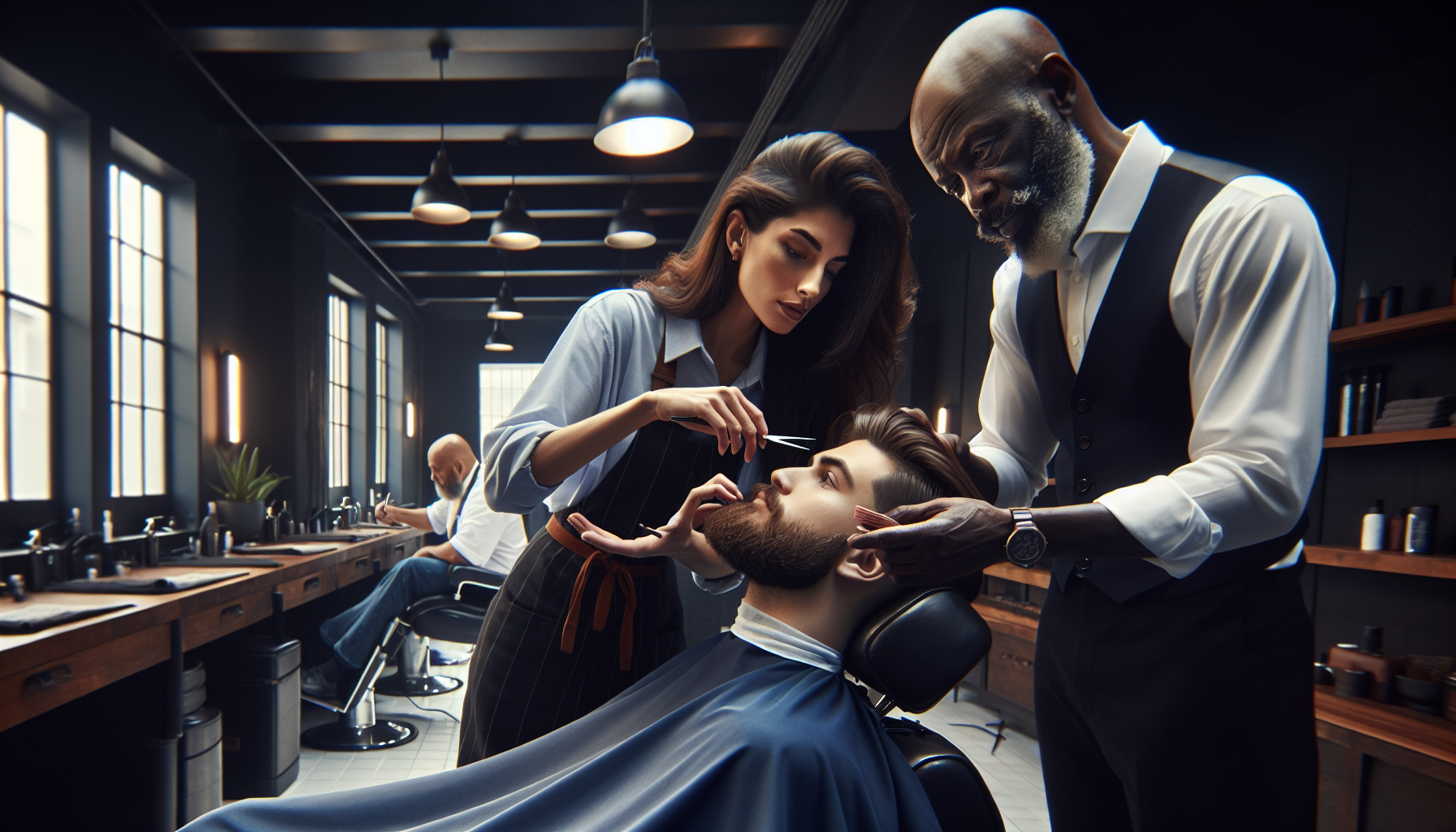
Certificate Level 2-3 Foundation Beauty Industry Barbering & Grooming

Certificate in Professional Barbering Services

Foundation Level

6 Subjects
24 Chapters
120 Lessons
500 Marks

LAPT — London Academy of Professional Training

Certificate in Professional Barbering Services
Certificate Level 2-3
  • BE-BAG-F
  • Foundation Stage
  • 500 total marks
  • Pass: 300 marks (60%)
  • Validity: Lifetime
Enrol Now View Brochure
AwardCertificate
Global LevelLevel 2-3
Total Marks500
Pass Mark300 (60%)
Subjects6
Chapters24
Classes120

About This Certification

Who Is This For?

This certification is designed for individuals seeking to enter the barbering industry, with little to no prior experience. It is suited for those who wish to learn the basic principles and practices of professional barbering services.

Course Curriculum

6 subjects • 24 chapters • 120 classes
01
Hair and Scalp Analysis
4 chapters • 20 classes • 50 marks • 10h
Understanding Hair Structure and Types 5 classes
1.1 Identifying Basic Hair Structures and Their Functions
## Lesson Overview This lesson focuses on identifying basic hair structures and their functions, vital knowledge for aspiring barbers. Understanding the anatomy of hair and the scalp will help students recommend proper care and treatment for various hair types. ## Delivery Tips - Use a mix of visual aids and hands-on activities to engage students. - Encourage interactive discussions to make the learning experience relatable. - Provide real-life examples and case studies to illustrate the importance of hair and scalp health. ## Common Misconceptions - Students may confuse the roles of the different hair layers; ensure clarity on each layer's specific function. - Some may believe hair types can be easily changed; highlight that while styling changes can be made, natural hair texture remains unchanged. ## Discussion Prompts - Ask students how various cultures perceive different hair types and their associated beauty standards. - Discuss how modern trends in hair styling may contradict traditional views on hair care. ## Timing Breakdown - Introduction of Hair Structure: 10 minutes - Hair Types and Characteristics: 15 minutes - The Hair Growth Cycle: 15 minutes - Scalp Health Discussion: 10 minutes - Practical Exercises: 30 minutes (total for all exercises) ## Differentiation - Provide additional resources or visual aids for students who learn better through diagrams or models. - Pair advanced students with those needing more guidance to foster peer learning. ## Assessment Guidance - Assess students during practical exercises based on their ability to identify hair structures and recommend care. - Use debrief questions to gauge comprehension and encourage critical thinking. ## Extension Activity - Assign students to research the impact of environmental factors on hair health and present their findings in the next class. This will deepen their understanding of the external influences on hair structure and promote wider industry knowledge.
1.2 Exploring Different Hair Types and Textures
## Lesson Overview In this lesson, students will explore the various hair types and textures, learning how to categorize them and understand their unique needs. It will encompass discussions on the natural characteristics of hair, including density, porosity, and width, across the main categories: straight, wavy, curly, and coily. Additionally, students will investigate how to manage and care for hair types based on their distinct features, ensuring that they can tailor their barbering approaches accordingly. ## Delivery Tips - Begin the class with a brief discussion about students’ experiences with different hair types and textures. - Use visual aids like charts and images to introduce the main categories, which will help in solidifying theoretical knowledge. - Engage the students in hands-on activities to reinforce learning by applying theory to practice. - Foster a collaborative learning environment by encouraging group discussions and peer assessments. ## Common Misconceptions - Students may confuse hair type with hair texture; clarify that type refers to the overall pattern (straight, wavy, etc.), while texture deals with strand thickness. - There might be a belief that all hair care products work for all hair types—emphasize the importance of customizing recommendations based on individual client profiles. ## Discussion Prompts - How do you think societal trends influence the perception of different hair types? - Discuss the psychological impact of hair type and texture on individuals' self-esteem and identity. ## Timing Breakdown - Introduction (10 minutes) - Group Exercises (30 minutes) - Individual Activities (20 minutes) - Closing Discussions and Reflections (10 minutes) ## Differentiation - For students needing additional support, provide one-on-one guidance and more visual aids during discussions. - Challenge advanced learners by asking them to explore lesser-known hair types and cutting-edge products for niche markets. ## Assessment Guidance - Evaluate student participation in discussions and activities to gauge their understanding. - Use formative assessments through observation during role-play exercises to assess their application of knowledge and interpersonal skills. ## Extension Activity - Have students research a specific hair type that is less common (e.g., mixed textures) and create a presentation on care techniques, challenges, and product recommendations.
1.3 Analyzing Hair Follicle Structure and Growth Patterns
## Lesson Overview This lesson focuses on analyzing hair follicle structure and hair growth patterns. Understanding these concepts is crucial for barbers to provide tailored services based on individual client needs. ## Delivery Tips Encourage active participation and hands-on activities. Use real-life examples and client scenarios to illustrate the importance of follicle structure and growth stages. Engage students with varied instructional strategies, such as discussions and demonstrations, to cater to different learning styles. ## Common Misconceptions Students may confuse different hair types or stages of growth. Emphasize that hair growth is not a linear process and that clients may exhibit varied growth patterns or hair types. ## Discussion Prompts - How do you think follicle structure influences hair health? - What are the implications of hair growth patterns on haircut designs? ## Timing Breakdown - Introduction to hair follicle structure: 10 minutes - Group activities analyzing growth stages: 20 minutes - Classifying hair types: 10 minutes - Demonstration of analyzing growth patterns: 15 minutes - Debrief and discussion: 10 minutes ## Differentiation Provide advanced materials for students who grasp concepts quickly, such as case studies of clients with unique hair types. For struggling students, pair them with peers for support during hands-on activities. ## Assessment Guidance Assess student understanding through participation in discussions and accuracy in labeling diagrams. Consider having a quiz on hair structure and growth patterns to formally evaluate comprehension. ## Extension Activity Assign students to research a specific hair type and present the findings, including common issues, styling techniques, and product recommendations based on their analysis.
1.4 Understanding Scalp Conditions and Their Impact on Hair
## Lesson Overview This lesson focuses on understanding the various scalp conditions that can affect hair health and growth. By the end of the session, students should be equipped to identify common scalp conditions and suggest appropriate treatments. ## Delivery Tips Engage students by utilizing visuals and real-life examples of scalp conditions. Encourage peer learning through role plays and discussions, which can enhance understanding and retention. Foster a supportive environment where students may share experiences and questions about scalp care. ## Common Misconceptions - **Scalp conditions are only cosmetic issues**: Some students may think that scalp conditions do not require serious attention. Clarify that these conditions can lead to more severe hair loss or scalp problems. - **All dandruff is the same**: Emphasize that different types of dandruff require different treatments. Reinforce the distinction between dandruff and conditions like seborrheic dermatitis. ## Discussion Prompts - What are some environmental factors that may contribute to scalp conditions? - How can lifestyle choices impact scalp and hair health? ## Timing Breakdown - Introduction to scalp conditions: 10 minutes - Common scalp conditions overview: 15 minutes - Treatment options discussion: 15 minutes - Practical exercises and debrief: 20-30 minutes ## Differentiation - For advanced students, include a research component on less common scalp conditions. - For students needing more support, offer guided notes or visuals to aid in understanding. ## Assessment Guidance Evaluate understanding through the practical exercises and the written reflection activity. Consider conducting a formative assessment quiz on scalp conditions and their treatments. ## Extension Activity Encourage students to create a pamphlet or digital presentation that outlines different scalp conditions and recommended treatments, which can be used as a resource for their future clients.
1.5 Applying Hair Type Knowledge to Barbering Techniques
## Lesson Overview This lesson focuses on understanding hair types, their characteristics, and how they influence barbering techniques. Students will learn to identify different hair types and apply appropriate cutting techniques and product recommendations based on this understanding. ## Delivery Tips Begin the lesson by engaging students with a discussion about their experiences with different hair types. Use visuals, such as images or videos, to illustrate the characteristics of each hair type. Ensure instructional materials are easily accessible and emphasize the importance of practical experiences, particularly during demonstrations and role plays. ## Common Misconceptions Students may believe that all hair types require the same care or cutting techniques. Address this by demonstrating the specific needs of each hair type and encouraging students to think critically about individual client needs. Also, emphasize that what works for one type of hair may not work for another. ## Discussion Prompts Encourage students to share their own hair care experiences and discuss how personal preferences and lifestyles influence their hair care routines. Challenge them with questions such as, "How does understanding hair porosity benefit your product recommendations?" or "Why is it important to customize hairstyles based on hair type?" ## Timing Breakdown Allocate approximately 5 minutes for introductions, 10 minutes for classroom discussion, 45 minutes for practical exercises, and 15 minutes for debriefing and wrap-up. This breakdown ensures that students engage with both theoretical and practical elements of hair type analysis. ## Differentiation Differentiate instruction by grouping students according to their prior knowledge. For advanced students, include deeper concepts such as hair structure and its impact on styling. For those needing extra support, provide additional resources, or one-on-one guidance during hands-on activities. ## Assessment Guidance Assess students through observation during practical activities, ensuring they can identify hair types and demonstrate appropriate cutting techniques. Additionally, evaluate their participation during role plays and discussions to gauge their understanding and application of consultation skills. ## Extension Activity As an extension, students could research different hair products available for each hair type, presenting their findings in a creative format, such as posters or digital presentations. This could culminate in a class workshop where students test products on mannequins to determine their effectiveness based on hair type.
Scalp Health and Common Conditions 5 classes
2.1 Understanding the Structure and Function of the Scalp
## Lesson Overview This lesson, 'Understanding the Structure and Function of the Scalp,' is designed to provide students with a comprehensive understanding of the scalp's anatomy, physiological functions, common conditions, and the importance of maintaining scalp health. The goal is for barbering professionals to apply this knowledge to enhance their services and provide informed client care. ## Delivery Tips To effectively deliver this lesson, engage students with visual aids such as diagrams or images of scalp layers and affected areas. Encourage discussion and questioning throughout the session to foster deeper understanding. Prior knowledge quizzes can help assess students’ understanding of related topics such as hair anatomy. ## Common Misconceptions Students may believe that the scalp consists of only skin and hair follicles. Emphasize the complexity of the scalp structure, including the importance of connective tissues and glands. Clarifying the differences between conditions like dandruff and seborrheic dermatitis is also essential, as students may conflate similar symptoms. ## Discussion Prompts Encourage conversations around client interactions by asking, "How can knowledge of scalp health influence client consultations?" and "What strategies can we implement to educate our clients about scalp conditions?" These prompts will foster interactive discussions and peer learning, which are essential in practical training environments. ## Timing Breakdown - Introduction to scalp anatomy: 10 mins - Overview of physiological functions: 10 mins - Discussion of common scalp conditions: 15 mins - Exercises and assessments: 30 mins - Debrief and closing discussion: 10 mins Allocate time wisely, ensuring that each segment has sufficient engagement while allowing for practical application through activities. ## Differentiation Be mindful of varying learning styles and paces. Consider utilizing visual aids (diagrams) for visual learners and allowing access to videos for auditory learners. For students needing additional support, break down complex concepts into smaller, more manageable parts. ## Assessment Guidance Assess understanding through informal methods, like observing participation during activities and discussions. A formative assessment can include a quiz on the scalp anatomy and conditions discussed at the end of the lesson. Encourage peer feedback during role play to facilitate reflective learning. ## Extension Activity Encourage students to research a lesser-known scalp condition and present their findings to the class. This extension will deepen their knowledge and help them learn about various client needs they may encounter in their careers.
2.2 Identifying and Evaluating Scalp Health Indicators
## Lesson Overview This lesson focuses on identifying and evaluating scalp health indicators as part of a comprehensive understanding of hair and scalp analysis in the professional barbering field. Understanding the significance of a healthy scalp not only enhances client satisfaction but also helps barbers address various scalp conditions effectively. ## Delivery Tips Encourage an interactive learning environment where participants feel comfortable discussing their experiences and observations related to scalp health. Use real-life scenarios to connect theory with practice and stimulate interest. Motivate students by discussing the impact of scalp health on hair growth and overall confidence. ## Common Misconceptions Some trainees may think that scalp health is not as important as hair care. Emphasize that a healthy scalp is foundational for healthy hair. Another misconception is that all scalp conditions can be treated with the same products; it's important to explain tailored approaches based on specific conditions. ## Discussion Prompts - How do different scalp conditions affect hair health and growth? - Why is it important for barbers to evaluate scalp health during consultations? ## Timing Breakdown Introductory lecture: 10 minutes Exercise: Scalp Observation Practice - 15 minutes Exercise: Condition Diagnosis Role Play - 20 minutes Reflection and discussion: 10 minutes Exercise: Identifying Scalp Health Indicators - 10 minutes Exercise: Treatment Plan Creation - 15 minutes Conclusion and Q&A: 10 minutes ## Differentiation Provide additional resources or one-on-one support for students who may struggle with key concepts. Advanced learners can be challenged to research less common scalp conditions and present their findings. Utilize visuals and hands-on demonstrations to cater to different learning styles. ## Assessment Guidance Use participant presentations and peer feedback during activities as informal assessment tools. Offer constructive feedback based on the effectiveness of their scalp evaluations and treatment plan creations. Optionally, implement a short quiz at the end of the lesson to assess understanding of key concepts. ## Extension Activity Encourage students to observe scalp conditions in real-world settings (under supervision) and document their analyses. Additionally, they can create a resource guide for clients that highlights common scalp conditions, signs, and preventative strategies.
2.3 Recognizing Common Scalp Conditions and Their Symptoms
## Lesson Overview This lesson focuses on recognizing common scalp conditions, their symptoms, and implications for barbering services. Participants will learn how to identify conditions such as dandruff, psoriasis, and seborrheic dermatitis, and the importance of scalp health in client consultations. ## Delivery Tips Start the lesson with an engaging discussion on the importance of scalp health. Use visuals and real-life scenarios to illustrate common conditions. Foster an interactive environment by encouraging questions and discussions throughout the lesson. ## Common Misconceptions 1. **Dandruff is just a cosmetic issue:** Many believe dandruff doesn't require attention; however, it can lead to discomfort. 2. **All scalp conditions are the same:** Understanding the differences between conditions like psoriasis and seborrheic dermatitis is crucial for treatment. ## Discussion Prompts - Why might clients hesitate to discuss scalp conditions with their barber? - How can barbers build trust with clients regarding sensitive skin issues? ## Timing Breakdown - Introduction (10 minutes) - Group Activity (30 minutes) - Role Play (20 minutes) - Debrief and discussion (10 minutes) - Summary (10 minutes) ## Differentiation Provide additional resources for students who may need more support, such as visuals or simplified texts. Encourage advanced students to research and present on rare scalp conditions. ## Assessment Guidance Evaluate students through participation in activities and discussions. Use a checklist for the role-play consultation to assess individual performance and understanding of the conditions. ## Extension Activity Encourage students to research and bring in information about lesser-known scalp conditions for an additional class discussion. They can create educational materials or presentations to share with peers.
2.4 Analyzing Client Scalp Profiles and Clinical Considerations
## Lesson Overview In this lesson, students will analyze client scalp profiles and learn clinical considerations integral to professional barbering. The various factors influencing scalp health will be covered, including hygiene practices, environmental impacts, and underlying health conditions. The focus will be on assessing common scalp conditions and developing personalized consultation methods. ## Delivery Tips To effectively deliver this lesson, begin with an engaging introduction that connects students to the importance of scalp health in barbering. Use visuals and real-life examples to demonstrate scalp conditions, which can help make theoretical concepts tangible. Ensure to integrate interactive discussions to maintain student interest. ## Common Misconceptions Students may confuse scalp conditions with general hair issues. Emphasize the distinct characteristics and underlying causes of each condition to avoid this confusion. Additionally, some students might underestimate the significance of a personalized approach to scalp care. Highlight case studies or testimonials to convey the effectiveness of tailored recommendations. ## Discussion Prompts Encourage students to share examples from their experiences (if applicable) and discuss how they can apply these concepts in their barbering practice. Ask them to reflect on the importance of trusting client-barber relationships in addressing sensitive health matters. ## Timing Breakdown - Introduction (5 minutes) - Presentation of common scalp conditions (15 minutes) - Scalp analysis techniques overview (15 minutes) - Hands-on activities (30 minutes) - Closing discussion and assessment (10 minutes) The total lesson time is 75 minutes, allowing flexibility for deeper discussions or additional exercises if needed. ## Differentiation Differentiate instruction by providing additional resources or modified worksheets for students who require more support. Pair more advanced students with those who may need assistance, facilitating peer learning. Additionally, consider offering advanced project options for extension learning on complex scalp conditions. ## Assessment Guidance Assess student understanding through participation in practical exercises, observations during role-plays, and their performance on the scalp health quiz. Collect feedback from students post-activities to gauge comfort levels with the skills practiced. Encourage reflection on their learnings. ## Extension Activity Encourage students to research less common scalp conditions and prepare a short presentation for the class, promoting further engagement and deeper understanding of scalp health complexities.
2.5 Implementing Scalp Care Techniques for Common Conditions
## Lesson Overview This lesson focuses on implementing scalp care techniques specifically geared toward common scalp conditions like dandruff, psoriasis, and seborrheic dermatitis. Students will learn about the symptoms, causes, treatment options, and effective communication strategies for client education and monitoring scalp health. ## Delivery Tips Encourage active participation and make use of visuals when discussing scalp conditions. Real-life case studies or video demonstrations could be advantageous in demonstrating effective techniques. Always encourage questions and provide clarity on complex topics. ## Common Misconceptions Many students may incorrectly believe that dandruff is solely caused by poor hygiene or that all scalp conditions can be treated with the same products. It is vital to clarify the distinct causes and treatments for different conditions and the importance of tailored advice for each client. ## Discussion Prompts 1. What similarities do you observe among the common scalp conditions? 2. How do external factors like stress and diet potentially influence scalp health? ## Timing Breakdown - Introduction to common scalp conditions (10 minutes) - Scalp care techniques demonstration (20 minutes) - Product selection discussion (15 minutes) - Client education tactics (15 minutes) - Review and debrief (10 minutes) ## Differentiation Students with varying levels of experience may benefit from peer-led discussions, allowing more experienced students to guide their peers. Additionally, providing advanced reading materials for those who quickly grasp the concepts can further their knowledge. ## Assessment Guidance Utilize the exercises as formative assessments to gauge students' understanding and practical application of knowledge. Provide feedback during the debriefing sessions to reinforce learning and improve skills. ## Extension Activity Encourage students to create an infographic summarizing key scalp conditions and effective scalp care techniques. This resource could be used in their future practice to educate clients visually.
Techniques for Analyzing Hair and Scalp 5 classes
3.1 Understanding Hair and Scalp Types
## Lesson Overview This lesson focuses on understanding hair and scalp types, examining their interrelation, and recognizing how environmental factors combine to influence overall hair health. Participants will learn to identify different hair and scalp types, develop skills to make recommendations for care, and understand the holistic approach necessary for effective barbering services. ## Delivery Tips Start the lesson by engaging students with a discussion on their personal experiences with different hair types and scalp conditions. Use real-life scenarios to illustrate points. Incorporate multimedia resources, such as videos or images, to demonstrate the various hair types and their characteristics before diving deeper into product recommendations and care routines. Encourage questions throughout to promote an interactive environment. ## Common Misconceptions - **Misunderstanding Hair Type Variability**: Some students may oversimplify hair types by believing that they fit strictly into one category. Reinforce that many individuals have a mix of hair types and that hair health can change over time. - **Scalp Condition Ignorance**: Students might think scalp care is secondary to hair care; stress that healthy hair originates from a healthy scalp, and both should be prioritized. ## Discussion Prompts - Discuss how environmental factors influence hairstyle choices and care routines. - Explore the implications of not addressing scalp conditions in clients and potential long-term effects on hair health. ## Timing Breakdown 1. Introduction to Hair Types (10 min) 2. Discussion on Scalp Conditions (10 min) 3. Group Activities (30 min: 15 min for Hair Type Classification; 20 min for Scalp Condition Role Play) 4. Link Between Hair and Scalp Types (10 min) 5. Impact of Environmental Factors (10 min) 6. Choosing the Right Products (10 min) ## Differentiation Adjust the complexity of the tasks based on student comfort levels. Provide additional support for students who struggle with classifications by offering detailed descriptions, while challenging advanced students with case studies or scenarios requiring in-depth analysis and product recommendations. ## Assessment Guidance Utilize both formative (class participation, individual activities) and summative assessments (quizzes on hair types and scalp conditions) to evaluate students’ understanding. Encourage peer assessments during role-plays to foster collaborative learning. ## Extension Activity Encourage students to research specific hair types or scalp conditions and prepare a brief presentation that includes product recommendations. This can be submitted for extra credit or shared with the class during the next lesson to enrich peer learning.
3.2 Identifying Common Hair and Scalp Conditions
## Lesson Overview In this lesson, students will learn about the anatomy of hair and scalp, along with common hair and scalp conditions. The key focus is to develop analytical skills for identifying these conditions and understanding their causes, management, and treatment options. ## Delivery Tips Begin with a brief overview of hair and scalp anatomy, using visuals to enhance understanding. Engage students in discussions about common conditions, ensuring to emphasize real-life connections. Use role play and practical observations to reinforce learning, as students often retain knowledge better through hands-on experiences. ## Common Misconceptions One common misconception is that all hair loss is permanent; it is important to clarify that certain types of alopecia can be reversible or manageable. Additionally, students may believe that only severe scalp conditions require attention, while mild issues can also significantly impact client comfort and confidence. ## Discussion Prompts Encourage students to discuss their observations of hair and scalp conditions they have seen in real clients or models. Prompt them to think critically about how a barber's intervention can impact a client's treatment journey. ## Timing Breakdown Allocate approximately 15 minutes for presentation and discussion, 20 minutes for practical activities, and 10 minutes for wrapping up with debrief questions. Adjust timing as needed based on class engagement and interactions. ## Differentiation To accommodate different learning styles, offer visual aids for those who benefit from seeing examples, and provide written materials for others. Allow students to work in pairs or groups to facilitate peer learning, which can help students who might struggle individually. ## Assessment Guidance Monitor student participation during practical activities. Use informal assessments through observation during role plays and discussions. Provide feedback on their ability to identify conditions and recommend treatments, encouraging reflection on their learning processes. ## Extension Activity As an extension, students can research a specific hair or scalp condition not covered in class. They will present their findings—focusing on causes, symptoms, and treatment options—in the next lesson, encouraging deeper learning and understanding of diverse conditions.
3.3 Conducting a Visual Hair and Scalp Inspection
## Lesson Overview This lesson focuses on conducting a visual hair and scalp inspection, an essential skill for barbers to assess the health of their clients' hair and scalp. Through practical exercises, students will learn how to identify common scalp conditions, assess hair health, and document their findings aptly. ## Delivery Tips Begin the lesson by introducing the importance of visual inspection in barbering. Use visual aids to demonstrate different scalp conditions. Encourage students to ask questions and share personal experiences related to hair and scalp issues. Emphasize the importance of creating a comfortable environment for clients during inspections. ## Common Misconceptions Students may believe that visual inspection is straightforward and requires no special skills. Remind them that attention to detail and knowledge of various conditions are critical. Also, clarify that not all scalp issues are visible and may require further inquiry or referral to specialists. ## Discussion Prompts - Discuss how different hair types may affect the inspection process. - Why is it important to document findings, and what could happen if this step is overlooked? ## Timing Breakdown - Introduction: 5 minutes - Individual Exercise: 15 minutes - Group Exercise: 20 minutes - Observation Exercise: 20 minutes - Written Exercise: 10 minutes - Conclusion and Debrief: 10 minutes ## Differentiation For students who may struggle, consider using videos or images to illustrate scalp conditions. Pair stronger students with those needing more assistance during group exercises. Provide additional time for documentation exercises if needed. ## Assessment Guidance Observe students during practical exercises for professionalism and thoroughness. Review their documentation for clarity and completeness. Conduct informal assessments through Q&A after each activity to gauge understanding. ## Extension Activity Encourage students to create a client care brochure that includes tips on maintaining healthy hair and scalp. This can be utilized as a marketing tool in their future barbering careers.
3.4 Utilizing Tools and Techniques for Detailed Hair Analysis
## Lesson Overview This lesson focuses on the essential skills needed for conducting a thorough hair and scalp analysis using various tools and techniques. By the end of the session, students should be familiar with common hair and scalp disorders, how to assess hair texture and density, and effectively utilize tools for analysis. The exercises reinforce practical skills while fostering collaborative learning. ## Delivery Tips Start with an engaging introduction that emphasizes the importance of detailed hair analysis in professional barbering. Incorporate visuals and real-life examples to make the content relatable. During demonstrations, ensure all students can see and engage with the tools being used. Encourage questions and discussions after each activity to reinforce learning. Use formative assessments throughout the lesson to gauge understanding. ## Common Misconceptions Some students may confuse hair texture with hair type, assuming they are the same. Ensure clarity on the definitions and importance of distinguishing between texture (thickness of strands) and type (straight, wavy, curly). Another misconception can be about the effectiveness of scalp analysis tools; clarify that choosing the right tool based on the case is crucial for accurate analysis. ## Discussion Prompts Utilize open-ended questions to foster critical thinking. For example, "What impact do you think the condition of the scalp has on overall hair health?" This can lead to broader discussions about maintenance practices. Another prompt could be, "How do societal beauty standards influence the way we perceive hair disorders?" ## Timing Breakdown Allocate time effectively: Introduction (5 minutes), Tool Demonstration (15 minutes), Exercises (20 minutes total), Group Debrief (15 minutes), and Closing Discussion (5 minutes). Always provide some buffer time for questions and clarifications. Adjust timing based on class engagement. ## Differentiation For advanced learners, introduce case studies with complex scalp conditions that require deeper analysis. For struggling students, provide additional support through one-on-one instruction or supplementary materials outlining key concepts. Facilitate peer mentoring opportunities to enhance skills. ## Assessment Guidance Use formative assessments through observation during exercises and role plays. Provide feedback on both individual and group performance. Evaluate students’ ability to use tools accurately and make informed assessments based on their analyses. Consider setting up a practical exam focusing on these skills for final assessment. ## Extension Activity Encourage students to research a specific hair or scalp disorder and prepare a presentation for the class, focusing on symptoms, potential treatments, and preventative measures. This not only reinforces learning but also invites peer education and collaboration.
3.5 Interpreting Results to Recommend Client-Specific Solutions
## Lesson Overview This lesson focuses on understanding hair and scalp analysis, highlighting the importance of accurate assessments for recommending client-specific solutions. By exploring various hair and scalp conditions, barbers will learn how to tailor hair care routines and apply their product knowledge to enhance client satisfaction. ## Delivery Tips Encourage interactive participation by allowing students to simulate real-life barber-client situations. Utilize visual aids, such as charts demonstrating different hair types and conditions, and product samples for hands-on learning. Maintain an engaging atmosphere by prompting students to share personal experiences related to hair care and common client challenges. ## Common Misconceptions 1. **One-size-fits-all solutions**: Students might underestimate the importance of personalized treatment recommendations. Reinforce that every client has unique needs based on their individual analysis. 2. **Misunderstanding product ingredients**: Some students may not fully grasp the implications of certain ingredients. Clarify the function of active ingredients in addressing specific issues. ## Discussion Prompts - How does a client's feedback influence the treatment process? - Can you recall a past client interaction where product knowledge greatly changed the outcome? ## Timing Breakdown - Introduction to hair and scalp analysis: 10 minutes - Group activity on case studies: 15 minutes - Role-play analysis simulations: 20 minutes - Custom care routine creation pairs: 15 minutes - Product knowledge quiz: 10 minutes - Review and discussion: 10 minutes ## Differentiation Consider providing additional support to students who may need more guidance in grasping complex concepts. For advanced learners, introduce case studies involving multiple hair conditions to deepen their analytical skills. Allow students with differing learning preferences to choose activities that suit their strengths. ## Assessment Guidance Assess students through participation in role-plays and group activities, in addition to their scores on the product knowledge quiz. Consider using peer feedback as a supplement to self-assessment, encouraging students to reflect on their learning process. ## Extension Activity For students looking to further their learning, suggest developing an informational guide that explores lesser-known hair and scalp conditions. This could include research on innovative products and treatment techniques, supporting their future barber career with extensive knowledge.
Applying Analysis to Client Consultations 5 classes
4.1 Understanding Hair and Scalp Conditions
## Lesson Overview This lesson focuses on understanding hair and scalp conditions, vital for any certified barber. By emphasizing common conditions like dandruff, split ends, and scalp issues, students will learn how these affect clients' lives and gain skills necessary for professional consultations. ## Delivery Tips To engage students, start with real-life scenarios or case studies that highlight the significance of hair and scalp health. Encourage active participation through discussions early in the lesson, and ensure that you are approachable to address any queries during practical sessions. ## Common Misconceptions Students may believe all scalp issues stem from poor hygiene; it’s essential to clarify that issues can be multifactorial, including genetic, environmental, and dietary influences. Emphasize that not all treatment needs will require medical referrals, but a comprehensive understanding is necessary to assess when to refer clients for treatment. ## Discussion Prompts During debriefing sessions post-exercises, prompt students with questions that enhance critical thinking. Ask them about real client interactions and how they would apply their knowledge in those scenarios. Encourage a space where they can share their feelings about client expectations related to hair health. ## Timing Breakdown 1. Introduction to hair and scalp conditions: 10 minutes. 2. Exercises (as detailed): 10-20 minutes each, depending on the complexity and student engagement. 3. Group discussions and debriefing: 5-10 minutes each after each activity. 4. Wrap-up and Q&A session: 10 minutes. ## Differentiation To support diverse learning needs, adjust activities: offer more prominent roles to quieter students in group work while encouraging those less confident in practical assessments to observe first. Consider providing additional resources or one-on-one support to those struggling with the material. ## Assessment Guidance Evaluate students based on participation in discussions, accuracy in condition diagnosis during exercises, and their ability to create effective treatment plans. Use both formative assessments, such as exit tickets, and summative assessments at the end of the module to gauge comprehension. ## Extension Activity Encourage students to follow current trends in hair care products by subscribing to relevant industry magazines or online platforms. Suggest they create a weekly journal documenting new products and treatments they discover, linking them back to the conditions discussed in class.
4.2 Identifying Client Needs Through Scalp Analysis
## Lesson Overview This lesson focuses on identifying client needs through thorough scalp analysis, emphasizing the importance of recognizing common scalp conditions, conducting systematic evaluations, and developing personalized treatment recommendations. By engaging students in practical exercises, they will deepen their understanding of scalp health issues and the methods to address them effectively. ## Delivery Tips Start the lesson with an engaging introduction about the significance of scalp health in barbering. Use real-life examples or case studies to illustrate the diversity of scalp conditions. Encourage interactive discussions during exercises to foster a collaborative learning environment. Emphasize the importance of effective communication with clients, especially when discussing sensitive issues such as scalp conditions. ## Common Misconceptions One common misconception among students is that scalp analysis is solely about the visual appearance of the scalp. Stress that it also includes understanding the client’s history and lifestyle factors. Another misconception is that barbers should only provide recommendations for products, without considering lifestyle changes. Clarify that comprehensive scalp care often involves a holistic approach that includes product recommendations as well as advice on diet and stress management. ## Discussion Prompts Utilize the debrief questions from classroom exercises as discussion prompts to facilitate a deeper understanding of the topic. Encourage students to share their insights and any challenges they faced during role plays. Discuss how different scalp conditions can impact various hair types and styles, linking analysis to practical barbering skills. ## Timing Breakdown Allocate the first 20 minutes for the theoretical introduction and overview of scalp analysis. Follow with 15 minutes for the "Scalp Condition Identification" activity, ensuring students understand how to apply their knowledge. Conclude with the "Client History Role Play" for 20 minutes. Use remaining time for discussion and wrap-up. ## Differentiation To accommodate different learning styles, consider providing additional resources, such as videos demonstrating scalp conditions or visual aids. Suggest varied pairings for activities to enable peer learning and discussions. For advanced students, challenge them to research uncommon scalp conditions and present findings to the class. ## Assessment Guidance Assess student understanding based on their participation in activities and the accuracy of their scalp condition identifications. Use peer feedback during role plays to informally assess their communication skills and the effectiveness of their questioning. A follow-up quiz on common scalp conditions may provide more structured evaluation. ## Extension Activity For students who excel or show advanced understanding, consider assigning them a project where they create a presentation on a specific scalp condition. They should research its causes, symptoms, and recommended treatments, which they can then present to their peers, enhancing their speaking and organizational skills.
4.3 Utilizing Hair Analysis Tools Effectively
## Lesson Overview In this lesson, students will learn about the importance of hair analysis tools in providing effective barbering services. They will explore different types of tools such as scalp cameras and hair microscopes, and understand their applications in assessing hair and scalp conditions. Students will also practice using these tools and interpreting the results to enhance their consultation skills. ## Delivery Tips Start the lesson by engaging students with a brief discussion on their prior experiences with hair analysis. Incorporate visual aids, such as slides or videos demonstrating the tools in action. Utilize hands-on activities for practical experience, ensuring to circulate and provide guidance during exercises. Leverage peer collaboration by fostering pairs or small groups to promote discussion and shared learning experiences. ## Common Misconceptions - Students may believe that hair analysis is limited to visual inspection; clarify that tools provide more precise assessments. - Some might think that all hair issues can be fixed with product applications, neglecting the importance of understanding underlying conditions that tools can help identify. ## Discussion Prompts - Discuss the variety of conditions that can affect scalp health and how different analysis tools can help identify specific issues. - Encourage students to share any real-life experiences they've had with clients that relate to hair and scalp conditions. ## Timing Breakdown - Introduction (5 minutes) - Types of Hair Analysis Tools (10 minutes) - Techniques for Using Tools (15 minutes, includes demonstration) - Breakout Activities (25 minutes) - Interpreting Results and Group Discussion (20 minutes) - Closure and Q&A (5 minutes) ## Differentiation For students who may struggle with technical analysis, provide additional resources such as videos or one-on-one coaching. Offer advanced students the opportunity to research and present specific conditions or advanced techniques in hair analysis. ## Assessment Guidance Evaluate students based on their participation in practical activities, their ability to correctly use the tools, and the accuracy of their interpretations. Consider offering a short quiz or reflective activity to assess understanding of concepts discussed in class. ## Extension Activity Encourage students to develop a case study based on hypothetical client hair conditions. They should outline their proposed usage of hair analysis tools, interpretation of results, and a recommended hair care regimen based on their analysis.
4.4 Interpreting Analysis Findings for Personalized Advice
## Lesson Overview In this class, students will learn how to interpret hair and scalp analysis findings to provide personalized advice. Understanding hair texture and scalp condition is crucial for suggesting appropriate treatments and products. Students will explore how to communicate effectively with clients regarding their hair and scalp health, considering both intrinsic factors and environmental influences. ## Delivery Tips Engage students through interactive activities and discussions that allow them to apply their knowledge practically. Encourage questions to promote a comfortable learning environment. Using visual aids, such as charts and case studies, can help clarify complex concepts. Ensure that students understand the real-world applicability of their learning by discussing various scenarios they might encounter in their practice. ## Common Misconceptions - Students may think hair texture does not impact treatment effectiveness, overlooking the need for tailored advice. Clarify that each hair type reacts uniquely to products and techniques. - Another misconception could be that scalp conditions are secondary to hair care. Reinforce that scalp health is foundational to overall hair care success. ## Discussion Prompts - Ask students how they feel they would approach a client with a challenging scalp condition. - Discuss how societal beauty standards might influence clients' expectations of their hair. ## Timing Breakdown - Introduce concepts (5 mins) - Individual activity on hair texture (15 mins) - Role play on scalp conditions (20 mins) - Group discussion on environmental factors (10 mins) - Workshop on care regimens (15 mins) - Class debrief (5 mins) ## Differentiation To support diverse learning needs, provide additional resources for students who may struggle with the material, such as visual aids or supplementary readings. Consider pairing students with varied expertise levels to facilitate peer learning. Accommodate students who require more time to complete tasks through extended deadlines when necessary. ## Assessment Guidance Assess students based on participation in activities, their ability to articulate findings clearly, and the practicality of the recommendations they develop. Peer feedback during discussions and presentations can serve as a useful formative assessment tool to gauge understanding. ## Extension Activity Encourage students to engage with real clients by conducting mock consultations or collaborating with a local salon to provide analysis under supervision. This would not only deepen understanding but also enhance their confidence and communication skills in a professional setting.
4.5 Communicating Analysis Results to Clients
## Lesson Overview This lesson focuses on how barbers can effectively communicate hair and scalp analysis results to their clients. The emphasis will be on building trust, alleviating concerns, and enhancing client satisfaction. ## Delivery Tips Utilize real-life scenarios and case studies during the lesson to make discussions relevant and relatable. Encourage students to actively participate by sharing their experiences. ## Common Misconceptions One common misconception is that clients understand jargon related to hair and scalp analysis. It is essential to teach students how to explain terms in simple language. Another misconception is that all clients will readily accept professional advice without concern; many will need reassurance. ## Discussion Prompts - How can you compare the significance of effective communication in barbering to other professions? - What strategies can barbers use to ensure clients feel heard and valued? ## Timing Breakdown - Introduction to communication skills: 10 minutes - Role Play Exercise: 15 minutes - Presentation Group Activity: 20 minutes - Client Concerns Discussion: 15 minutes - Feedback Simulation: 10 minutes - Wrap up and debrief: 10 minutes ## Differentiation Students with different skill levels can be accommodated by pairing them with more experienced classmates in role play exercises or by allowing them to choose how they present their case studies (e.g., visual, oral, or written forms). ## Assessment Guidance Assessments can be conducted through observation during role plays and presentations, focusing on communication effectiveness, client engagement, and clarity of information conveyed. Peer feedback can also serve as a valuable evaluative tool. ## Extension Activity As an extension, students can create a portfolio of client consultation techniques, including a variety of scenarios and their corresponding communication strategies. This portfolio could serve as a reference in their future barbering careers.
02
Customer Service Skills
4 chapters • 20 classes • 75 marks • 15h
Understanding the Barbering Clientele 5 classes
1.1 Identifying Client Needs and Preferences
## Lesson Overview This lesson focuses on the importance of understanding client needs and preferences in the barbering profession. By covering effective communication techniques and assessing client demographics, students will develop the skills to provide personalised barbering experiences that enhance client satisfaction and loyalty. ## Delivery Tips 1. Begin the lesson with a brief discussion on the significance of client relationships in the barbering industry. Use real-life scenarios or anecdotes to illustrate the impact of understanding client needs. 2. Integrate role-playing exercises throughout the session to provide students with practical applications of the concepts discussed. Encourage them to reflect on their experiences during debrief sessions. 3. Ensure that students understand the importance of cultural sensitivity and how it affects client preferences. ## Common Misconceptions - Some students may believe that providing a great haircut is enough, underestimating the importance of personal connection with clients. - Others might think that demographics are solely defined by age or gender, neglecting factors like cultural backgrounds which heavily influence preferences. ## Discussion Prompts - How might understanding a client's background change the way you approach a service? - Can you identify a time when you did not fully understand a client's needs and how it affected your service? ## Timing Breakdown - Introduction (10 mins) - Practical Exercise 1 - Client Profile Creation (15 mins) - Discussion and debrief (10 mins) - Practical Exercise 2 - Role-Playing Consultations (20 mins) - Group debrief and conclusion (10 mins) ## Differentiation For students who might struggle with communication skills, consider providing them with prompt cards that include common questions to ask during consultations. Higher-achieving students could create their own scenarios based on demographic profiles and challenge their peers to identify service preferences from those scenarios. ## Assessment Guidance Evaluate students based on their engagement in role-plays and the creativity displayed in client profiles. Observing their ability to communicate effectively and adapt their services based on fictional scenarios can help gauge their understanding. ## Extension Activity Assign students to shadow a professional barber for a day. They should take notes on how the barber interacts with clients, focusing on how they identify and respond to client needs and preferences in real-time, and share their insights in the next class.
1.2 Building Effective Communication Strategies
## Lesson Overview In this lesson, students will develop effective communication strategies tailored for the barbering profession. They will learn about both verbal and non-verbal skills, the importance of active listening, personalisation techniques, and the overall impact of communication on customer satisfaction. ## Delivery Tips Begin the lesson with a brief discussion on the pivotal role communication plays in client interactions. Use relatable examples from real-life barbering experiences to engage students. Encourage participation through role-plays and simulations that reflect actual scenarios they might encounter. Make sure to circulate during group activities to provide guidance and facilitate discussions. ## Common Misconceptions Students may believe that communication only involves speaking. Clarify that effective communication includes listening, observing non-verbal cues, and adapting to client needs. Another misconception might be that communication is secondary to technical skills in barbering. Emphasise that interpersonal skills are just as critical for building client loyalty and ensuring repeat business. ## Discussion Prompts - How can misunderstandings arise in barber-client communication, and what can be done to prevent them? - In what ways do cultural differences influence communication styles in a barbering context? ## Timing Breakdown - Introduction (5 min) - Active Listening Role Play (15 min) - Non-Verbal Communication Charades (20 min) - Personalisation Techniques Workshop (10 min) - Client Feedback Simulation (15 min) - Group Discussion and Debrief (10 min) ## Differentiation To accommodate diverse learners, provide different levels of scenarios for role-play based on students' experience. For students who may need extra support, offer sentence starters or examples of effective communication techniques. Advanced students could be encouraged to explore more complex scenarios involving multiple clients or difficult communication challenges. ## Assessment Guidance Assess students through observation during role-plays for their ability to demonstrate active listening and non-verbal communication techniques. Peer feedback can also be a valuable tool to gauge understanding and application of personalized communication strategies. ## Extension Activity Challenge students to keep a communication journal for a week, documenting their interactions with clients and reflecting on their use of communication skills. They can identify areas for improvement and set goals for their next week’s interactions, integrating lessons learned into their practice.
1.3 Understanding Diverse Hair Types and Styles
## Lesson Overview This lesson focuses on understanding diverse hair types and how they impact barbering services. Participants will learn to categorize hair types, appreciate the significance of hair texture, adapt to cultural hairstyles, and select appropriate products. All these elements contribute to enhanced customer service skills, which are vital for building rapport with clients. ## Delivery Tips Begin with an engaging introduction about the importance of recognizing different hair types in barbering. Use practical visuals—like hair samples or videos showing different styles on various hair types—to enhance understanding. Encourage students to participate actively by asking them about their experiences with different hair textures and styles. ## Common Misconceptions Students may believe that all hair types can be treated the same way or underestimate the impact of hair texture on product choice. Clarifying these distinctions early in the lesson is crucial. Emphasize that even within the same category, individual hair properties can vary greatly. ## Discussion Prompts Encourage conversation by asking questions such as: "What are some challenges you face when dealing with different hair types?" and "How do cultural influences shape hairstyle trends you encounter?" This will stimulate peer discussions and deepen understanding. ## Timing Breakdown Plan for an estimated total class duration of 70-90 minutes. Allocate 10 minutes for the introduction, 50 minutes for exercises, and 10-20 minutes for discussion and debrief. Ensure to stick to the time allotted for each activity to keep the class engaged. ## Differentiation For students who may struggle with specific content areas, consider providing additional resources or pairing them with more advanced peers during group activities. Use various teaching methods, including visual aids, tactile demonstrations, and verbal instructions to cater to different learning styles. ## Assessment Guidance Assess comprehension through informal methods like observing participation during role-plays and group discussions. Additionally, consider creating a short quiz at the end of the lesson to evaluate students' knowledge on hair types and relevant products, ensuring they grasp the core concepts. ## Extension Activity For those who excel, suggest independent research on trending hairstyles across various demographics. Students could create a presentation or collage showcasing their comprehensive understanding of cultural influences on hairstyling, which can be shared in a future class session.
1.4 Managing Client Expectations and Feedback
## Lesson Overview This lesson focuses on managing client expectations and feedback, vital aspects of delivering professional barbering services. Barbers must understand what clients expect versus what they provide, and this session will cover key strategies for effective communication, collecting feedback, and addressing dissatisfaction. ## Delivery Tips Begin the class with a brief overview of client expectations. Use real-life scenarios and ask students to reflect on their experiences. Encourage engagement by highlighting effective communication tips. Role-playing can be particularly useful in helping students practice their responses to both positive feedback and dissatisfaction. ## Common Misconceptions A common misconception students may have is that all client expectations are unreasonable or unrealistic. It is crucial to convey that many expectations arise from personal experiences and that understanding them can lead to better service. ## Discussion Prompts - What strategies can barbers use to manage high client expectations? - How can barbers ensure they remain open to feedback, even if it is negative? ## Timing Breakdown - Introduction to expectations (10 min) - Group discussion on communication strategies (10 min) - Exercise 1: Expectation Chart (15 min) - Exercise 2: Role-Playing Feedback (20 min) - Debrief and review (10 min) ## Differentiation For students who may struggle with communication, provide them with guided prompts to help steer conversations. Encourage more advanced students to take leadership roles in discussions or scenarios where they can facilitate peer learning. ## Assessment Guidance Evaluate students based on participation in activities and their ability to engage in constructive conversations. Observational assessments during role plays can help gauge their comprehension and efficacy. ## Extension Activity As an extension, students can develop a client satisfaction survey tailored to their specific services. They can then discuss how to analyze and utilize the feedback to implement service improvements.
1.5 Creating a Positive Client Experience
## Lesson Overview This lesson focuses on the essential customer service skills needed to create a positive client experience in the barbering industry. Students will learn about understanding client needs, effective communication, the personalization of service, and methods for gathering and evaluating client feedback. The aim is to equip future barbers with the necessary skills to build a loyal clientele and enhance their overall service quality. ## Delivery Tips Engage students with real-world scenarios and examples of both excellent and poor customer service experiences in the barbering industry. Encourage role-playing and group discussions to foster interaction. Highlight the significance of listening skills and adapting to different clients' needs during demonstrations. ## Common Misconceptions A common misconception is that technical skills alone are sufficient for success in the barbering industry, while customer service skills are equally crucial. It's also a misconception that every client will express their needs clearly; many clients rely on barbers to interpret their unspoken expectations. ## Discussion Prompts Encourage students to share their personal experiences with customer service: - Discuss a time when a barber exceeded your expectations or failed to meet them. What factors contributed to the experience? - What do you think is the most significant element of service personalization in the barbering context? ## Timing Breakdown - Introduction (5 min) - Group Activity 1: Client Needs Assessment Role Play (15 min) - Group Activity 2: Personalisation Feedback Analysis (20 min) - Demonstration: Effective Communication Skills Workshop (20 min) - Written Activity: Client Feedback Survey Creation (10 min) - Debrief and Class Discussion (10 min) ## Differentiation Adapt activities based on student ability levels. Pair stronger students with those needing additional support for role plays. Provide additional resources or one-on-one assistance for students struggling with survey creation or feedback analysis. Consider using visual aids for students who benefit from visual learning. ## Assessment Guidance Evaluate student participation in activities and the quality of their surveys created during the written activity. Use peer feedback on the role plays and group discussions for a more comprehensive assessment of their understanding and application of customer service skills. ## Extension Activity As an extension, have students develop a customer service training manual for new barbers that includes guidelines on understanding client needs, communication strategies, personalization techniques, and the importance of feedback. This manual can serve as a helpful resource for future classes.
Effective Communication Techniques 5 classes
2.1 Understanding the Elements of Effective Communication
## Lesson Overview This lesson focuses on the essential components of effective communication specifically tailored to the barbering industry. It emphasizes the importance of active listening, both verbal and non-verbal communication, and creating a supportive environment for clients. By mastering these skills, barbers will enhance customer satisfaction and foster loyalty. ## Delivery Tips Engage students with real-life examples from the barbering field to illustrate effective communication. Encourage practice by using role-play and scenarios that simulate client interactions. Ensure to use clear language and demonstrate body language techniques where appropriate. Remind students that effective communication is not just about speaking but also involves attentive listening and observing non-verbal cues. ## Common Misconceptions A prevalent misconception is that communication is purely verbal and that as long as the barber speaks clearly, there will be no misunderstandings. Reinforce that non-verbal communication is equally powerful, and many clients may react to body language rather than words. Additionally, some may believe that active listening is passive; emphasize that it requires active engagement and responsiveness. ## Discussion Prompts - Discuss how communication styles can differ among various clients and the implications of adapting to those styles. - Share experiences where misunderstandings occurred due to ineffective communication and how they could have been avoided. ## Timing Breakdown - Introduction (5 minutes) - Explanation of components (10 minutes) - Group activities (30 minutes) - Debriefing and discussion (10 minutes) ## Differentiation Tailor activities to accommodate different learning levels by providing varying degrees of complexity in scenarios. For instance, beginners may practice basic communication skills, while advanced students can tackle more nuanced client profiles involving complex needs. ## Assessment Guidance Assess understanding through student participation in activities and the quality of reflections during debrief discussions. Consider providing feedback on how well they utilized communication techniques in their exercises. ## Extension Activity For further skill development, assign students to observe real barber-client interactions and take notes on both verbal and non-verbal communication cues. They can then present their observations and discuss ways to apply effective communication strategies in future practice.
2.2 Developing Active Listening Skills
## Lesson Overview This class focuses on developing active listening skills essential for providing exceptional customer service in the barbering industry. Students will learn the concept of active listening, its significance in client interactions, and practical techniques to enhance their listening abilities. ## Delivery Tips To effectively teach active listening, create a welcoming and engaging environment that encourages open communication. Utilize examples from real-life barbering experiences to illustrate concepts. Role-playing scenarios can effectively demonstrate both effective and ineffective listening techniques. ## Common Misconceptions One common misconception is that listening is a passive activity. In reality, active listening requires engagement and effort. Another misconception is that using verbal acknowledgments might interrupt the flow of conversation when they, in fact, reinforce the listener's engagement and understanding. ## Discussion Prompts Ask students to share their previous experiences as customers where they felt listened to or ignored. Facilitate a dialogue around how these experiences impacted their impression of the service received. Encourage them to relate their insights back to barbering practice. ## Timing Breakdown The lesson can be structured over a 60-minute session. Allocate 10 minutes for an introduction to active listening, 20 minutes for exercises, 15 minutes for group discussion, and 15 minutes for summarizing key takeaways and answering questions. ## Differentiation Consider the varying levels of experience among students. Offer additional support to those who struggle with concepts by providing examples and breaking down components of active listening further. For advanced learners, challenge them with complex customer service scenarios requiring refined listening strategies. ## Assessment Guidance Monitor student engagement during role plays and group observations. Provide constructive feedback on their listening techniques and the effective use of verbal and non-verbal cues. Use peer assessments to encourage reflection on each person’s active listening abilities. ## Extension Activity Encourage students to keep a listening journal for the week following this lesson, documenting their reflections on listening encounters they experience in various contexts — not just in barbering. This can be a self-assessment tool to track improvements and areas needing further development.
2.3 Mastering Non-Verbal Communication Techniques
## Lesson Overview This lesson aims to equip students with the essential skills of non-verbal communication in the context of customer service within the barbering industry. Understanding non-verbal cues, including body language, eye contact, and gestures, is crucial for establishing strong relationships with clients. The lesson emphasizes the interpretation of these cues and how they impact client comfort and overall satisfaction. It is structured to include practical exercises that reinforce these concepts through experiential learning. ## Delivery Tips Encourage students to actively participate and engage in the exercises by ensuring a safe and supportive environment for sharing experiences. Remind them that practice makes perfect, and being mindful of non-verbal cues takes time and patience. Use real-world scenarios to emphasize the importance of these skills, such as common challenges barbers face when interpreting client signals. ## Common Misconceptions A common misconception is that verbal communication holds more weight than non-verbal communication. Reinforce that non-verbal communication can often convey emotions and thoughts more powerfully than words. Additionally, students may underestimate the impact of cultural differences in non-verbal cues; stressing the importance of cultural awareness is crucial. ## Discussion Prompts - How do you think changes in body language can affect a client’s feelings about their haircut? - Can you recall a time when non-verbal communication significantly influenced your interaction with someone? How did it change the outcome? ## Timing Breakdown As planning for a 60-minute lesson, allocate 10 minutes for introductions and an overview of non-verbal communication, followed by 10 minutes for the Eye Contact Awareness Drill, and 15 minutes for the Body Language Simulation activity. Allow 15 minutes for debriefing and discussing the lessons learned from the exercises, leaving 10 minutes for closing remarks and feedback. ## Differentiation For students who may struggle with practical components, offer them tasks that require less overt performance, such as observing and providing feedback on body language from classmates at the back of the room. For advanced learners, encourage them to explore deeper discussions on how slight variations in body language can change the tone of client interactions. ## Assessment Guidance Assess student participation in activities, the quality of interactions during role-plays, and contributions to discussions. Consider having them reflect in writing on what they learned about non-verbal communication and its application in customer interactions. ## Extension Activity Encourage students to maintain a 'non-verbal communication journal' during their barbershop training. They should take notes on different clients' body language and eye contact, reflecting on how these cues inform their service provision. This will help reinforce learned concepts beyond the classroom and into their practical experiences.
2.4 Enhancing Interpersonal Dialogue with Empathy
## Lesson Overview This lesson focuses on enhancing customer service skills through the integration of empathy into interpersonal dialogue. Students will learn about the importance of empathy in establishing rapport, active listening skills, and the use of both verbal and non-verbal communication. Exercises will provide practical experience, allowing students to apply these concepts in real-world scenarios. ## Delivery Tips - Begin the lesson by sharing real-life examples of positive and negative customer service experiences related to empathy. This will set a relatable context for the students. - Encourage students to share their thoughts and feelings about their experiences with customer service to facilitate an open atmosphere. - Highlight the importance of body language and tone in conveying empathy during discussions. ## Common Misconceptions - Students may believe that empathy is primarily about providing solutions rather than understanding feelings. Clarify that empathy encompasses emotional validation as well. - Some might feel that they must agree with customers to be empathetic. Emphasize that empathy involves acknowledgment of feelings without necessarily agreeing. ## Discussion Prompts - Discuss scenarios where empathy could either mitigate or exacerbate customer complaints. - Ask students to recall a time when they felt truly understood by a customer service representative. ## Timing Breakdown - Introduction to empathy in customer service: 10 minutes - Active listening exercise: 15 minutes - Role-playing customer scenarios: 20 minutes - Class debrief and discussion: 10 minutes ## Differentiation - For students who may struggle with role-playing, pair them with supportive partners. - Encourage advanced students to lead discussions or prepare more complex scenarios for their peers. Provide additional resources for students who wish to explore empathy in deeper contexts. ## Assessment Guidance - Formatively assess students based on their participation in activities, their ability to demonstrate key skills during role-plays, and the quality of feedback they provide to peers. Consider using a rubric for evaluating their empathetic interactions. ## Extension Activity - As an extension, students can journal about their personal experiences with empathy in various settings, including customer service, personal relationships, and community engagements. They can also reflect on how these experiences shape their understanding and practice of empathy in professional contexts.
2.5 Applying Effective Communication in Customer Interactions
## Lesson Overview This lesson focuses on applying effective communication strategies in customer interactions, with an emphasis on active listening, verbal and non-verbal communication, and empathy. Students will learn the significance of these skills in enhancing customer service levels in the barbering profession. ## Delivery Tips Start the class by engaging students in a discussion about their previous customer service experiences. Encourage them to share both positive and negative interactions and what contributed to these experiences. This real-life connection can help elucidate the importance of communication skills. Utilize multimedia, such as role-play videos demonstrating effective communication, to visually reinforce the concepts discussed. ## Common Misconceptions One common misconception is that listening is a passive activity. Emphasize that active listening requires engagement and effort. Another misconception is that verbal communication is more important than non-verbal; clarify that both are equally influential in conveying messages. ## Discussion Prompts - How do you think non-verbal communication affects a customer's perception of service? - Can you think of a specific example where empathy changed the outcome of a customer interaction? ## Timing Breakdown - Introduction (5 minutes): Brief overview of the topic and its relevance in barbering. - Active Listening Role Play (15 minutes): Conduct the role-play exercise and debrief. - Empathy Reflection Exercise (10 minutes): Allow time for individual reflection and sharing. - Class discussion (10 minutes): Address discussion prompts and share insights. ## Differentiation For students who may struggle with verbal communication, provide templates or sentence starters to guide their responses. For advanced learners, challenge them to role-play more complex customer scenarios that require a higher level of empathy and adaptability. ## Assessment Guidance Observe the active listening role plays to assess students' use of techniques such as paraphrasing, summarizing, and providing feedback. Take notes on their ability to demonstrate empathy during the reflection exercise to gauge their understanding. Consider providing a brief quiz on key terms and concepts discussed in class. ## Extension Activity Assign students to watch a video or read an article on a renowned figure in customer service that emphasizes empathy and active listening. Have them prepare a brief presentation on the insights gained and how they can apply these to their future interactions as barbers.
Conflict Resolution and Client Retention 5 classes
3.1 Understanding Client Expectations and Emotions
## Lesson Overview This lesson focuses on understanding client expectations and emotions in the context of barbering services. It prepares students to recognize and respond to various client needs, tailoring their approaches to foster satisfaction and retention. The content lays the foundation for enhancing communication skills, ultimately benefiting client interactions. ## Delivery Tips - Set a welcoming tone for the class to encourage open discussion. - Use real-life examples and experiences from your own barbering background to ground theoretical concepts in practice. - Facilitate brainstorming sessions where students can share their insights without judgment, enhancing peer learning. ## Common Misconceptions - Clients always have high expectations. In reality, client expectations can vary greatly based on their previous experiences and personal preferences. - All clients express their emotions openly. Some clients may conceal anxieties or preferences, so it's essential to actively listen and observe non-verbal cues. ## Discussion Prompts - Discuss the role of previous experiences in shaping current client expectations. - Examine various emotions clients may feel during their visit and how these emotions can be addressed during their service. ## Timing Breakdown - Introduction (5 minutes): Overview of lesson objectives. - Group Activities (30 minutes): Conduct exercises that explore client expectations and emotions. - Role Play (20 minutes): Practice managing client emotions. - Class Debrief (15 minutes): Share insights and discuss key takeaways. ## Differentiation - For students who need additional support, pair them with a more experienced peer during group activities. - Provide scenario cards with varying difficulty levels to cater to comprehension differences across the class. ## Assessment Guidance - Observe students during role plays and group discussions, noting their engagement and ability to apply lesson concepts. - Collect feedback from students about their feelings towards the exercises to assess how well they understood the material. ## Extension Activity Encourage students to keep a journal for one week where they note interactions with clients (real or imagined) and the emotional responses observed or elicited. This will deepen their understanding of client emotions and expectations in practical terms.
3.2 Identifying Early Signs of Conflict in Client Interactions
## Lesson Overview This lesson focuses on understanding early signs of conflict in client interactions, particularly in the context of barbering services. By the end of the class, students should be able to recognize verbal and non-verbal cues from clients, demonstrating active listening and empathy to prevent conflicts. Each component is geared towards improving customer service skills and ensuring positive client experiences. ## Delivery Tips To effectively deliver this lesson, utilize a mix of theory and practical activities. Begin with a brief introduction outlining the importance of conflict prevention in barbering. Engage students through interactive discussions about their experiences with clients. Incorporate multimedia resources such as video clips to illustrate concepts before moving into hands-on activities. Be sure to circulate during activities to provide support and feedback. ## Common Misconceptions Students might assume that conflict only arises from explicit verbal complaints. Emphasize that non-verbal cues can also indicate dissatisfaction, which may lead to bigger issues if not addressed. Additionally, some students may believe they need to solve all client problems immediately; remind them that active listening and empathy are just as critical in managing client expectations. ## Discussion Prompts Use targeted questions to encourage dialogue. Ask students about their previous experiences with clients: "What are some signs you’ve overlooked in past interactions?" and "How could recognizing those signs have changed the outcome?" This can help draw connections between theory and real-life situations. ## Timing Breakdown Plan for 10 minutes of introduction and theory, followed by 10 minutes for each activity, allowing 5-10 minutes for debriefing and discussions afterward. Reserve the last few minutes for questions or clarifications. Adjust timing based on class size and engagement. ## Differentiation To accommodate different learning styles, offer visual aids and provide verbal instructions along with written guides. For students who may struggle with role play, allow them to observe first before participating. Encourage peer feedback, fostering a supportive environment. ## Assessment Guidance Assess students through participation in activities, looking for engagement in role-plays and observations. Consider informal assessments through debrief questions, focusing on their reflections and insights. Additionally, you may assign written reflections on how they might apply these skills in real-world scenarios. ## Extension Activity For further learning, challenge students to create a guide or video tutorial on effective communication and conflict resolution strategies in client interactions. This can be shared as a class resource, reinforcing their understanding of the material while enhancing engagement.
3.3 Techniques for Effective Communication and De-escalation
## Lesson Overview This lesson focuses on effective communication and de-escalation techniques relevant to the barbering profession. It underscores the necessity of understanding conflict triggers and employing proper strategies to manage disagreements. By emphasizing active listening and empathy, students will learn to enhance client relationships and maintain a professional demeanor even in challenging circumstances. ## Delivery Tips Deploy a mix of lecturing and interactive activities to cater to different learning styles. Begin with theoretical concepts followed by practical applications. Encourage discussion and role-playing to facilitate deeper理解。 ## Common Misconceptions One common misconception is that conflicts mean a failure of service or that conflicts should always be avoided. It’s crucial to teach that conflicts can be opportunities for engagement and improvement. Additionally, some may believe that only verbal communication is necessary; however, non-verbal cues play a significant role in customer interactions. ## Discussion Prompts Encourage students to share personal experiences with conflict in different settings. Ask how they felt during these situations and what could have been done differently. This personal connection will make the lesson more impactful. ## Timing Breakdown Allocate time efficiently by spending approx. 10 minutes on theoretical discussion, 20 minutes on group exercises, and 30 minutes on role-plays and feedback sessions. Ensure ample time for debriefing discussions after each exercise to solidify learning. ## Differentiation Consider pairing students of varying skill levels in role-plays to allow for mentorship opportunities. Provide additional resources on communication techniques for students who may require more support or offer advanced scenarios for those who excel. ## Assessment Guidance Assessment can be formed through peer feedback during role-plays, evaluating the effectiveness of de-escalation techniques and active listening. Additionally, a reflective journal entry after the lesson could help assess understanding and personal growth in communication skills. ## Extension Activity As an extension, students can create a personal action plan outlining how they intend to implement the communication and de-escalation strategies learned in this lesson into their practical barbering sessions. This plan can include specific scenarios they commonly face and potential strategies to handle them.
3.4 Implementing Conflict Resolution Strategies in Barbering
3.5 Building Long-term Client Relationships through Resolution
## Lesson Overview This lesson focuses on building long-term client relationships in the barbering industry through effective conflict resolution and customer service skills. It covers various types of conflicts that may arise, effective communication techniques, resolution strategies, and the importance of follow-up in solidifying client satisfaction. ## Delivery Tips - Engage students with real-world examples of conflict in barbering to open the discussion. - Use role-play and pair exercises to create a safe environment for students to practice their communication skills. - Emphasize the emotional aspect of client interactions, as many conflicts stem from misunderstandings or unmet expectations. - Encourage students to share personal experiences dealing with difficult clients, fostering relatability. ## Common Misconceptions - Some students may believe that conflict can always be avoided. Reinforce the idea that conflict can be a natural part of client interactions and that it can be resolved constructively. - Another misconception could be that communication doesn't need to be adjusted based on the client's demeanor; highlight the importance of adapting communication to the situation. ## Discussion Prompts - What are some unique scenarios in your experience where conflict arose in a barbering context? - How can active listening change the outcome of a client interaction? ## Timing Breakdown - Introduction and discussion of conflicts: 10 minutes - Conflict Role Play: 15 minutes - Active Listening Exercise: 10 minutes - Debrief and group discussion: 10 minutes Total Lesson Duration: 45 minutes ## Differentiation - For students who may struggle with communication, provide them with scripts or sentence starters during role-plays. - Pair stronger communicators with those who may need more support to foster learning in a collaborative way. ## Assessment Guidance - Observe students during role-plays and active listening exercises, noting their use of conflict resolution techniques and active listening skills. - Use feedback from peers after exercises to assess understanding and application of skills. ## Extension Activity - Ask students to reflect and write about a conflict they witnessed in a barber shop setting and how they would handle it differently, focusing on communication and relationship building.
Creating a Personalized Client Experience 5 classes
4.1 Understanding Client Needs: Building the Foundation
## Lesson Overview This lesson focuses on understanding client needs within barbering services by emphasizing the importance of active listening, personalising the client experience, and gathering valuable client feedback. Students will learn to engage effectively with clients, fostering a welcoming atmosphere that encourages open communication. ## Delivery Tips Begin the session with a discussion on the importance of client relationships in barbering. Use real-life examples or anecdotes to illustrate how understanding client needs leads to heightened satisfaction. Clearly outline the objectives of each exercise, ensuring students understand the relevance of active listening and feedback. Encourage them to participate fully to gain a deeper understanding. ## Common Misconceptions - Students might believe that conveying their own opinions is more critical than listening to the client. Emphasize that the client's voice should always take precedence. - Some may think that personalising services is time-consuming. Highlight efficiency and the potential for increased client loyalty stemming from personalised experiences. ## Discussion Prompts - What are some instances where you felt misunderstood by a service provider? How could they have improved the experience? - How does personalisation contribute to client satisfaction beyond just aesthetic services? ## Timing Breakdown - Introduction (10 min) - Active Listening Role-Play (15 min) - Debrief and discussion (5 min) - Feedback Evaluation Workshop (20 min) - Wrap-up and questions (10 min) ## Differentiation To accommodate different learning styles, provide varied activities such as visual aids for those who benefit from seeing information in action, or audio recordings of clients discussing needs for auditory learners. For students needing additional support, partner them with more experienced peers during activities. ## Assessment Guidance Evaluate student performance during role-play through peer feedback forms that look for evidence of active listening and engagement. Additionally, assess the group presentations for their ability to analyse feedback and suggest actionable improvements, observing the depth of insight from their discussions. ## Extension Activity As an extension, students can conduct surveys outside class to gather real client feedback. They should analyze this data to create a report detailing key findings and recommendations for improving service in practical barbering settings.
4.2 Communicating Effectively: The Art of Active Listening
4.3 Tailoring Services: Customizing Barber Techniques
## Lesson Overview This lesson focuses on customizing barbering techniques based on individual client needs and preferences. By actively listening, adapting techniques, utilizing feedback, and building long-term relationships, barbers can provide exemplary service. Students will learn the importance of these skills through practical exercises, which highlight communication, evaluation, and interaction with clients. ## Delivery Tips Engage students with real-life scenarios to illustrate concepts. Use role-play to enable students to practice communication skills. Encourage open discussions and emphasize the importance of feedback in improving service quality. Tailor your teaching approach based on student experience levels and engagement style. ## Common Misconceptions Some students may think that a standard approach to haircuts is sufficient for every client. Clarify that personalizing services is essential for client satisfaction. Additionally, some might underestimate the impact of follow-up communications on client relationships. ## Discussion Prompts Ask students how they feel when a barber remembers their previous styles or personal details. Discuss specific ways they can retain information about clients to enhance their service. Also, encourage students to consider how frequently they should communicate with clients post-appointment. ## Timing Breakdown - Introduction/overview of concepts: 10 minutes - Role Play activity: 15 minutes - Demonstration of techniques: 20 minutes - Group feedback session: 10 minutes - Individual brainstorming session: 10 minutes Total: 65 minutes, but adjust as necessary based on class engagement. ## Differentiation Adapt activities according to student skills. For beginner students, provide more structured guidance during the role-play. Advanced students can engage in deeper discussions and lead feedback sessions independently. Tailor feedback to suit individual learning needs. ## Assessment Guidance Monitor student participation in role plays and discussions. Assess understanding through their contributions to group activities and debrief questions. Consider administering short quizzes or reflective writing assignments to evaluate knowledge retention. ## Extension Activity For students who excel, consider an extension activity involving a mock client appointment, where they must not only cut hair but also conduct a full consultation, apply modifications based on client feedback, and follow-up with relationship-building strategies. Include peer or instructor feedback to enhance learning.
4.4 Enhancing Comfort: Creating a Welcoming Atmosphere
## Lesson Overview In this module, students will explore the importance of creating a welcoming atmosphere in the barbering industry. This includes understanding how a comfortable environment impacts client satisfaction and retention. Students will learn about the key elements contributing to a welcoming salon and techniques for personalizing client experiences. ## Delivery Tips Begin with a brief discussion on the first impressions clients have when entering a salon. Use visual aids such as videos or images of different salon environments to illustrate the concept of atmosphere. Encourage students to share their own experiences, both positive and negative, related to salon environments. Engage students through interactive activities that emphasize key concepts discussed in the lesson content. ## Common Misconceptions One common misconception is that technical skills are the only determining factors in client satisfaction. Highlight the importance of atmosphere in tandem with these skills. Additionally, some students may underestimate the impact of small details, like lighting and cleanliness, on the client's overall experience. Reinforce that every element contributes to creating a comprehensive client experience. ## Discussion Prompts - How do your previous experiences in salons influence your view on client comfort? - In what ways can a barber’s interaction and communication improve client trust? ## Timing Breakdown - Introduction to welcoming atmosphere: 10 minutes - Group discussion on personal experiences: 10 minutes - Conducting exercises: 25 minutes - Class debrief and feedback: 15 minutes ## Differentiation For students who may struggle with verbal communication, encourage non-verbal techniques such as body language and eye contact. Additionally, provide visual prompts or scripts to help guide their interaction during role-plays. Advanced students can be tasked with creating their own scenarios for role play or developing a cleaning checklist based on industry standards. ## Assessment Guidance Student assessment can be conducted through observation during role-plays and partner activities. Focus on their ability to communicate effectively and create a welcoming atmosphere based on the discussed principles. Provide constructive feedback highlighting strengths and areas for improvement. ## Extension Activity Encourage students to visit a local salon and evaluate its environment based on the elements discussed in class. Have them take notes on what contributes to or detracts from the welcoming atmosphere and present their findings in the next session.
4.5 Delivering Satisfaction: Ensuring a Memorable Client Experience
## Lesson Overview This lesson emphasizes the crucial role of customer service skills in the barbering profession. By focusing on personalisation, effective communication, problem-solving, feedback gathering, and lasting impressions, students will learn how to enhance their interactions with clients. Each segment of the lesson underscores the value of creating memorable experiences that foster client loyalty and satisfaction. ## Delivery Tips Begin the lesson with an engaging discussion on the significance of personalisation. Use relatable anecdotes to illustrate points. Incorporate multimedia resources, like video clips of barber-client interactions, to provide context. When discussing communication techniques, encourage students to practice active listening within their pairs. Additionally, clarify the importance of empathy in customer service through real-world examples. ## Common Misconceptions Many students may underestimate the importance of small gestures in personalisation. Some might think clients only care about the service's quality, not the interaction. It's essential to clarify that exceptional service integrates technical skills with interpersonal connections. Also, students may believe that feedback collection is only for improvements but by emphasizing its role in reinforcing positive experiences, these misconceptions can be overcome. ## Discussion Prompts Facilitate a discussion around the question: "What does a memorable client experience look like?" Also, engage the class in contemplating the difference between hearing and listening in conversations with clients. Promote open discussion, allowing students to share their ideas and support each other's views. ## Timing Breakdown - Introduction to Personalisation: 10 mins - Effective Communication Techniques: 15 mins - Group Role Play Activity: 20 mins - Problem-Solving Skills Discussion: 15 mins - Feedback Collection Activity: 20 mins - Creating Lasting Impressions: 10 mins - Wrap-up and Summary: 10 mins Total: 120 mins ## Differentiation For students needing additional support, provide scripted scenarios for role plays. This allows them to feel more comfortable in their interactions. For advanced learners, encourage them to create more complex scenarios with multiple layers of client needs. Peer feedback can also serve as a helpful tool, allowing students to learn from one another in a collaborative environment. ## Assessment Guidance Assess students through observation during role plays and group discussions, noting their ability to apply customer service skills in practice. Use feedback forms, filled out by peers, to gauge their understanding of concepts like personalisation and feedback solicitation. ## Extension Activity Encourage students to design a personal service plan for a fictional client, detailing how they would tailor their approach based on the client’s preferences. Ask them to include strategies for collecting feedback and addressing potential service issues. This extension fosters deeper application of the lesson's concepts in a practical context.

03
Hygiene and Safety
4 chapters • 20 classes • 75 marks • 10h
Understanding Health and Safety Regulations in Barbering 5 classes
1.1 Exploring Health and Safety Regulations in Barbering
## Lesson Overview This lesson focuses on exploring health and safety regulations in barbering, emphasizing the importance of hygiene and safety practices within the profession. By the end of the session, students should understand key legislation, best hygiene practices, and risk management strategies in a barbershop setting. ## Delivery Tips Use engaging teaching techniques, such as role-plays and group workshops, to enhance student participation. Encourage students to share personal experiences in the barbering industry related to hygiene and safety. Use real-life examples relevant to their future careers to bridge theory and practice. ## Common Misconceptions One common misconception is that personal safety is the only concern when discussing health regulations. Emphasizing that the welfare of clients is equally important can help address this gap. Additionally, some students may underestimate the impact of poor hygiene on business success. ## Discussion Prompts Consider discussing how students might feel if they were to visit a barber who does not follow hygiene practices. Furthermore, talk about the legal implications of ignoring health regulations and how that could affect current and future employment opportunities. ## Timing Breakdown Introduce the lesson and objectives (5 mins), engage in the hygiene best practices role play (15 mins), conduct the risk assessment workshop (20 mins), and conclude with debrief discussions (10 mins). Adjust the timing based on classroom dynamics and student engagement levels. ## Differentiation Provide additional support for students struggling to understand health regulations by offering supplementary materials or one-on-one discussions. Challenge advanced students to propose more complex risk management strategies or create detailed action plans for compliance with legislation. ## Assessment Guidance Assess understanding through participation in activities and group presentations. Consider using rubrics to evaluate how well students identify hazards and suggest safety measures. A follow-up quiz on key legislation and best practices can further solidify understanding. ## Extension Activity For students who excel, suggest researching a health and safety topic in barbering and presenting their findings to the class. Topics could include the latest hygiene technology in salons or a comparative analysis of international health regulations in the barbering profession.
1.2 Identifying Common Health Hazards in Barbering Environments
## Lesson Overview This lesson focuses on identifying common health hazards in barbering environments and emphasizes the importance of hygiene and safety practices. Participants will learn about the potential risks associated with barbering tools and chemicals, and the legal frameworks that govern health regulations in the industry. ## Delivery Tips To effectively engage students, consider starting the lesson with a brief video showcasing common safety incidents in barbering environments. Follow this with a discussion of what went wrong and how it could have been avoided. Utilize hands-on demonstrations to reinforce sanitisation practices and encourage active participation through role-playing or group discussions. ## Common Misconceptions One common misconception among students may be that sanitation is only necessary for visible dirt. Emphasize that microscopic organisms can be present even when tools appear clean. Another misconception is that personal hygiene is not a shared responsibility in the barbering setting. Reinforce that both practitioners and clients have roles to play in maintaining a safe environment. ## Discussion Prompts - What specific roles do regulations play in maintaining safety in a barber shop? - How do personal hygiene and sanitation impact the overall perception of a barbering business? ## Timing Breakdown - Introduction: 10 minutes - Tool Sanitisation Demonstration: 15 minutes - Group Activity on Chemical Safety Practices: 20 minutes - Group Presentations: 15 minutes - Wrap-up Discussion: 10 minutes With a total time of about 70 minutes, ensure the pacing allows for both instruction and student engagement, making adjustments as necessary based on class response. ## Differentiation For students who may require additional support, consider providing templates for their group activities or allowing extra time for research. Additionally, advanced students could be encouraged to explore more complex scenarios involving multiple hazards and their solutions in pairs. ## Assessment Guidance Observe group interactions during the presentations to assess understanding of the health hazards discussed. Formative feedback can be provided during demonstrations and group work, allowing students to refine their knowledge and practices in real-time. ## Extension Activity As an extension, challenge students to create a 'Safety in Barbering' brochure that outlines best practices for hygiene and safety, which they could distribute within their local barbering community. This not only reinforces the lesson content but also empowers students to advocate for safe practices beyond the classroom.
1.3 Implementing Personal Hygiene Standards in Barbering
## Lesson Overview In this lesson, students will learn the importance of personal hygiene in barbering, effective hand hygiene techniques, the sanitization of tools and equipment, and the implications of poor hygiene standards. Emphasis will be placed on developing practical skills that ensure a hygienic environment for both barbers and clients. ## Delivery Tips Start with a brief introduction to the significance of personal hygiene, using real-life examples or case studies to highlight its importance. Use visuals such as charts or videos to demonstrate cleaning techniques and hygiene protocols. Allow for hands-on practice and ensure students have adequate time to ask questions and engage fully with the content. Consider group discussions to facilitate peer learning. ## Common Misconceptions One common misconception is that hand sanitizers are an adequate substitute for washing hands. While they are beneficial in the absence of soap and water, they are not a complete replacement; effective handwashing is always preferable when possible. Another misconception is that cleanliness in tools is optional; in reality, it is a legal requirement to ensure client safety. ## Discussion Prompts Encourage dialogue around the following questions: What should clients expect in terms of hygiene when they visit a barber? What responsibilities do barbers have in ensuring their own hygiene? How does cultural perception affect standards of hygiene in barbering? ## Timing Breakdown Allocate approximately 15 minutes for introduction, 30 minutes for activities and demonstrations, 10 minutes for the quiz, and 5-10 minutes for debriefing and discussion. Ensure you manage time effectively to engage all students in practical activities. ## Differentiation Adapt activities by providing visual aids for students who benefit from them or offering additional support during hands-on practice. Challenge advanced students by asking them to develop their own hygiene protocols based on current health guidelines. More visual learners might benefit from video content or infographics that explain procedures clearly. ## Assessment Guidance Assess students through their participation in practical activities, their completion of the quiz, and their engagement in discussions. Offer feedback based on both their knowledge and ability to apply hygiene practices effectively. Use peer assessments during role-playing to encourage collaborative learning. ## Extension Activity For an extension activity, students could research a specific infectious disease related to the barbering industry and present their findings, including prevention measures that can be implemented in the salon. This reinforces the importance of ongoing education in hygiene and safety practices.
1.4 Practicing Safe Handling of Barbering Tools and Equipment
## Lesson Overview This lesson focuses on the critical importance of hygiene and safety in barbering. The aim is to equip students with practical skills related to the safe handling of tools, sanitisation practices, the usage of personal protective equipment (PPE), and risk assessment protocols. By the end of the session, students will have a clear understanding of how to conduct their work professionally while ensuring a safe environment for themselves and their clients. ## Delivery Tips Begin with a brief introduction emphasizing the high stakes involved in barbering due to the use of sharp tools and the close contact with clients. Utilize engaging multi-media tools, such as videos or demonstrations, to illustrate the dangers associated with improper tool handling and ineffective sanitisation. Promote active participation through hands-on activities while encouraging open discussions among students about their previous experiences with hygiene and safety in other settings. ## Common Misconceptions Many students may underestimate the importance of proper tool sanitisation, believing that visual cleanliness is enough. Reinforce that sanitisation protocols must adhere to industry standards to prevent infection. Additionally, some may assume PPE is unnecessary for certain tasks; clarify the universal need for PPE to mitigate risks regardless of perceived danger. ## Discussion Prompts 1. Can anyone share an experience where improper hygiene practices led to a negative outcome in a professional setting? 2. How do cultural perceptions of safety influence our approaches to hygiene in beauty services? ## Timing Breakdown - Introduction: 10 minutes - Exercises: 25 minutes (10 minutes for individual practice + 15 minutes for group sanitisation) - Reflection and Discussion: 10 minutes - Wrap-Up: 5 minutes Total Time: 50 minutes ## Differentiation For students who may struggle with the technical handling of tools, provide additional support by pairing them with more proficient peers or using larger, easier-to-manipulate tools during practice sessions. Offer written instructions along with visual aids to assist visual learners, and be prepared to provide one-on-one coaching as needed. ## Assessment Guidance Assess student understanding through observation during practical exercises and through questions posed during debrief discussions. Additionally, students can be evaluated on their adherence to safety protocols and the effectiveness of their sanitisation practices during group activities. ## Extension Activity As an extension, students can research and present on current trends and innovations in barbering tool safety and hygiene. This could include developments in sanitisation technologies, eco-friendly cleaning products, or advanced PPE designs specific to the hair and beauty sector.
1.5 Evaluating Compliance with Health and Safety Legislation
## Lesson Overview In this lesson, we explore the essential aspects of health and safety regulations in the barbering industry, focusing on compliance with the Health and Safety at Work Act 1974 and relevant regulations such as COSHH and RIDDOR. The aim is to help students understand their responsibilities regarding client and personal safety through practical exercises and discussions. ## Delivery Tips To engage students effectively, begin with a brief introduction to the importance of health and safety regulations in barbering. Use real-life examples to illustrate the consequences of non-compliance. Following the introduction, employ a mix of practical exercises and discussions to reinforce learning. ## Common Misconceptions One common misconception is that personal protective equipment (PPE) is optional or not necessary in all scenarios. Emphasize the legal and health implications of neglecting PPE, and the specific regulations that mandate its use. ## Discussion Prompts - What health and safety issues do you think are most prevalent in the UK barbering industry? - How would you respond to an incident of non-compliance in your workplace? ## Timing Breakdown - Introduction (10 minutes) - Group activity on risk assessment (15 minutes) - COSHH quiz and review (10 minutes) - PPE demonstration (20 minutes) - Health and safety policy review (15 minutes) - Wrap-up and Q&A (10 minutes) ## Differentiation For students who may struggle with written tasks, provide alternative methods for completing the COSHH quiz, such as verbal responses or one-on-one assistance. Ensure that role-play scenarios are adaptable so that all students can contribute depending on their comfort and skill levels. ## Assessment Guidance Assess students based on their participation in activities, accuracy in the mini quiz, and engagement during discussions. Provide feedback focusing on both their understanding of the material and their ability to apply it in practical situations. ## Extension Activity For students eager to extend their knowledge, consider assigning a research task on recent changes to health and safety regulations in the beauty industry. Encourage them to present their findings to the class as a way of fostering deeper understanding and continued learning.
Mastering Sanitation Protocols for Barbering Equipment 5 classes
2.1 Understanding Key Sanitation Standards in Barbering
## Lesson Overview This lesson introduces students to the critical role of sanitation and hygiene in the barbering industry. Emphasis is placed on not just compliance with regulations, but also the ethical responsibility of maintaining high standards of cleanliness for client safety and professional credibility. Topics include legal requirements, sanitisation techniques, and maintaining a clean workspace. Students will learn both theoretical knowledge and practical skills essential for modern barbering. ## Delivery Tips To effectively deliver this lesson, engage students with real-world examples of sanitation mishaps and their consequences. Incorporate visuals, such as infographics illustrating proper sanitisation techniques, and utilize demonstrations to show effective cleaning practices. Encourage participation by posing questions throughout the lesson to check for understanding and prompt discussion. ## Common Misconceptions - **Sanitation vs. Cleaning**: Many may confuse general cleaning with proper sanitation; clarify the differences and the importance of disinfection. - **Infrequent Sanitisation**: Some students may believe that tools only need cleaning at the end of the day; stress the requirement for regular, even between client appointments. ## Discussion Prompts Encourage students to discuss the following: - The implications of failing to adhere to sanitation standards in their future careers. - Their thoughts on how personal hygiene complements professional sanitation practices in barbering. ## Timing Breakdown - Introduction to sanitation: 10 minutes - Legal and industry requirements: 15 minutes - Sanitisation techniques: 20 minutes - Activity: Setup and role-play: 35 minutes - Discussion and debrief: 10 minutes - Total: 90 minutes ## Differentiation To accommodate diverse learning styles, provide various resources such as videos demonstrating sanitation processes and hands-on practice with tools for tactile learners. Offer advanced material for students looking to delve deeper into sanitation science. Allow for peer mentoring, wherein advanced students can assist those who may struggle with the concepts. ## Assessment Guidance Monitor students during activities to assess their understanding of the sanitation techniques and protocols. Utilize a rubric for the group sanitisation setup activity that includes criteria such as organization, understanding of materials, and presentation skills. Also, consider a short quiz at the end of the lesson to reinforce learning outcomes. ## Extension Activity As an extension, students could research and present on sanitation standards from different countries or regions, discussing how local laws influence barbering practices worldwide. This activity will enhance their understanding of global industry standards and practices.
2.2 Identifying and Categorizing Barbering Tools and Equipment
## Lesson Overview This lesson focuses on the identification and categorization of barbering tools and equipment, emphasizing their importance in delivering quality services, particularly in the realms of hygiene and safety. By familiarizing students with tools such as cutting, styling, and finishing tools, they will better understand their functions and the critical nature of hygiene practices in the barbering profession. ## Delivery Tips 1. Start with an engaging introduction that highlights the significance of barbering tools. 2. Use visuals (e.g., overhead projector) to display tools and their proper names. 3. Share real-world examples where tool categorization played a key role in service quality and client satisfaction. 4. Regularly check for understanding through informal quizzes or shout-outs as you discuss each category of tools. ## Common Misconceptions - Some students may believe that all tools are interchangeable, not recognizing the specific functions of each type. Clarify how different tools are designed for specific tasks. - Misunderstanding the importance of sanitation may lead some to think that simple cleaning is enough. Discuss the difference between cleaning and disinfecting. ## Discussion Prompts - Discuss why sanitation is vital in barbering and the responsibilities of a barber in maintaining hygiene. - Explore the consequences of neglecting tool maintenance and sanitation in a professional setting. ## Timing Breakdown - Introduction: 5 minutes - Tool identification activity: 15 minutes - Sanitation role play: 20 minutes - Group discussion and debrief: 10 minutes - Total time: 60 minutes ## Differentiation - For advanced students, include a deeper discussion on the latest tools and devices, including technology used in modern barbering. - For those needing additional support, provide visual aids and one-on-one instruction during hands-on activities to assist with tool identification and sanitation procedures. ## Assessment Guidance - Monitor student participation in activities to assess understanding of tool identification and sanitation practices. - Use the debrief questions to gauge comprehension and encourage reflective thinking about the importance of hygiene in barbering. ## Extension Activity - Assign students to research a specific barbering tool, prepare a short presentation on its uses, and share with the class, focusing on hygiene protocols associated with that tool.
2.3 Cleaning Techniques for Non-Electrical Barbering Equipment
## Lesson Overview This lesson focuses on the importance of sanitation in the barbering industry, with a particular emphasis on non-electrical equipment. It aims to equip students with the knowledge and practical skills necessary to maintain hygiene standards through effective cleaning techniques, proper product choice, and scheduled maintenance. ## Delivery Tips Begin the lesson by discussing the critical role that sanitation plays in establishing client trust and a professional image. Utilize visual aids, such as images of properly cleaned tools versus contaminated ones, to illustrate the potential risks associated with inadequate cleaning. Engage students in practical activities to reinforce their understanding and encourage participation. Use role-play scenarios to simulate real-world situations related to hygiene in a barber shop setting. ## Common Misconceptions Students may believe that cleaning tools infrequently is acceptable if they appear visually clean. Emphasize that pathogens are not always visible to the naked eye and that regular, thorough cleaning is essential. Additionally, highlight that not all cleaning products are suitable for every material used in barbering tools, and it is important to read labels carefully. ## Discussion Prompts Encourage students to share personal experiences or observations relating to the importance of cleanliness in barbering environments. Ask them to consider how clients react to the presence or absence of sanitation practices and what impact it may have on their decision to return for further services. ## Timing Breakdown Allocate time within the lesson for an introductory presentation (10 minutes), followed by the scavenger hunt exercise (15 minutes), and finish with the cleaning schedule activity (20 minutes). Reserve additional time at the end for group discussions and debriefing. ## Differentiation For students needing more support, provide guided worksheets that outline key cleaning practices and products. Advanced students can explore case studies discussing outbreaks linked to poor sanitation in barbershops and propose symptoms and solutions. ## Assessment Guidance Monitor group activities to ensure that students are effectively communicating and engaging with the material. Use formative assessments, such as observing the cleaning schedules they create, to assess their understanding. Consider providing a brief quiz at the end of the lesson to check for retention of the key concepts. ## Extension Activity As an extension, have students research and present on eco-friendly and natural cleaning products for barbering tools. This can be integrated into the lesson on choosing the right cleaning products and encourage students to consider sustainability in their practice.
2.4 Safe Handling of Chemical Disinfectants and Their Applications
## Lesson Overview This lesson focuses on safe handling of chemical disinfectants in the barbering industry. It emphasizes the importance of understanding the different types of disinfectants available, safe handling procedures, application techniques, and adherence to safety protocols. By the end of the lesson, students should be able to choose the appropriate disinfectant for specific tasks, use PPE effectively, and apply disinfectants safely to promote a hygienic environment in barbering. ## Delivery Tips To engage students effectively, start with a brief overview of the importance of disinfectants in maintaining hygiene in barbering. Use real-life examples and scenarios to bring relevance to the material. Encourage active participation by asking students to share their experiences with disinfectants. Utilize visual aids and demonstrations throughout the lesson to reinforce concepts. Group activities can foster collaboration and critical thinking, allowing students to learn from each other. ## Common Misconceptions One common misconception is that all disinfectants are interchangeable; however, this is not true. Different disinfectants have varying effectiveness against specific pathogens and surfaces. Another misconception is that proper contact time is unnecessary if the disinfectant is applied generously, but inadequate contact time can result in ineffective disinfection. ## Discussion Prompts At various stages of the lesson, prompt students with questions such as, "What challenges might you face when choosing a disinfectant?" and "Can you think of situations where disinfectants might be misused?" Encouraging students to express their thoughts can lead to insightful discussions and reinforce learning objectives. ## Timing Breakdown - Introduction (5 minutes) - Lecture on types of disinfectants (15 minutes) - Group activity on disinfectant selection (15 minutes) - PPE demonstration (10 minutes) - Practice and debrief (10 minutes) - Wrap-up discussion (5 minutes) Total: 60 minutes ## Differentiation Be mindful of students who may struggle with understanding technical terminology. Provide glossaries and visual aids. For advanced students, offer opportunities for research on newer disinfectant technologies or emerging pathogens. Pair struggling students with peers who can assist during group activities. ## Assessment Guidance Observe students during group activities to assess their understanding of disinfectant selection and safe handling. Administer a short quiz at the end of the lesson to evaluate their knowledge of key concepts. Ensure they can identify proper PPE for handling disinfectants and articulate safety protocols. ## Extension Activity As an extension, students can create an informative poster detailing the characteristics and uses of different types of disinfectants. These posters can be displayed in the classroom to serve as a visual reminder of the lesson content and assist in promoting continuous learning.
2.5 Implementing a Daily Sanitation Checklist for Barbering Services
## Lesson Overview This lesson is designed to provide students with an understanding of sanitation practices in barbering, equipping them with the knowledge to implement a daily sanitation checklist. Emphasis is placed on the significance of sanitation to ensure client safety and compliance with health regulations. Students will participate in practical exercises that reinforce the key components of sanitation and develop skills related to the application of these practices in a real-world setting. ## Delivery Tips When teaching this lesson, ensure that students understand the gravity of sanitation in public health. Use engaging visuals and real-life examples to highlight sanitation failures and their consequences. Encourage interactivity by prompting students to share their experiences with sanitation or any related topics that interest them. Utilize role-playing scenarios to make the learning experience dynamic. ## Common Misconceptions Some students may believe that sanitation is only necessary when visibly dirty or after certain services. Reinforce that sanitation must be continuous and preemptive to avoid contamination. Additionally, clarify that all tools and surfaces, not just those in direct contact with hair, require sanitization. ## Discussion Prompts 1. Discuss the potential consequences of failing to adhere to sanitation protocols in barbering. 2. How can barbers continuously improve sanitation practices in their shops? ## Timing Breakdown - Sanitation Role Play: 15 minutes - Discussion on sanitation importance: 10 minutes - Sanitization Procedures Demonstration: 20 minutes - Feedback and Q&A session: 15 minutes This breakdown provides ample time for practical application, theoretical understanding, and open dialogue among students. ## Differentiation For students who may struggle with practical demonstrations, offer additional one-on-one time to practice sanitization techniques. Conversely, challenge advanced students to research and present on emerging sanitation technologies or products in the barbering industry. ## Assessment Guidance Assess student understanding through observation of the role-play and the demonstration exercises. Provide constructive feedback based on their application of the sanitation checklist and give them an opportunity to reflect on their processes. ## Extension Activity Encourage students to create a comprehensive sanitation manual for a fictitious barbershop, documenting cleaning products, procedures, and specific task assignments for each staff member. Presenting their manuals can further reinforce their understanding of effective sanitation practices.
Implementing Personal Hygiene and Workplace Cleanliness 5 classes
3.1 Understanding the Importance of Personal Hygiene in Barbering
## Lesson Overview In this lesson, students will learn about the critical role personal hygiene plays in the barbering profession. Emphasis will be placed on various practices that ensure a hygienic environment, including handwashing, maintaining a clean workspace, and the importance of sanitising tools. Understanding these concepts is vital not only for client safety but also for establishing a professional reputation in the industry. ## Delivery Tips To engage students effectively, start with a visual presentation highlighting the consequences of poor hygiene practices in barbering. Use real-world examples or case studies to illustrate points. Incorporate interactive elements such as discussions and demonstrations to keep students involved. Encourage students to ask questions throughout the lesson and provide opportunities for hands-on practice. ## Common Misconceptions One common misconception is that personal hygiene is primarily about appearance; however, it is about overall health and safety. Another misconception is that cleaning tools once a day is sufficient, not recognizing that tools should be sanitised after each use. Address these misconceptions clearly to reinforce the importance of consistent hygiene practices. ## Discussion Prompts Engage students by asking them how they would feel as clients in a salon that does not adhere to hygiene standards. Discuss how their feelings might change if a barber they know were to neglect personal hygiene. Encourage them to brainstorm other service industries where hygiene is equally important and why. ## Timing Breakdown - Introduction to personal hygiene: 5 minutes - Importance of handwashing: 10 minutes - Role-playing tool sanitisation: 15 minutes - Cleanliness in the workplace discussion: 5 minutes - Wrap-up and reflection: 5 minutes ## Differentiation Offer tailored support to students who may struggle with practical demonstrations by providing additional one-on-one time to practice techniques. For advanced students, challenge them to research specific sanitisation protocols or create a hygiene checklist for barbers that can be implemented in real-world settings. ## Assessment Guidance Observe students during demonstrations to assess their understanding of personal hygiene practices. Provide constructive feedback on their techniques. Consider administering a short quiz after the lesson to evaluate comprehension of the material covered, focusing on key concepts like the importance of hygiene, proper handwashing, and tool sanitisation practices. ## Extension Activity Have students create hygiene posters that highlight best practices for barbers. These can be displayed in the classroom or within the training facility to reinforce the concepts learned in class. Encourage students to include illustrations and catchy slogans that promote awareness of personal hygiene and its importance in barbering.
3.2 Recognizing Hygiene Standards and Regulations in the Workplace
## Lesson Overview In this lesson on Recognizing Hygiene Standards and Regulations in the Workplace, students will learn about hygiene standards and practices in barbering. Focusing on personal hygiene, workplace cleanliness, and regulatory requirements, they will understand how maintaining these standards is crucial not only for public health safety but also for the success and reputation of their barbering practice. ## Delivery Tips Start the lesson by discussing students' thoughts on the importance of hygiene in barbering and asking for real-life examples. Use visual aids such as posters or digital slides to reinforce points on hygiene standards. Encourage interaction by asking for volunteers during demonstrations and facilitate discussions around the practices shared by the students. Break the lesson into engaging segments to maintain attention. ## Common Misconceptions Many students may underestimate the impact of personal hygiene on client perceptions. Some might think that basic hand washing is enough and may not consider other aspects like the cleanliness of tools. Clarifying these misconceptions will help emphasize the importance of comprehensive hygiene practices. ## Discussion Prompts - Why do you think some barbers may neglect personal hygiene? What can motivate them to adhere to these standards? - Can you think of a time when you experienced poor hygiene in a service setting? What was your reaction? ## Timing Breakdown - Introduction (5 minutes) - Personal Hygiene Routine Demonstration (15 minutes) - Break (5 minutes) - Identifying Cleanliness Standards (20 minutes) - Group Presentations and Discussion (15 minutes) ## Differentiation For students who may struggle with public speaking, allow them to present their findings in pairs rather than to the entire class. Provide visual or written aids for those who may find it challenging to articulate their thoughts verbally, ensuring all students can participate meaningfully. ## Assessment Guidance Use informal assessment strategies such as observation during demonstrations and group activities. Provide feedback on their participation and understanding of hygiene practices. Conduct a follow-up quiz or worksheet on hygiene standards to evaluate their retention of the material covered. ## Extension Activity Encourage students to create a hygiene checklist for their own barbering practices at home. They can use this checklist in their training and adapt it for use in their future workplaces. This will help reinforce accountability and continuous improvement in hygiene practices.
3.3 Practicing Effective Handwashing Techniques
## Lesson Overview This lesson focuses on the vital role of effective handwashing in the barbering profession. It covers the importance of hand hygiene, steps for proper handwashing, when to wash hands, choosing the right hygiene products, and the legal and professional responsibilities of barbers. By the end of the class, students should have a comprehensive understanding of hand hygiene practices and their significance in preventing infections. ## Delivery Tips To engage students, use a variety of teaching methods such as demonstrations, discussions, and practical exercises. Incorporate visuals like posters showing handwashing techniques and statistics on the effects of good hygiene. Encourage student participation by asking questions throughout the lesson to gauge understanding and keep everyone involved. ## Common Misconceptions One common misconception is that hand sanitizers are just as effective as soap and water. While sanitizers can be useful, they do not eliminate all types of germs and should not replace handwashing when soap and water are available. Another misconception is that washing hands quickly is sufficient; the reality is that effective handwashing should take at least 20 seconds to ensure thorough cleaning. ## Discussion Prompts Encourage open dialogue with questions like "What personal experiences do you have with infections related to hygiene?" or "How do you think client perceptions of hygiene affect their choice of barbers?" These discussions can help relate the concepts to real-life scenarios. ## Timing Breakdown Allocate time strategically: 5-10 minutes for introduction, 10-15 minutes for demonstrations or group activities, 10 minutes for the quiz, and allow time at the end for wrap-up discussions. Plan to adjust timing based on class engagement and understanding. ## Differentiation For students who may struggle, consider providing visuals or step-by-step handouts for the handwashing process. For advanced learners, assign additional research tasks on hand hygiene regulations in different countries or the science behind hand sanitizers. ## Assessment Guidance Assess student understanding through the written quiz and participation in group activities. Observations during demonstrations or role-playing can also give insights into their grasp of the topic and ability to apply hand hygiene practices. ## Extension Activity As an extension activity, have students create an informative brochure that outlines proper handwashing techniques, timings, and product recommendations. This could be shared with local barbershops or used in community awareness initiatives, allowing students to apply their knowledge beyond the classroom.
3.4 Identifying and Using Personal Protective Equipment (PPE)
## Lesson Overview In this lesson, students will learn about the crucial role of Personal Protective Equipment (PPE) in maintaining safety and hygiene standards in the barbering profession. By understanding the various types of PPE, their uses, and correct procedures for donning and doffing, students will cultivate the skills necessary for professional practice. ## Delivery Tips Use engaging visual aids and hands-on demonstrations to help students connect with the material. Encourage interaction by asking open-ended questions and facilitating discussions throughout. Ensure that all students have opportunities to practice donning and doffing PPE, as this hands-on experience builds confidence. ## Common Misconceptions Some students may believe that PPE is only necessary for chemical exposure, while they need to understand its broader applications for all aspects of their work. Highlight examples of skin protection from hair and the importance of maintaining a professional appearance through cleanliness. ## Discussion Prompts - How does wearing PPE impact your work environment and client relations? - In what scenarios do you think missing PPE could lead to an unsafe situation? ## Timing Breakdown - Introduction (5 mins) - Group Activity (15 mins) - Demonstration (20 mins) - Practice Session (20 mins) - Wrap-up Discussion (10 mins) ## Differentiation Provide additional support for students who struggle with the steps of donning and doffing by pairing them with peers who can assist. Consider providing written instructions or visual guides that they can refer to while practicing. For advanced students, challenge them to identify potential hazards they may face in their work environment related to PPE. ## Assessment Guidance Evaluate students based on their participation in group discussions and practical exercises. Observe their technique and adherence to correct procedures for PPE. Encourage peer-to-peer feedback in group activities to promote collaborative learning. ## Extension Activity Assign students to research and present on different PPE regulations in various states or countries, comparing and contrasting with local requirements. This will deepen their understanding of the legal and safety implications of PPE in the barbering profession.
3.5 Maintaining Clean and Hygienic Workstations
## Lesson Overview This lesson, focused on maintaining clean and hygienic workstations, is integral to ensuring both client safety and a barber's professional reputation. The various sections emphasize personal hygiene practices, cleaning protocols, and tool disinfection, all of which contribute to a barber's overall professionalism and the establishment's image. ## Delivery Tips Engage students through demonstrations and practical activities. Begin with a strong introduction outlining the importance of hygiene in barbering. Use visual aids and real-life examples to enhance understanding. Use role play to simulate scenarios they will encounter in the barbershop, encouraging discussion on best practices. ## Common Misconceptions Some students may believe that personal hygiene is less important once they have a clean workstation. Reinforce that both aspects are complementary and critical to client satisfaction and health. Additionally, dispel myths surrounding the effectiveness of quick cleaning versus proper disinfection. ## Discussion Prompts Encourage students to reflect on personal hygiene practices outside of the classroom, relating them to their future work as barbers. Discuss the impacts of poor hygiene on a barber's reputation and the potential consequences for clients. ## Timing Breakdown - Introduction to Hygiene in Barbering: 10 minutes - Hand Washing Demonstration: 15 minutes - Workstation Cleaning Competition: 20 minutes - Role Play: Client Interaction: 15 minutes - Tool Disinfection Training: 10 minutes - Wrap-up and Discussion: 10 minutes Total: 80 minutes ## Differentiation Provide extra support for students who may struggle with the practical aspects of the cleaning protocols by pairing them with proficient peers. Offer additional resources for advanced students wishing to explore hygiene regulations and standards in detail. ## Assessment Guidance Observe students during practical exercises to assess their understanding of cleaning techniques and personal hygiene practices. Use peer feedback during role-play activities to encourage collaborative learning and critical self-reflection on hygiene procedures. ## Extension Activity Encourage students to create a hygiene checklist for their personal use in the barbershop. This can include daily, weekly, and monthly tasks for maintaining hygiene standards, which they can adapt as they begin their careers in barbering.
Risk Assessment and Emergency Procedures in Barbering 5 classes
4.1 Understanding Occupational Hazards in Barbering
## Lesson Overview This lesson focuses on understanding occupational hazards in barbering, emphasizing hygiene and safety. It is critical that barbers recognize and mitigate risks to ensure a safe working environment for themselves and their clients. The content covers identifying risks, implementing safety measures, understanding emergency procedures, and legal responsibilities. ## Delivery Tips Start the lesson with an engaging introduction that outlines the importance of safety in barbering. Use real-life examples or case studies to illustrate hazards. Encourage student participation and experiences. Utilizing visual aids such as videos or diagrams can enhance understanding. ## Common Misconceptions Many students may underestimate the risks associated with common barbering practices, believing that accidents won’t happen to them. Addressing these misconceptions is vital by highlighting statistics and real incidents in the field. Additionally, some may think that safety procedures are cumbersome; emphasize their importance in preventing serious injuries and maintaining a professional environment. ## Discussion Prompts Encourage conversations during debrief sessions after practical exercises. Some prompts include: "What specific steps can be taken in our daily routines to improve safety?" and "Why is it vital for barbers to stay current with safety procedures and legal regulations?" ## Timing Breakdown - Introduction to occupational hazards: 10 minutes - Identification Activity: 15 minutes - Implementing safety measures discussion: 10 minutes - Emergency procedures overview: 10 minutes - Practical exercises (Workplace Hazard Identification & Role Play): 35 minutes combined (15 + 20) - Wrap-up discussion and Q&A: 10 minutes ## Differentiation For students who need additional support, offer simplified scenarios or visual aids during activities. Advanced students can be challenged with complex real-life cases to analyze. Grouping students in a way that encourages peer teaching can also help reinforce the material. ## Assessment Guidance Assess student understanding through their participation in activities, their ability to identify hazards, and their performance during role plays. Consider using a simple rubric to evaluate their contributions and application of safety protocols in practice sessions. ## Extension Activity As a follow-up, students can create a safety presentation for their future workplaces, focusing on identifying hazards and proposing safety measures tailored to their specific environment. This will encourage them to apply what they’ve learned in a practical context.
4.2 Identifying and Assessing Risks in the Barber Shop
## Lesson Overview This lesson focuses on identifying and assessing risks within the barbershop environment, which is crucial for ensuring safety and hygiene for both clients and staff. Students will learn about various hazards, including physical, chemical, biological, and ergonomic risks, along with the procedures for conducting risk assessments and implementing control measures. Emergency preparedness will also be a key focus, providing students with practical skills necessary for effective response in hazardous situations. ## Delivery Tips To effectively deliver this lesson, create an engaging atmosphere that encourages participation and discussion. Utilize visual aids and real-life examples to illustrate the risks involved in a barbershop. Ensure to facilitate interactions among students during the activities, as this peer engagement can enhance learning outcomes. Consider incorporating multimedia presentations to showcase videos or case studies related to hygiene and safety in barbershops. ## Common Misconceptions 1. Students may underestimate the importance of emergency procedures, thinking that such scenarios are unlikely. 2. Some might believe that hazards only relate to physical aspects and overlook chemical or biological risks. It is essential to address these misconceptions by highlighting real-life incidents and emphasizing the necessity of a comprehensive safety approach. ## Discussion Prompts - What experiences have you had in understanding safety protocols? - How do you think hygiene can impact your practice as a barber? - In your opinion, what is the most critical area of hygiene and safety in a barbershop? ## Timing Breakdown - Introduction and Overview: 10 minutes - Group Activity: Hazard Identification Walk: 15 minutes - Role-Playing Emergency Procedures: 20 minutes - Written Exercise: Risk Assessment Documentation: 10 minutes - Pair Activity: Control Measures Brainstorm: 10 minutes - Debrief and Closing Discussion: 10 minutes ## Differentiation To support different learning styles, offer visual aids for visual learners (e.g., diagrams of hazards), provide hands-on practice for kinesthetic learners (e.g., role-play exercises), and allow auditory learners to participate in discussion-based activities. Adjust group sizes to accommodate varying abilities—pairing less experienced students with those who have more knowledge can foster mentorship. ## Assessment Guidance Assessment should consist of both formative and summative methods. Monitor group discussions and participation in activities to gauge student understanding continuously. Review written risk assessments for completeness and clarity, providing constructive feedback where necessary. Consider a practical demonstration of emergency procedures as a summative assessment, evaluating students' ability to respond correctly under simulated conditions. ## Extension Activity For students seeking more advanced understanding, assign them to research specific case studies where improper hazard management led to incidents in the industry, asking them to present their findings and suggest improvements to the current practices.
4.3 Implementing Control Measures for Common Barbering Risks
## Lesson Overview This lesson focuses on the importance of implementing control measures to mitigate common risks in barbering. Students will learn about identifying potential hazards, maintaining equipment, following hygiene protocols, and handling emergencies. The objective is to equip future barbers with the knowledge and practical skills necessary to create a safe, hygienic environment for their clients. ## Delivery Tips Start the lesson by discussing the various risks associated with barbering. Use real-life examples to engage students’ interest. Incorporate visual aids, such as images of tools and hygiene practices, to reinforce learning. Encourage student participation through questions and discussions throughout the lesson. ## Common Misconceptions - Some students may believe that accidents don't happen in a professional setting. It's important to emphasize that risks are always present, and proper control measures are essential. - Others might think that hygiene is not as critical in barbering as in other health professions. Clarify that hygiene is paramount to prevent infections and ensure client trust. ## Discussion Prompts - What are the most significant risks you think you may encounter as a barber? - How do you think a barber’s hygiene practices influence client satisfaction? Encourage students to think critically about these prompts, drawing on their own experiences and perceptions. ## Timing Breakdown - Introduction to Barbering Risks: 10 minutes - Control Measures for Equipment Safety: 15 minutes - Hygiene Procedures in Barbering: 15 minutes - Emergency Procedures and First Aid: 15 minutes - Practical Activities: 40 minutes - Debrief and Q&A: 10 minutes Adjust the timings as necessary based on class size and engagement levels. ## Differentiation Incorporate various teaching methods to cater to different learning styles. Use visual aids for visual learners, discussions for auditory learners, and hands-on activities for kinesthetic learners. Offer additional resources, such as videos or articles about barbering safety and hygiene, for students who may need extra support. ## Assessment Guidance Assess students through observation during practical activities. Use checklists to ensure they demonstrate proper techniques, including tool maintenance, hygiene practices, and emergency response. Consider self-assessments where students reflect on their learning and identify areas for improvement. ## Extension Activity Encourage students to create a personal safety and hygiene plan that they can implement in their future barbering practices. This could include setting specific standards for equipment maintenance, personal cleaning routines, and emergency procedures they feel confident about following.
4.4 Developing Emergency Response Protocols
## Lesson Overview This lesson on developing emergency response protocols emphasizes the importance of safety in barbering environments. Students will learn the critical components of emergency response, tailored plans, roles during emergencies, and communication strategies. With practical exercises, students are empowered to enact these protocols confidently. ## Delivery Tips Use real-life scenarios that barbers may encounter to make the content relatable. Engage students in discussions to help them think critically about each component of emergency preparedness. Encourage participation by prompting students to share personal experiences or stories related to emergencies they have encountered. ## Common Misconceptions Some students may believe they only need to know basic first aid. Clarify that comprehensive emergency protocols extend beyond first aid, incorporating evacuation plans and communication strategies. Another misconception is that emergencies are unlikely to occur in barbering; emphasize that preparation is vital regardless of perceptions about frequency. ## Discussion Prompts What are some common emergencies in a barbering setting? How can we ensure all team members are adequately prepared through training and practice? Encourage students to think critically about the role of teamwork and communication in effective emergency responses. ## Timing Breakdown Total Lesson Duration: 60 minutes - Introduction & Overview: 10 minutes - Group Activity (Emergency Role Assignments): 15 minutes - Role Play Activity (Effective Communication Drill): 20 minutes - Class Discussion & Q&A: 15 minutes ## Differentiation Consider offering additional support for students who struggle with communication or role understanding. Pair these students with peers who can help guide them during activities. Conversely, challenge advanced students by assigning more complex emergency scenarios or having them create tailored response plans for hypothetical situations. ## Assessment Guidance Assess student understanding through participation in group discussions and role-play activities. Additionally, consider having students submit a written response plan for a specific emergency scenario, which can be reviewed for clarity, completeness, and practicality. ## Extension Activity Encourage students to research a recent emergency incident in a salon or similar environment. They should identify what went well and what could have been improved in the response, presenting their findings to the class for further learning.
4.5 Practicing Safe and Rapid Emergency Procedures
## Lesson Overview This session focuses on practicing safe and rapid emergency procedures within barbering establishments. It covers the fundamental concepts of understanding emergency procedures, conducting risk assessments, rapid response techniques, the importance of emergency equipment, and cultivating a safety culture. ## Delivery Tips Begin the lesson by emphasizing the significance of emergency preparedness in barbering. Use real-life examples to engage students. Encourage participation during discussions by prompting students with questions related to their prior experiences with emergencies. Utilize multimedia resources, such as videos or articles, to illustrate emergencies in salons and how they were handled. ## Common Misconceptions A common misconception is that emergencies are unlikely to happen in a barbershop setting; in reality, they can and do occur. Students may also think that first aid is only necessary for severe injuries. Clarify that even minor incidents require knowledge of first aid and proper emergency procedures. ## Discussion Prompts Ask questions like, "What specific hazards have you encountered or observed in your workplace?" and "How do you think proper training in emergency procedures can transform a barbershop environment?" These prompts can stimulate thoughtful discussion and reflection among students. ## Timing Breakdown Dedicate approximately 10 minutes for an introductory discussion, followed by the practical activities (30 minutes), and conclude with a 15-minute debrief session. Adjust the timing according to the group size to ensure all students can participate actively. ## Differentiation For students who require additional support, provide handouts summarizing key emergency procedures and conduct one-on-one practice with first aid techniques. Advanced students might be encouraged to lead discussions on more complex scenarios or to research best practices in different settings. ## Assessment Guidance Assess students based on participation in discussions and group activities, ensuring that they can explain the rationale behind their emergency procedures. Consider practical assessments of first aid skills or written reflections summarizing what they learned during the activities. ## Extension Activity Encourage students to create a safety plan for an imagined barbershop, outlining emergency procedures, risk assessments, and equipment needs. This could culminate in a presentation to the class, allowing for peer feedback and further learning.
04
Grooming Services
4 chapters • 20 classes • 75 marks • 10h
Understanding Barbering Tools and Equipment 5 classes
1.1 Identifying Essential Barbering Tools
## Lesson Overview This lesson focuses on the identification and understanding of essential barbering tools. Students will be introduced to various tools, their specific uses, and the importance of tool maintenance. It is essential for students to develop a comprehensive understanding of each tool's purpose to enhance their skills in barbering services. ## Delivery Tips Start with an engaging introduction that captures students' attention regarding the importance of barbering tools. Use visuals and examples to demonstrate various tools during the lesson. Incorporate hands-on activities to solidify understanding and encourage peer learning. Always circulate during group work to assist and guide students as needed. ## Common Misconceptions Students may confuse the functions of clippers and trimmers, thinking they can be used interchangeably. They may also underestimate the importance of tool maintenance and care, assuming that tools only need basic cleaning. Address these misconceptions directly during practical exercises and discussions. ## Discussion Prompts Engage students with questions about their experiences with barbering tools. Ask, "Which tool do you find most beneficial in your grooming services?" and "How can understanding these tools impact the overall client experience?" These questions encourage reflection on their learning. ## Timing Breakdown The lesson should be approximately 60-90 minutes, allocating 15-20 minutes for introductory discussions and demonstrations, followed by 40 minutes of practical exercises and group work. Leave 10-15 minutes at the end for debriefing and answering questions. ## Differentiation Cater to various learning styles by providing visual aids, hands-on practice, and group discussions. Offer additional support for students who may struggle with understanding tool functions by pairing them with peers who excel. Challenge advanced learners by asking them to demonstrate more complex techniques using the tools. ## Assessment Guidance Observe students during practical exercises to assess their understanding of the usage and care of barbering tools. Use formative assessments, such as direct questions during group discussions or informal quizzes about tool functions and maintenance, to gauge their knowledge retention. ## Extension Activity Invite students to create a presentation on a specific barbering tool, detailing its history, uses, and care. Allow them to present their findings to the class as an additional way to reinforce knowledge and engage further with the subject matter.
1.2 Understanding Functions and Uses of Clipper and Trimmers
## Lesson Overview This lesson aims to provide students with a comprehensive understanding of clippers and trimmers in the context of professional barbering services. By delving into the functions, types, and essential maintenance of these tools, students will be well-equipped to make informed decisions on their use and care. The lesson emphasizes practical skills through hands-on activities and collaborative learning. ## Delivery Tips - Start the class with a brief introduction to clippers and trimmers, using visual aids to illustrate the differences. - Involve students by encouraging them to share their experiences with the tools. This will foster engagement and clarify various concepts. - Break down each section into manageable segments, allowing time for questions and discussions. - Utilize demonstrations alongside verbal explanations to reinforce learning outcomes effectively. ## Common Misconceptions - Some students may think all clippers and trimmers are the same; clarifying the specific uses for different hair types and grooming tasks is crucial. - Students might overlook the importance of routine maintenance, believing tools need to be replaced often instead of properly cared for. Emphasize regular maintenance benefits. ## Discussion Prompts - Discuss different scenarios where a particular type of clipper or trimmer is essential. How does the client's hair type influence your choice? - Engage students in conversation regarding the importance of trimmer precision and how it impacts a haircut's overall appearance. ## Timing Breakdown - Introduction (10 minutes) - Types and Functions Explanation (15 minutes) - Practical Exercises (35 minutes: each exercise 20 mins with a transition) - Debrief and Q&A (10 minutes) ## Differentiation - Provide additional resources or hands-on support to students needing extra help or modified activities for those with advanced skills. - Allow more skilled students to demonstrate techniques to reinforce their knowledge while aiding peers. ## Assessment Guidance - Observe and provide feedback during practical exercises, focusing on technique and understanding of tool functions. - Use peer evaluations after pair activities to encourage constructive criticism and collaborative growth. ## Extension Activity - Have students create a maintenance schedule for their tools, including cleaning and replacement guidelines. This could be an ongoing project requiring reflection on what they learn as they progress through the course.
1.3 Exploring Scissors and Razors for Precision Cutting
## Lesson Overview This lesson focuses on the vital tools of scissors and razors used in barbering. Students will explore the characteristics of different types of scissors and razors, understand their applications in various grooming techniques, and practice using these tools effectively. The lesson aims to equip students with the necessary skills and knowledge for precise cutting in their future careers. ## Delivery Tips To ensure an engaging and informative session, start with an introduction that outlines the importance of scissors and razors in barbering. Use visual aids such as images or videos demonstrating different techniques and tools. Throughout the lesson, incorporate hands-on practice sessions, allowing students to gain practical experience. Encourage students to work in pairs or groups to promote collaboration and peer feedback. ## Common Misconceptions Students may believe that all scissors are the same and can be used interchangeably. Emphasize the differences in blades, handle designs, and intended uses, such as straight scissors for blunt cuts versus texturising scissors for layering. Additionally, students may think that any razor can achieve the same precision. Clarifying the unique advantages of straight versus safety razors is essential. ## Discussion Prompts - How does the choice of tools affect the final outcome of a haircut? - In your opinion, which technique is most beneficial for specific hairstyles, and why? Encourage students to support their arguments with examples from their practice. ## Timing Breakdown - Introduction to tools and techniques: 5 minutes - Practical activity (scissors technique): 15 minutes - Practical activity (razor assessment): 20 minutes - Debrief and discussion: 10 minutes Overall, aim for a 50-minute class session to allow for thorough exploration of content while also leaving time for practical exercises and discussions. ## Differentiation Consider students' varying skill levels by offering additional support to those who may struggle with techniques. Provide instructional videos or one-on-one guidance for those who need extra help. For advanced students, encourage them to experiment with different techniques or styles to challenge themselves. ## Assessment Guidance Assess students based on their practical execution of techniques and their ability to articulate their understanding during discussions. Use peer assessments as a component of evaluation, allowing students to learn from one another. Keep an open line of communication for feedback and improvement suggestions. ## Extension Activity Encourage students to research a specific styling technique that utilizes scissors or razors, then present their findings to the class. This activity not only reinforces their learning but also promotes engagement with existing trends in barbering.
1.4 Mastering Combs and Brushes for Styling Techniques
## Lesson Overview This lesson focuses on the essential tools of combs and brushes in barbering, examining their distinct types and functions. Barbers will learn to select appropriate tools based on hair types and desired styles, as well as master various techniques to enhance client satisfaction. ## Delivery Tips Start with a demonstration of each type of comb and brush, illustrating their uses with different hair types, then transition into hands-on activities. Encourage creativity during exercises and remind students to focus on the rationale behind their tool choices. ## Common Misconceptions Students may initially confuse the functions of similar combs or brushes. Clarify that combs are primarily for detangling and sectioning, while brushes are for styling and finishing. It’s also important to address that not all brushes are suitable for every hair type. ## Discussion Prompts What differences have you noticed in various brushes and combs? How can these differences impact the styling process? Discuss the importance of adapting techniques based on individual client hair characteristics. ## Timing Breakdown Consider allocating 10 minutes for introductions and overview, followed by 30-40 minutes for activities, and wrap up with 10 minutes of discussions and reflections. Adjust timing based on class size and pace. ## Differentiation For students struggling with theory, provide visual aids and hands-on practice. Advanced students can develop a mini-project selecting tools for a specific clientele or styling challenge. Group students strategically for peer support. ## Assessment Guidance Evaluate students based on their participation in activities, their justification of comb and brush selections, and peer feedback during role-play sessions. Regular quizzes on the types of combs and brushes can also support their learning progression. ## Extension Activity Encourage students to research the history and development of combs and brushes, focusing on how traditional tools have evolved with modern barbering techniques, or explore how different cultures utilize various grooming tools.
1.5 Demonstrating Maintenance and Safety Practices for Tools
## Lesson Overview This lesson focuses on the essential maintenance and safety practices for barbering tools critical for the success of any barber. Students gain proficiency in the identification, cleaning, and safe handling of various tools, culminating in a comprehensive understanding that affects their professional practice. ## Delivery Tips Begin with a brief introduction to barbering tools, highlighting their diverse functions. Use visual aids, such as images or actual tools, to engage students. Encourage active participation through discussions and hands-on activities to reinforce learning. Ensure to emphasize safety practices consistently throughout. ## Common Misconceptions Students may assume that cleaning and sanitising tools are optional or that routine maintenance is unnecessary. It is essential to clarify that regular maintenance not only extends tool life but also significantly impacts client safety and satisfaction. ## Discussion Prompts Encourage students to reflect on their experiences or expectations regarding the use of barbering tools. Prompt discussions around why they think specific practices are essential in a barbershop setting, and how proper tool care can enhance their skill level and professionalism. ## Timing Breakdown - Tool Identification: 15 minutes - Sanitisation Role Play: 20 minutes - Safety Practices Demonstration: 15 minutes - Tool Condition Assessment: 10 minutes Total Duration: 60 minutes ## Differentiation For students who may struggle with the content, consider using visual aids like videos or diagrams of tools and sanitisation procedures. Provide additional guidance during practical exercises and encourage peer support in role-playing activities. ## Assessment Guidance Observe student participation during practical activities and their interactions during discussions. Use debrief questions as a tool to assess comprehension and application of concepts learned. Consider a short quiz at the end to evaluate understanding of tool maintenance and safety practices. ## Extension Activity As an extension, ask students to create a maintenance schedule for their tools based on frequency of use. They could research local regulations regarding sanitation and maintenance in their area to understand the legal aspects of their practice better.
Fundamentals of Hair and Skin Anatomy 5 classes
2.1 Explore: Understanding Hair Structure and Growth
## Lesson Overview The aim of this lesson is to provide students with a comprehensive understanding of hair structure and growth, including the different types of hair and factors affecting hair health. This foundational knowledge is crucial for students pursuing a career in barbering as it informs their approach to grooming and styling. ## Delivery Tips Consider using visual aids such as hair structure models or digital presentations to enhance student engagement. Start with an interactive discussion about students' own hair types and care routines to establish a personal connection to the content. Engage students in hands-on activities to reinforce theoretical concepts. ## Common Misconceptions One common misconception is that all hair strands are identical in structure. In fact, variations exist in the thickness and composition of hair types. Address any misunderstandings about the hair growth cycle, emphasizing that the phases are not often visible in everyday experiences. ## Discussion Prompts Use open-ended questions to prompt discussion, such as: 1. How might clients’ different hair types affect your product recommendations? 2. What are some visible signs that a client’s hair health needs attention? ## Timing Breakdown Make sure to allocate time efficiently. Plan for approximately 20 minutes for the lesson introduction, 30 minutes for practical activities, 15 minutes for student presentations or role-plays, and 15 minutes for debriefing and discussion. Adjust timing based on class size and student engagement levels. ## Differentiation To support diverse learners, provide advanced readings for those eager to delve deeper into hair biology. For students needing additional support, offer one-on-one assistance during practical activities. Encourage peer collaboration, allowing students to learn from one another’s insights. ## Assessment Guidance Assess students through their participation in activities and their ability to articulate the concepts presented. Utilize formative assessments like quizzes or reflective journaling to gauge understanding continuously. Give feedback on their diagrams and role-plays to encourage deeper learning. ## Extension Activity As an extension, encourage students to research a specific hair type or condition that interests them. They can present their findings to the class, focusing on unique care techniques or historical perspectives on hair health. This reinforces the importance of continuous learning in the field of barbering.
2.2 Identify: Skin Anatomy and Its Functions
## Lesson Overview This lesson focuses on the anatomy of the skin and its vital functions. Students will learn about the three main layers of skin: the epidermis, dermis, and subcutaneous tissue. Each layer serves specific purposes critical for maintaining skin health. Additionally, students will explore various skin types, their characteristics, and the implications for grooming services. By the end of this session, students should have a solid understanding of skin structure and function, enabling them to tailor their barbering services appropriately. ## Delivery Tips Encourage active participation by connecting anatomical concepts to practical applications in barbering. Use visuals, such as diagrams or models of skin, to enhance comprehension. Incorporate discussions on skin health relevance to grooming to contextualize the material. Consider using analogies or real-life examples from salon experiences that can help solidify complex concepts. ## Common Misconceptions - Students may think that the epidermis alone is responsible for the skin's barrier function, overlooking the importance of the dermis. - Some might underestimate the role of sweat and sebaceous glands in maintaining skin health, assuming hygiene practices are solely about external cleaning. ## Discussion Prompts - How do you think knowledge of skin anatomy can improve service delivery in your barbering practices? - What are some signs of healthy versus unhealthy skin that you can identify as a barber? ## Timing Breakdown - **Introduction to Skin Anatomy** - 10 minutes - **Detailed Study of Epidermis** - 15 minutes - **Detailed Study of Dermis** - 15 minutes - **Discussion on Skin Types** - 15 minutes - **Practical Exercises** - 30 minutes - **Wrap-Up and Q&A** - 15 minutes ## Differentiation Provide additional resources and visual aids for students who may struggle with complex terms or concepts. For advanced learners, introduce topics like dermatology basics to further enrich their understanding. Other accommodations, such as extended time or modified tasks, can be critical for students needing additional support. ## Assessment Guidance Assess students through participation in practical exercises and their ability to demonstrate knowledge through role-play and group discussions. Consider implementing a short quiz at the end of the lesson to evaluate retention of key concepts and ensure comprehension. ## Extension Activity Encourage students to research a common skin condition (e.g., acne, eczema) and present how it affects grooming services. This encourages deeper inquiry and application of theoretical concepts to real-world scenarios.
2.3 Discover: The Types and Properties of Hair
## Lesson Overview This lesson aims to educate students about the different types and properties of hair, emphasizing the importance of personalization in barbering services. It will cover hair classification, structure, and specific properties that influence grooming techniques and product choices. By the end of the lesson, students will be able to understand how to assess individual client needs based on hair characteristics. ## Delivery Tips To effectively deliver this lesson, encourage interactive discussions and provide hands-on activities. Utilize visuals, such as diagrams of hair structure, to clarify concepts. Also, incorporating technology through videos or slideshows can enhance students' understanding. Ensure to foster an open environment where students feel comfortable asking questions about hair properties and differences. ## Common Misconceptions 1. All hair behaves the same regardless of its type or properties. This is incorrect, as hair type profoundly affects how it responds to products and styling. 2. The medulla is present in all hair types. However, it is absent in finer hair, which can sometimes lead to misjudgments about hair density. ## Discussion Prompts 1. How would you explain the significance of hair properties to a client? 2. Can you think of product recommendations based on a client's specific hair type and structure? ## Timing Breakdown 1. Introduction to hair types: 10 minutes. 2. Exploration of hair structure: 15 minutes. 3. Discussion of hair properties: 10 minutes. 4. Group activities: 20 minutes. 5. Conclusion and debrief: 10 minutes. Total: 65 minutes. ## Differentiation To accommodate various learning styles, consider mixing visual, auditory, and kinesthetic activities. For visual learners, provide charts and videos. For auditory learners, discuss concepts in groups or pairs, and for kinesthetic learners, include hands-on activities like the hair structure demonstration. ## Assessment Guidance Assess students' understanding through observation during group activities and through their ability to articulate concepts during discussions. Additionally, a short quiz could be administered at the end of the lesson to gauge comprehension of the key topics discussed. ## Extension Activity As an extension, students could research a particular hair care product designed for specific hair types and present their findings on how its formulation caters to that type. This can deepen their understanding of the practical applications of hair properties in real-world barbering.
2.4 Learn: Common Scalp and Skin Conditions in Barbering
## Lesson Overview This lesson aims to equip future barbers with knowledge about common scalp and skin conditions they may encounter in their professional practice. It emphasizes the importance of identifying these conditions to enhance client care and safety. Through interactive activities, students will engage with real-life scenarios to build their confidence in handling sensitive topics during client consultations. ## Delivery Tips Begin the lesson with an engaging introduction that highlights the relevance of scalp and skin conditions in barbering. Utilize visuals to depict various conditions, fostering discussion. Encourage students to ask questions and share personal experiences related to skin and scalp issues. Ensure discussions on office standards and practices to reinforce professionalism in client interactions. ## Common Misconceptions Students may believe that scalp and skin conditions are not their concern, thinking these issues are solely in the domain of medical professionals. Address this misconception by reinforcing the barber's role in being aware of and understanding these conditions for the client's benefit. Emphasize that early identification can facilitate better client experiences and outcomes. ## Discussion Prompts Utilize open-ended questions to stimulate discussion among students. For example, ask, "What are some potential consequences of not recognizing scalp and skin conditions?" or "How might you address a client’s concerns without causing embarrassment?" These prompts will guide students to think critically about their responsibilities as barbers. ## Timing Breakdown - Introduction (5 minutes) - Observation Exercise (15 minutes) - Reflection and Pair Work (10 minutes) - Role Play Activity (20 minutes) - Sanitation Quiz (10 minutes) - Debrief and Wrap Up (10 minutes) Total: 70 minutes ## Differentiation For students who may need additional support, provide one-on-one assistance during activities or offer modified scenarios that are easier to navigate. Advanced students can be encouraged to research additional conditions and present their findings to the class, thereby enhancing their learning experience. ## Assessment Guidance Assess students' understanding through their participation in role plays and discussions, focusing on their ability to identify conditions and communicate effectively about them. Formal assessments can include the sanitation quiz and peer reviews. Provide constructive feedback that encourages growth in communication and technical skills related to client interactions. ## Extension Activity As an extension, students can research specific case studies of clients with scalp and skin conditions and present recommendations for treatment and management. Additionally, invite a dermatologist or skincare professional to speak about their role and referral process, providing students with a broader understanding of the interprofessional collaboration in the beauty field.
2.5 Apply: Analyzing Client Hair and Skin Conditions
## Lesson Overview This lesson focuses on the analysis of client hair and skin conditions essential for professionals in the barbering services sector. By understanding the various hair types and skin types, the environmental factors influencing their health, and how to conduct thorough assessments, students will be well-equipped to provide tailored grooming solutions. The goal is to ensure optimum health and appearance for clients through informed recommendations. ## Delivery Tips Begin the lesson with a brief discussion on why understanding hair and skin conditions is crucial in barbering. Utilize real-life scenarios to engage students and encourage participation. Encourage students to share their personal experiences related to hair and skin concerns to make the lesson relatable. Use visuals and hands-on activities to reinforce learning, as this age group typically responds well to varied teaching methods. ## Common Misconceptions Students may believe that hair and skin care products are universally effective, without understanding the necessity of tailoring these products based on hair and skin types. Another misconception could arise around environmental factors, assuming they have little effect on hair and skin conditions while real-world examples may illustrate otherwise. Highlighting these misconceptions at the beginning can be beneficial in guiding discussions later in the lesson. ## Discussion Prompts Encourage inquiry by posing questions such as: "How would you approach a client with a combination skin type?" or "Can you provide examples of how climate affects hair types?" This will allow students to think critically and apply their knowledge in simulated scenarios. ## Timing Breakdown Allocate time wisely, dedicating around 15 minutes for each activity while ensuring debriefs follow promptly after. The introductory discussion can take about 10 minutes, with the lesson flowing from theory to practice with clear transitions. Time management is key, as transitioning smoothly will keep students engaged. ## Differentiation To accommodate diverse learning styles, offer extra resources for visual learners such as videos demonstrating hair and skin analysis. For those who may struggle, consider providing guided notes or mentoring during practical activities. Allow advanced students to lead discussions or assist peers to reinforce their knowledge while supporting others. ## Assessment Guidance Assess student understanding through both formative and summative evaluations. Participation in activities, the quality of their assessments, and contribution to discussions should be observed and regarded as measures. An assessment rubric can help in judging the effectiveness of their recommendations and strategy execution in role plays. ## Extension Activity As an extension, students could research current trends in hair and skin care products tailored for specific environmental conditions, followed by presentations to share their findings. This would not only deepen their understanding but also equip them to stay updated in the fast-evolving personal grooming market.
Techniques for Cutting and Styling Hair 5 classes
3.1 Understanding Hair Types and Textures
## Lesson Overview This lesson focuses on the fundamental concepts of hair types and textures as essential elements in providing professional barbering services. Students will gain an understanding of how to identify various hair types (straight, wavy, curly, coily) and textures (fine, medium, coarse), which will aid in hairstyling and product selection. ## Delivery Tips Use visual aids, such as diagrams or videos, to illustrate hair types and textures. Encourage students to engage in discussions about their own experiences and preferences with their hair to make the lesson relatable. Group activities foster collaboration and allow students to learn from each other, enhancing the learning experience. ## Common Misconceptions Many students may confuse hair type with hair texture. Emphasize the distinction clearly, underscoring that hair type is based on the shape of the follicle, while texture relates to the diameter of individual strands. Additionally, some students may assume that all products work universally for all hair types – clarify the need for specificity in product selection. ## Discussion Prompts Encourage students to discuss: What personal experiences have you had with different hair types? How do you think understanding hair types will enhance your skills as a barber? Engage them in analyzing real-life scenarios where incorrect assessments could lead to unsatisfactory client outcomes. ## Timing Breakdown This lesson duration is approximately 60 minutes. Allocate 5-10 minutes for the introduction, 20 minutes for practical exercises, and a debrief session of about 15 minutes. Lastly, spend time on questions to reinforce learning and clarify any misunderstandings. ## Differentiation For students requiring additional support, provide visual references or samples to aid in understanding hair characteristics. Advanced learners can be challenged to explore specialized techniques for styling various hair types beyond the basic methods discussed in class. ## Assessment Guidance Observation and participation in activities will serve as formative assessments. Review students’ ability to identify hair types, their justification for product selections, and their engagement during role-plays. Feedback should be constructive, highlighting both strengths and areas for improvement. ## Extension Activity As an extension, students could conduct research on the history of various hair types across cultures and present their findings. This project would broaden their understanding of the significance of hair beyond the technical aspects, enriching their educational experience in barbering.
3.2 Mastering Basic Cutting Techniques
## Lesson Overview In this lesson on Mastering Basic Cutting Techniques, participants will learn about essential cutting tools and techniques necessary for professional barbering. The objective is to develop foundational skills in cutting while understanding the functionality of various tools available in the barbershop. This session will include discussions around practical applications, ensuring that students receive hands-on experience with cutting tools and techniques. ## Delivery Tips Encourage active participation by explaining the purposes of each tool and technique before practical activities. Use demonstrations to visually reinforce techniques, allowing students to observe proper grips and angles. Be prepared to circulate during hands-on activities to provide feedback and correct any improper techniques early on. ## Common Misconceptions One common misconception is that using scissors for a blunt cut is the same as using them for layering. It's essential to clarify the differences in hand positioning and technique required for each cut. Additionally, some students may underestimate the importance of equipment maintenance, believing that any pair of scissors or clippers will suffice. ## Discussion Prompts Facilitate a discussion around various hairstyles and the cutting techniques that would best suit them. Pose questions like, "How does layering benefit different hair types?" and explore real-life applications of the techniques learned. ## Timing Breakdown - Introduction to Cutting Tools: 10 minutes - Basic Cutting Techniques Overview: 10 minutes - Layering and Texturizing Explanation: 15 minutes - Hands-on Activities: 40 minutes total divided into four exercises, approximately 10-15 minutes each. - Review and Evaluation Discussion: 10 minutes ## Differentiation To cater to varying skill levels, offer additional resources and one-on-one attention to those needing extra help. Advanced students could work on more intricate techniques or lead peer discussions. Providing visual aids or video demonstrations may benefit learners who grasp concepts better through visual learning. ## Assessment Guidance Assessment should be ongoing through observation during practical application. Utilize peer feedback methods and self-evaluation checklists to encourage students to reflect on their work. A final assessment could involve a practical demonstration to showcase each student’s cutting skills and their ability to implement feedback received from peers. ## Extension Activity For those who wish to deepen their understanding, suggest researching advanced cutting techniques beyond the basics covered in class. Students could prepare brief presentations on a specific technique or style to share with their peers in the following week, fostering a collaborative learning environment.
3.3 Applying Advanced Styling Methods
## Lesson Overview This lesson focuses on advanced styling methods critical for barbers, emphasizing techniques like point cutting, product application, and customization for different hair types. Through hands-on practice, students will refine their skills and enhance their ability to meet diverse client needs. ## Delivery Tips To engage students effectively, begin with a discussion to assess their current knowledge on cutting techniques and styling products. Use visuals, such as videos of advanced cutting techniques, to illustrate concepts. Encourage questions throughout to create an interactive learning environment. Reinforce practice through varied exercises that cater to different skill levels. ## Common Misconceptions Students may believe advanced styling techniques are only necessary for certain hair types. Clarify that mastery of these skills is beneficial across the board. Another misconception involves the belief that more product is always better; emphasize proper selection and application over quantity. ## Discussion Prompts Encourage students to share experiences where a specific cutting technique made a significant difference. Discuss how different hair types affect product choices and hair styling longevity. ## Timing Breakdown - Introduction to advanced cutting techniques: 10 minutes - Hands-on practice (Point Cutting): 15 minutes - Pair activity on product applications: 10 minutes - Role play on health and safety: 20 minutes - Observation exercise on hair types: 15 minutes - Class discussion and wrap-up: 10 minutes ## Differentiation Provide additional resources for advanced students who may require more challenging tasks, such as exploring less common styling products or emerging trends in barbering. For those needing support, pair them with stronger students or offer step-by-step guides for techniques. ## Assessment Guidance Observe students during practical exercises, noting their application of techniques and product choices. Provide feedback on their performance and understanding of concepts, adjusting instructional strategies as needed. ## Extension Activity Encourage students to research and present on a less common hair styling trend or product currently making waves in the barbering industry, allowing them to delve deeper into contemporary barbering practices.
3.4 Exploring Tools and Equipment for Haircutting
## Lesson Overview This lesson on exploring tools and equipment for haircutting is designed to enhance students' understanding of the essential tools involved in barbering. The content covers the introduction to haircutting tools, the significance of maintaining equipment, and the application of different techniques based on the tools at hand. It aims to create a solid foundation for students entering the field of professional barbering. ## Delivery Tips When delivering this lesson, engage students with a mix of demonstrations and practical exercises. Use multimedia resources such as videos showing professional barbers in action to illustrate the importance of each tool. Encourage students to ask questions and share their personal experiences with tools. This can enhance engagement and deepen understanding. ## Common Misconceptions Students may believe that all haircutting can be accomplished with just one or two tools. Clarify that each tool serves a specific purpose that caters to various styles and hair types. Additionally, some might underestimate the importance of sanitation or maintenance; stress the significant health implications involved in neglecting these practices. ## Discussion Prompts - Discuss the impact of using the wrong tool for a specific haircut. What are the potential results? - How does the maintenance of tools affect the quality of services provided to clients? ## Timing Breakdown The lesson should be divided into sections: 10 minutes for tool identification, 15 minutes for sanitation practices, and 10 minutes for technique discussions. Ensure ample time for students to engage in hands-on activities while also leaving room for reflective discussions on their experiences. ## Differentiation To cater to different learning styles, provide visual aids, hands-on demonstrations, and practical exercises. For students that may struggle, pair them with more experienced peers during practical activities for support. Adapt the timing or complexity of the tasks to suit varying skill levels in the class. ## Assessment Guidance Observe students during practical activities to assess their understanding and application of tool identification and sanitization techniques. Participation in discussions can be another metric for understanding their grasp of the content. Encourage peer feedback to foster a supportive learning environment. ## Extension Activity Encourage students to research different hair types and the corresponding tools that work best for each. They can present their findings in a group setting, discussing how their tools would address the unique challenges presented by diverse hair textures and styles.
3.5 Practicing Consultation Skills for Personalized Style
## Lesson Overview This lesson focuses on developing consultation skills essential for barbers to create personalized grooming experiences for their clients. Students will learn how to engage clients effectively by understanding their preferences, evaluating their hair types and face shapes, and crafting personalized style plans. A thorough understanding of these components ensures satisfaction and builds long-term relationships. ## Delivery Tips Begin the lesson with an engaging introduction to consultation skills, emphasizing their importance in the barber-client relationship. Use role-playing scenarios to bolster student confidence in practical application. Encourage reflective discussions on personal experiences and client interactions, ensuring a real-world connection to the skills being taught. Utilize visual aids to make learning more interactive and concrete. ## Common Misconceptions Students might believe that consultation is a one-way communication process focused primarily on taking orders from clients. Clarify that it is a dynamic dialogue where both the barber and client actively engage. Additionally, some students may underestimate the significance of hair type and face shape in influencing style recommendations, so highlight these aspects throughout the lesson. ## Discussion Prompts Prompt students to consider their own grooming preferences and how they might communicate these if they were clients. Challenge them to think about how different personality types may influence their approach to consultations. Use these discussions to draw attention to the importance of adapting consultation styles to suit different clients. ## Timing Breakdown - Introduction to Consultation Skills: 10 minutes - Group Activity: Face Shape Evaluation: 20 minutes - Role-Play: Client Preference Scenarios: 15 minutes - Discussion and Debrief: 15 minutes Total time: 60 minutes ## Differentiation To accommodate varied learning styles, provide extra visual aids, such as infographics or videos showcasing successful consultations. Take into consideration different speech and communication proficiency levels, allowing students to practice at their own pace. Pair students with stronger communicators with those who may need additional support during role-play activities. ## Assessment Guidance Observe students during activities to assess their ability to engage in effective consultations. Use peer feedback forms to facilitate constructive criticism within pairs or groups. Furthermore, consider developing a checklist for self-assessment post-activities, focusing on areas like clarity of communication, listening skills, and style recommendations. ## Extension Activity Encourage students to research and present on famous hairstyles suited for each face shape. They could create a visual presentation that highlights the styles, discussing how these styles cater to specific features and why they work. This would reinforce their understanding while also expanding their knowledge of current trends in hairstyling.
Mastering Shaving and Beard Grooming 5 classes
4.1 Understanding Facial Hair Types and Growth Patterns
## Lesson Overview This lesson aims to equip students with an understanding of various facial hair types and their growth patterns, crucial for effective barbering services. Students will explore different styles, genetics affects on hair growth, and the grooming practices tailored for each type. By the end of this lesson, students should be able to recognize various facial hair types, understand their characteristics, and provide appropriate grooming advice. ## Delivery Tips - Start the class with a brief introduction to facial hair, using engaging visuals. - Encourage participation through real-life examples and personal experiences with facial hair. - Use a variety of teaching aids, including video demonstrations and diagrams, to cater to different learning styles. - Foster an interactive atmosphere where students feel comfortable expressing their thoughts and asking questions. ## Common Misconceptions - Some students might believe that all facial hair types require the same grooming techniques. Clarify that each type has unique needs. - It's a common misconception that only certain ethnicities can grow thick facial hair. Educating students about genetic diversity will build awareness and inclusivity in grooming. ## Discussion Prompts - Ask students how cultural influences impact their perception of facial hair styles. - Initiate a conversation on how facial hair styles have evolved over time and their significance in modern grooming. ## Timing Breakdown - Introduction to facial hair types: 10 minutes - Group activity on identifying hair types: 15 minutes - Discussions on growth patterns: 15 minutes - Practical demonstration of grooming techniques: 20 minutes - Wrap-up and Q&A: 10 minutes ## Differentiation - Provide additional resources for students who may have varying levels of prior knowledge. - Modify activities to include visual aids for students who may need them. - Pair students of differing skills in the observation activities to foster peer learning. ## Assessment Guidance - Utilize participation in discussions and activities as informal assessments. - Have students complete a short quiz at the end of the lesson on facial hair types and growth patterns. - Encourage self-reflection through exit tickets where students write down what they learned. ## Extension Activity For students who show a keen interest, suggest researching different cultures' attitudes towards facial hair. They could prepare a short presentation to share in the next class. This could promote cross-cultural understanding in grooming services.
4.2 Selecting and Maintaining Shaving Equipment
## Lesson Overview This lesson focuses on the selection and maintenance of shaving equipment, aiming to cultivate a comprehensive understanding among aspiring barbers. Students will explore various tools, learn essential maintenance skills, understand hygiene practices, and identify quality shaving products. The goal is to ensure that learners develop the skills they need to provide exceptional grooming services while maintaining high standards of safety and hygiene. ## Delivery Tips Engage students with interactive demonstrations while providing clear, step-by-step instructions during practical tasks. Encourage participation and dialogue; the more students share their thoughts and questions, the better they'll grasp the material. Utilize visual aids, including diagrams and videos of equipment maintenance when appropriate to solidify understanding. ## Common Misconceptions Some students may mistake a straight razor for a safety razor due to their similar appearances. It is vital to clarify the operational differences and usage scenarios of each tool. Additionally, students may underestimate the importance of hygiene practices, believing that their tool's performance is sufficient without proper cleaning. Emphasizing a routine and rigorous hygiene practice dispels these myths. ## Discussion Prompts Encourage students to discuss their previous experiences with shaving equipment. Ask them about products they've tried or how they handle their grooming—this can foster a lively discussion. Urge them to consider personal grooming practices and how these relate to professional obligations in a barbershop setting. ## Timing Breakdown - Overview of shaving equipment: 10 minutes - Hygiene practices: 15 minutes - Maintenance techniques demonstration: 15 minutes - Hands-on practice: 20 minutes - Debrief and discussion: 10 minutes Total: 70 minutes (can be adjusted based on class size and engagement) ## Differentiation Adapt the lesson by catering to varying levels of experience; pair novice students with more experienced peers during hands-on activities. Use additional visual and auditory resources to assist learners who may need extra help grasping complex concepts. Consider providing advanced reading or video demonstrations for students who can handle more challenging content. ## Assessment Guidance Observe students during practical activities, assessing their ability to identify equipment and correctly demonstrate maintenance. Provide constructive feedback on their performance, emphasizing hygiene and customer care. Consider a brief written quiz at the end of the lesson to gauge understanding and retention. ## Extension Activity Encourage students to develop a personal maintenance schedule for their grooming tools, outlining a step-by-step guide. This activity reinforces the importance of routine maintenance while allowing students to reflect on their learning and apply it in practical scenarios.
4.3 Executing a Classic Wet Shave Technique
## Lesson Overview This lesson focuses on executing a classic wet shave technique, covering crucial aspects such as preparation, product selection, execution of the shave, and post-shave care. By the end of the lesson, students will understand how to prepare clients properly for a comfortable shave, choose and apply appropriate products, execute the shaving technique effectively, and provide aftercare to soothe the skin. ## Delivery Tips Begin the class by engaging students with a discussion about their previous experiences with shaving. This can help set the stage for the lesson and allow students to connect personally with the content. Utilize videos and demonstrations to illustrate key techniques, allowing students to visualize proper procedures before trying them. Encourage students to ask questions throughout the lesson to foster an interactive learning environment. ## Common Misconceptions One common misconception is that more pressure is needed to achieve a close shave. Emphasizing the importance of a light touch can help clear this up. Students may also believe all shaving products are the same; thus, it's essential to highlight the differences between various products and their appropriate uses. ## Discussion Prompts - Why is it important to communicate with the client during the shave? - What effects can the choice of shaving product have on the overall shaving experience? ## Timing Breakdown Allocate 15 minutes at the beginning for class introductions and discussions. Spend 30 minutes on product demonstrations and application techniques. Reserve 20 minutes for students to practice on one another. Finally, allow 15 minutes for a debrief and feedback session. ## Differentiation To support varying skill levels, consider pairing advanced students with beginners during practice activities. Advanced students can guide and mentor their peers, providing valuable insights and reinforcing their own learning. Additionally, provide visual aids and written instructions for students who may benefit from step-by-step guidelines. ## Assessment Guidance Observe students during practical activities to assess their technique and application of products. Use checklists that outline the proper steps for preparation, product application, and execution of the shave. Provide constructive feedback after each exercise, focusing on both strengths and areas for improvement. ## Extension Activity For students interested in further exploring the topic, have them research a specific type of shaving product (e.g., natural or organic options). They should prepare a brief presentation for the class on its benefits, usage, and any considerations that come with it. This encourages deeper understanding and supports their knowledge base in professional barbering.
4.4 Trimming and Shaping Various Beard Styles
## Lesson Overview This lesson focuses on trimming and shaping various beard styles, key for aspiring barbers. It includes understanding different styles, techniques for trimming, choosing the right tools, and effective customer consultation. The goal is for students to not only learn the practical skills needed but also to appreciate the significance of styles in personal grooming and identity. ## Delivery Tips Engage the students with a mix of demonstration and hands-on practice. Begin by introducing various beard styles, encouraging students to discuss their preferences and experiences. Use visual aids like slides or printed images to illustrate each style. After introducing the tools, demonstrate the techniques clearly, explaining the purpose of each tool as you use them. ## Common Misconceptions Students may assume that all beard styles require the same maintenance or are suited for all face types. It's vital to clarify that each style has unique characteristics and may enhance certain features while detracting from others. Emphasize the importance of customer consultation for personalized recommendations. ## Discussion Prompts Encourage students to discuss their current understanding of beard styles and share personal experiences with grooming. Ask questions about why they believe certain styles are more popular and how trends have changed over time. This can lead to a discussion about cultural influences on grooming practices. ## Timing Breakdown - Introduction to Beard Styles: 10 minutes - Demonstration of Trimming Techniques: 15 minutes - Hands-on Practice: 20 minutes - Group Discussion: 10 minutes - Review and Q&A: 5 minutes Adjust timing based on class dynamics and proficiency. ## Differentiation Offer additional guidance and tailored instruction to students who may struggle with specific techniques. More advanced students can be challenged with complex styles or expected to mentor their peers during practice sessions to enhance their learning and teaching skills. ## Assessment Guidance Assess students based on their participation in activities, their ability to recognize and label styles, and their skillful execution of trimming techniques during practice. Provide constructive feedback on both their technical skills and their consultation approaches, focusing on improvement areas. ## Extension Activity Encourage students to create a grooming plan for a hypothetical client. This plan should include a chosen beard style, the necessary tools for maintenance, and a schedule for upkeep. Students can present their plans in small groups for peer feedback. This fosters practical application of both technical skills and client consultation strategies.
4.5 Applying Aftercare and Skin Conditioning Techniques
## Lesson Overview This lesson focuses on the critical aspects of applying aftercare and skin conditioning techniques in the grooming services context. Emphasizing the importance of tailored aftercare products, skin conditioning techniques, and responsive feedback mechanisms, students will develop comprehensive skills to enhance client satisfaction. The objective is to equip students with knowledge about various skin types, suitable products, and effective techniques to ensure skin health and client loyalty. ## Delivery Tips Engage students with real-life scenarios and encourage discussion around their experiences with aftercare. Use visual aids and product samples to promote hands-on learning. Encourage students to bring in product recommendations they personally use or believe would be effective, enhancing peer-to-peer learning. Be prepared to answer specific questions regarding skin types and product efficacy. ## Common Misconceptions A common misconception among students may be that all skin types can use the same aftercare products. Highlighting the importance of personalisation based on specific needs can combat this misunderstanding. Additionally, some may undervalue the role of client feedback; reinforce that feedback is instrumental in continuous service improvements. ## Discussion Prompts - How do different skin types affect your product choices? - What aftercare practices have you observed in your own experiences that you would want to implement? ## Timing Breakdown - Introduction and Lesson Overview (5 minutes) - Group Activity: Product Selection Simulation (15 minutes) - Role Play: Client Feedback (20 minutes) - Class Discussion and Debriefing (10 minutes) - Wrap-Up and Reflection (5 minutes) ## Differentiation Tailor activities according to the varying levels of experience among students. Provide additional resources for those who may need more guidance, while challenging advanced students with more complex skin condition scenarios. Encourage collaboration among mixed-ability pairs or groups to facilitate peer learning. ## Assessment Guidance Assess students based on their participation in activities, their understanding of how to choose effective aftercare products, and their ability to communicate effectively with clients. Observations during role-play activities can guide formative assessments, providing insights into each student's grasp of client interaction and product knowledge. ## Extension Activity As an extension, students can research specific aftercare brands and their recommended uses for various skin types. They can create infographics that show key ingredients and benefits of these products, which can be shared with the class or displayed in the training facility.
05
Haircutting Techniques
4 chapters • 20 classes • 125 marks • 20h
Understanding Hair Types and Structures 5 classes
1.1 Identifying and Understanding Basic Hair Types
## Lesson Overview This lesson focuses on identifying and understanding the basic types of hair—straight, wavy, and curly. Understanding these distinctions is crucial for providing tailored barbering services. The lesson will cover the unique characteristics and care needs of each hair type, equipping students with the knowledge to recommend appropriate styling products and techniques. ## Delivery Tips Encourage students to engage actively during discussions and activities. Use real-life examples from barbering experiences to illustrate points. Incorporate multimedia resources, such as videos demonstrating styling techniques for different hair types, to cater to various learning preferences. Interactive activities, such as group discussions and partner work, facilitate collaboration and deepen understanding. ## Common Misconceptions Some students might believe that all hair types can be treated the same way, leading to incorrect product recommendations. Clarify that each hair type requires specific care, styling products, and techniques. Additionally, there may be confusion about the effects of hair structure, like thickness and porosity, on hair management. ## Discussion Prompts - Reflect on a time you struggled to style a particular hair type. What resources would have helped you? - How can understanding hair types improve client relations and trust in your services? ## Timing Breakdown - Introduction to Hair Types: 10 minutes - Activities (Hair Types Identification and Product Matching Workshop): 35 minutes - Class Discussion and Q&A: 10 minutes - Wrap Up and Debrief: 5 minutes Total Duration: Approximately 60 minutes. ## Differentiation Provide advanced resources for students with prior knowledge of hair types, allowing them to explore more complex aspects, such as hair color impacts on hair condition. For students who may need extra support, consider pairing them with peers for collaborative tasks. Visual aids and hands-on demonstrations can cater to diverse learning needs. ## Assessment Guidance Assess students through participation and their ability to accurately identify hair types and recommend suitable products during activities. The quality of poster presentations can also serve as an assessment tool, allowing instructors to gauge understanding and creativity. ## Extension Activity As an extension, students can create a client profile for a hypothetical client with a specific hair type, detailing their needs, challenges, and tailored recommendations for products and styling techniques. This practical task encourages empathy and comprehension of client diversity in hair care.
1.2 Examining Hair Structure and Composition
## Lesson Overview This lesson focuses on examining the hair structure and its implications for haircutting techniques. It aims to provide students with a well-rounded understanding of hair's biological composition, types, and care implications. ## Delivery Tips Engage students from the beginning with visuals of hair under a microscope and real-life hair samples. Utilize hands-on activities to reinforce theoretical concepts. Encourage discussions and allow students to ask questions related to their experiences with different hair types. ## Common Misconceptions - Many students may believe that all hair types should be treated equally, leading to improper selections of products and techniques. Address this by emphasizing the uniqueness of each hair type and how specific approaches can enhance results. - Students often underestimate the importance of the cuticle's health on overall hair appearance. Use practical demonstrations to illustrate how damaged cuticles can impact hair behavior. ## Discussion Prompts - Discuss the importance of hair structure in client consultations. How does this knowledge enable barbers to provide personalized services? - How might cultural differences influence hair care practices and expectations in clients? ## Timing Breakdown - Introduction to the lesson (5 minutes) - Group activities (15 minutes) - Individual tasks (15 minutes) - Role-plays and demonstrations (15 minutes) - Debriefing and Q&A (10 minutes) Ensure to leave space for questions and clarification during the activities. ## Differentiation - Provide varied hair samples for students who may have different levels of experience. You could also offer advanced students opportunities to explore concepts such as chemical treatments and their interactions with hair structures. - Allow students to work at their own pace, especially for written tasks. ## Assessment Guidance Use formative assessments throughout the lesson; for instance, observe students' participation during role-plays and group discussions. Consider giving a short quiz after the lesson to assess their understanding of hair types and structures. ## Extension Activity As an extension, students can research a specific hair care product line suitable for a hair type and prepare a presentation. This activity encourages deeper understanding and application of hair structure knowledge in practical settings.
1.3 Analyzing the Impact of Hair Type on Cutting Techniques
## Lesson Overview This lesson focuses on the integration of hair type knowledge with practical haircutting techniques. Students will learn to identify different hair types, understand their structural characteristics, and adapt cutting methods accordingly to achieve optimal results when working with clients. ## Delivery Tips Consider using varied teaching methods, such as direct instruction, visual aids, and hands-on demonstrations, to cater to different learning styles. Provide real-life examples and encourage students to participate actively in discussions. Using video clips of cutting techniques can also enhance understanding. ## Common Misconceptions One common misconception is that all hair types can be treated with the same techniques, leading to poor outcomes. Emphasize that each hair type has its unique needs and that cutting techniques should be customized accordingly. Additionally, students may overlook the significance of the hair’s density in their approach, so remind them to consider this factor closely. ## Discussion Prompts Facilitate discussions around scenarios different barbers may face in the salon, such as handling overly dense curly hair versus fine straight hair. Prompt students to think critically about how their techniques might change based on individual client needs. ## Timing Breakdown Plan for a 60-minute lesson, beginning with a 10-minute introduction to hair types, followed by a 30-minute hands-on activity (combining classification and density assessment), and concluding with 10 minutes for a demonstration of cutting techniques, leaving 10 minutes for feedback and group discussion. ## Differentiation Differentiate instruction by allowing advanced students to work on more complex cutting techniques or explore the use of styling products, while providing additional support to those who may struggle with understanding hair structure. Use mixed-ability groups for pair and group activities to enhance peer learning. ## Assessment Guidance Assess students through their participation in activities, contributions to discussions, and completion of written assignments such as the cutting techniques portfolio. Provide constructive feedback and ensure they understand how to apply theory to practice. ## Extension Activity Encourage interested students to conduct research on emerging trends in haircutting techniques and how they relate to specific hair types. Share findings in a presentation format, which can foster interest in continuous learning and professional development.
1.4 Demonstrating Proper Techniques for Different Hair Structures
## Lesson Overview This lesson on demonstrating proper techniques for different hair structures emphasizes the importance of understanding various hair types and textures in haircutting. Barbers must provide tailored services based on their clients' unique hair characteristics, ranging from straight to coily textures. With well-structured activities, students will gain hands-on experience in identifying hair types and applying specific cutting techniques that enhance each hair's natural beauty. ## Delivery Tips Start the lesson with a brief introduction to hair types and textures, highlighting how these characteristics influence haircutting techniques. Use visual aids like hair type charts to reinforce learning. Throughout the lesson, encourage students to ask questions and engage in discussions as they practice the techniques. Ensure that students understand the importance of communication with clients regarding their hair preferences before executing cuts. ## Common Misconceptions Some students may believe that all hair types can be cut using the same techniques. Emphasize the importance of customizing techniques based on hair structure and texture. Additionally, clarify that while curly hair may be cut dry, straight hair can often be cut wet without compromising the outcome. Misunderstandings about the necessity for product application post-cutting can also arise, so discuss the role of products in styling. ## Discussion Prompts After the practical activities, lead a discussion on the significance of adapting techniques for different hair types. Encourage students to share their experiences and the adjustments they made while practicing cutting techniques. Discuss the client's perspective and how barbers can enhance client satisfaction by understanding their hair needs. ## Timing Breakdown - Introduction to hair types: 5 minutes - Group discussion on characteristics: 5 minutes - Hair Type Assessment exercise: 10 minutes - Pairing for Cutting Simulation activity: 20 minutes - Feedback session: 10 minutes - Conclusion and review: 5 minutes ## Differentiation Advanced students can be tasked with creating unique haircutting styles based on hair types, while those needing more support can focus on mastering basic techniques. Incorporate visual and kinesthetic learning tools, such as videos or guided practice sessions, to assist all learners. Pair students with diverse skill levels to encourage peer learning. ## Assessment Guidance Monitor student performance during the hair type assessment and cutting simulation. Use formative assessments like observation checklists or peer feedback to gauge their understanding and application of techniques. Provide constructive feedback that encourages growth and self-reflection. ## Extension Activity Challenge students to conduct research on current haircutting trends for different hair types and create a presentation. They can explore techniques, products, and styles popular in various cultures around the world, fostering a broader understanding and appreciation for diverse hair practices.
1.5 Applying Knowledge of Hair Types in Customized Haircuts
## Lesson Overview This lesson focuses on applying knowledge of hair types, density, texture, and porosity in customized haircuts. Students will learn to categorize hair, assess client needs, and develop effective consultation techniques tailored to diverse hair characteristics. ## Delivery Tips 1. Start with an engaging introduction that highlights the importance of understanding hair types in providing quality barbering services. 2. Use visual aids, such as diagrams and photographs of various hair types, during discussions to enhance comprehension. 3. Foster an interactive environment where students feel comfortable sharing their experiences and insights about hair types. ## Common Misconceptions - Students may confuse hair texture with hair type; it is crucial to clarify that texture refers to thickness (fine, medium, coarse) while type denotes curl pattern. - Some may believe that all hair types require the same maintenance; help them understand that needs differ based on moisture retention (porosity). ## Discussion Prompts - What challenges do you anticipate when explaining different hair types to clients? - How does understanding porosity impact the products a barber might recommend? ## Timing Breakdown - Introduction: 10 minutes - Hair Type Classification Activity: 15 minutes - Density and Texture Assessment: 20 minutes - Porosity Discussion: 10 minutes - Client Consultation Role Play: 15 minutes - Conclusion and Q&A: 10 minutes Total: 80 minutes ## Differentiation - Provide additional resources or references for advanced students looking to deepen their knowledge. - Offer guided support for students who need assistance recognizing different hair types and textures. - Allow students to work in pairs or groups for activities to facilitate collaboration and peer learning. ## Assessment Guidance Evaluate students based on their participation in practical activities, their capability to classify hair types, and their effectiveness in role-playing consultations. Use informal assessments through debrief questions to gauge understanding. ## Extension Activity Encourage students to research a specific hair type or texture in detail, including common challenges and recommended styles. They can present their findings to the class, fostering a deeper understanding of the complexities involved in hair care and styling.
Fundamental Haircutting Tools and Techniques 5 classes
2.1 Identifying Essential Haircutting Tools
## Lesson Overview In this lesson, students will be introduced to essential haircutting tools, focusing on scissors, clippers, and combs. Understanding the purpose, maintenance, and application of each tool is crucial for successful haircutting. By the end of the lesson, students should be able to identify the tools, demonstrate their use, and explain their maintenance. ## Delivery Tips Start with an engaging introduction that highlights the importance of haircutting tools in barbering. Use visuals or actual tools for demonstration. Encourage interaction by asking students to share any experience they might have with these tools. Incorporate a demonstration of each tool's use to set clear expectations. Utilize group activities to foster collaboration and allow peer learning. ## Common Misconceptions Some students may believe that all scissors can be used interchangeably for different hair types, not understanding the importance of specialized tools like texturising shears. Emphasize the unique functions of each tool and why they are essential for achieving various styles. Additionally, students might underestimate the amount of maintenance required for clippers and scissors - reinforce the importance of regular tool upkeep. ## Discussion Prompts - Discuss how the choice of tools can affect the final outcome of a haircut. - What factors should be considered when selecting which tool to use? - How can clients influence the choice of hair cutting tools through their desired hairstyle? ## Timing Breakdown - Introduction (5 minutes): Overview of tools. - Demonstration (10 minutes): Show each tool in action. - Practical Exercises (35 minutes): Divide time between scissor and clipper practice. - Wrap-up (5 minutes): Review key concepts and answer remaining questions. ## Differentiation For students who may struggle, offer one-on-one support during practical exercises. Use peer pairings strategically to ensure students of varying skill levels can assist one another. Advanced students can be tasked with exploring more complex styles using a variety of tools, while beginners focus on mastering the basics. ## Assessment Guidance Observe students during practical exercises to assess their articulation and application of tool usage. Use peer assessments where students can provide feedback to one another. A follow-up quiz on tool identification and maintenance can reinforce theoretical understanding. ## Extension Activity Encourage students to create a guidebook or poster detailing each tool and its proper use, including maintenance tips. This can be a collaborative project that allows creativity and reinforces their learning while providing a visual reference for future use.
2.2 Understanding the Functions of Each Tool
## Lesson Overview This lesson focuses on understanding the functions of various haircutting tools including scissors, clippers, combs, and razors. An important aspect of the barbering profession, proper knowledge of tools not only improves haircut quality but also increases efficiency. Students will learn the distinct roles each tool plays in achieving a desired hairstyle. ## Delivery Tips Begin the class by showcasing each tool and explaining its specific functions. Use visual aids and demonstrations to enhance understanding. Encourage questions throughout the lesson to ensure clarity. Consider dividing students into smaller groups for hands-on practice to foster collaboration. ## Common Misconceptions Students may believe that all scissors and clippers are the same or interchangeable. It's important to clarify that different types serve unique purposes and that selection impacts haircut outcomes. Additionally, some students might underestimate the importance of tool maintenance, so reinforce that care affects performance and hygiene. ## Discussion Prompts Engage students with open-ended questions such as: What are some common mistakes related to tool usage that you've observed? How can proper tool selection enhance client satisfaction? Encourage discourse around personal experiences or observations from the field. ## Timing Breakdown Ensure the lesson is structured within a suitable timeframe: 10 minutes of introduction, 15 minutes for individual activities, 20 minutes for demonstrations, and a final 15 minutes for debriefing and discussion. This pacing helps maintain a focused yet flexible environment conducive to learning. ## Differentiation Consider the varying skill levels within the class. For students struggling to grasp concepts, provide additional resources or one-on-one time with tools. Advanced students can be tasked with teaching peers or exploring advanced techniques with the tools, promoting peer education. ## Assessment Guidance Collect worksheets from the "Identifying Tool Functions" exercise as a form of formative assessment. Grade based on accuracy and clarity of explanations. Additionally, assess students during the maintenance demonstration to ensure they grasp the essential cleaning and repair techniques. ## Extension Activity Encourage students to research a specific haircutting tool not covered in class. They can present their findings, including historical background, advancements, or unique aspects of the tool's design and application. This promotes deeper engagement and personal investment in the subject matter.
2.3 Demonstrating Basic Cutting Techniques
## Lesson Overview This lesson focuses on basic cutting techniques that every barber should master. The understanding and proper use of core haircutting tools such as scissors, clippers, and combs are pivotal. It is essential to highlight the importance of good hygiene and tool maintenance to ensure the best outcomes in styling. ## Delivery Tips Engage students by inviting them to share their experiences with different tools. Incorporate visual aids such as videos or live demonstrations to showcase various cutting techniques. Encourage hands-on practice to solidify their learning, and circulate throughout the class to provide immediate feedback. ## Common Misconceptions Some students may believe that scissors can only be used for certain styles when, in fact, they can adapt various techniques depending on the desired outcome. Emphasize the versatility of each tool and technique. Additionally, clarify that the style of the cut is determined not just by technique but also by the client’s hair type and preferences. ## Discussion Prompts - How can understanding different tools enhance your creativity in haircutting? - Discuss the impact of effective client consultations on your haircutting results. ## Timing Breakdown Allocate time accordingly for each section of the lesson: 10 minutes for introduction, 15 minutes for demonstrations, 20 minutes for hands-on practice, and 15 minutes for client consultation role-play. Ensure sufficient time is left for evaluations and discussions at the end of the class, aiming for a total class duration of 70-75 minutes. ## Differentiation Tailor activities for varying skill levels by allowing more experienced students to tackle complex styles or advanced techniques. Pair struggling students with confident peers for guidance and support during practice times, fostering a collaborative learning environment. ## Assessment Guidance Assess students on their practical skills during hands-on activities. Use observational checklists to gauge their understanding of techniques and effectiveness of client consultations. Encourage self and peer-assessments to cultivate critical thinking and reflection. ## Extension Activity For advanced students, offer an extension task to explore advanced cutting techniques such as razor cutting or advanced texturising methods. Assign a research project where they document various haircutting styles and the techniques used, enhancing their knowledge of industry trends and historical context.
2.4 Practicing Tool Maintenance and Care
## Lesson Overview In this lesson, barbering students are introduced to the critical components of tool maintenance and care, which are paramount in ensuring high-quality performances in hair cutting and styling. Understanding the intricacies of various barber tools, sanitization, and maintenance routines forms the backbone of professional standards in the barbering industry. The lesson includes practical exercises that reinforce the topics as students learn through both theory and hands-on practice. ## Delivery Tips Engage students early in the lesson by asking them about their previous experiences with different tools. Create an interactive dialogue that invites questions. Utilize demonstrations and visual aids to clarify complex concepts, as seeing tools in use can significantly enhance understanding. Encourage collaboration during group activities and foster an inclusive atmosphere where all students can share ideas and insights. ## Common Misconceptions Some students might think that cleaning and maintenance are optional if tools seem to be functional. It is crucial to reiterate that effective maintenance prevents issues and extends tool longevity. Another misconception is that all tools require the same maintenance routine, whereas each tool may have specific requirements based on its design and material. ## Discussion Prompts Consider prompting the class with questions about their own routines with tool care. Ask why maintaining tools is crucial beyond functionality and delve into aspects like professionalism and client trust. Encourage thoughts about encouraging clients' knowledge of hygiene and tool care shared within the barbershop environment. ## Timing Breakdown - Introduction (10 mins) - Practical exercises (70 mins) - Tool Identification Quiz (10 mins) - Maintaining Scissors (15 mins) - Tool Storage Challenge (20 mins) - Troubleshooting Scenarios (15 mins) - Discussion & Review (20 mins) - Conclusion and Takeaways (5 mins) ## Differentiation Provide advanced learners with complex tool scenarios that require deeper analytical skills while supporting those who may struggle with additional visuals or one-on-one assistance during practical activities. Adjust group sizes based on experience levels, ensuring mixed-ability partnerships in activities. ## Assessment Guidance Assess understanding through observation during practical exercises, ensuring students demonstrate proper cleaning, maintenance, and organization techniques. Review answers to quizzes collectively for immediate feedback and adjust lessons based on common errors observed. ## Extension Activity Encourage students to create a personal tool care and maintenance schedule that they can utilize throughout their barbering careers, incorporating specific timelines and techniques learned during the class. Additionally, think about creating a resource poster that outlines best practices for tool maintenance and storage that could be displayed in the classroom or shop.
2.5 Applying Techniques to Create Basic Haircuts
## Lesson Overview This lesson on basic haircutting techniques is designed to introduce students to the fundamental tools and skills required for successful haircut creation. Students will engage in hands-on activities that emphasize the importance of proper tool usage, collaboration, and self-assessment. By the end of the session, students should feel confident in their ability to perform basic haircuts and evaluate their work critically. ## Delivery Tips Encourage students to ask questions during demonstrations, emphasizing the purpose of each tool and technique. Provide real-world scenarios where specific techniques may be beneficial, allowing students to visualize their application. Additionally, demonstrate proper maintenance practices for tools, reinforcing the concept of longevity and performance in haircutting. ## Common Misconceptions - Students may believe that scissors and clippers are interchangeable, but each serves a unique purpose in achieving different styles. Clarify this by showing examples of haircuts that utilize both. - Another misconception is that the cutting length is the only factor in haircut quality; however, blending and texturizing techniques are equally crucial. Educate students on the significance of layering and slicing. ## Discussion Prompts - What role does communication play in achieving a successful haircut? - How might different hair types affect your choice of tools and techniques? Encourage debate around these questions to deepen understanding. ## Timing Breakdown Allocate 15 minutes for tool familiarization, allowing students to explore and practice with the tools. The pair practice should take 20 minutes per student, including time for feedback. Finally, reserve 5 minutes for the debrief questions to reinforce learning and encourage reflection. ## Differentiation For students who require more guidance, pair them with advanced peers who can assist during practical exercises. Modify the haircut styles and techniques based on individual proficiency levels to ensure all students are engaged and challenged appropriately. ## Assessment Guidance Observe students during practical exercises and review their ability to use tools correctly and execute techniques as instructed. Use the debrief questions as a formative assessment to gauge their understanding and comfort level with the material. ## Extension Activity To further solidify skills, assign students to create a visual portfolio of various haircut styles, detailing the techniques used and tools required for each. This can be a group project fostering collaboration and creativity.
Advanced Haircutting Styles and Patterns 5 classes
3.1 Understanding Advanced Haircutting Techniques
## Lesson Overview This lesson aims to enhance students' understanding and application of advanced haircutting techniques, including layering, texturising, geometric styles, and fadding. By practicing through a variety of exercises, students will gain hands-on experience and confidence. ## Delivery Tips Encourage an interactive atmosphere where students feel comfortable sharing their techniques and challenges. Use demonstrations to show advanced techniques clearly, ensuring that all students can see and understand the process. Consider using video resources to reinforce complex techniques. ## Common Misconceptions Students may confuse layering with texturising; clarify that while both techniques modify the hair's shape, layering adds length variation, whereas texturising reduces bulk. Additionally, some may believe that geometric cuts are only for specific hairstyles; emphasize that geometric principles can apply across various styles. ## Discussion Prompts - Discuss the impact of different layering techniques on styling versatility. - Explore how incorporating fade techniques changes the dynamics of a haircut and client perception. ## Timing Breakdown - Introduction (5 minutes): Provide an overview of advanced techniques. - Layering Techniques Practice (15 minutes): Individual exercise focused on layering. - Geometric Cut Showcase (20 minutes): Group activity for geometric styles presentation. - Debrief and discussion (10 minutes): Reflect on activities and challenges. ## Differentiation For advanced students, challenge them to create original styles integrating multiple techniques. For beginners, provide templates or examples to follow closely. Pairing students of different skill levels can facilitate peer learning. ## Assessment Guidance Assess students based on their participation in exercises, their ability to execute techniques accurately, and their reflections during the discussions. Provide constructive feedback on each student’s work, focusing on their technique, creativity, and overall execution. ## Extension Activity Encourage students to explore hair texture and face shapes in their haircut designs. Assign them a project to create a hairstyle portfolio that includes at least three different advanced techniques tailored to varying client profiles.
3.2 Analyzing Face Shapes and Hair Types for Precision Cutting
## Lesson Overview This lesson focuses on analyzing face shapes and hair types to refine precision cutting techniques in barbering. It aims to equip students with the ability to link facial dimensions with suitable haircuts while understanding individual hair characteristics such as texture and density. ## Delivery Tips Encourage students to practice measuring and assessing both face shapes and hair types regularly. Be prepared to provide examples and demonstrations that highlight the importance of these concepts in real-world applications. Incorporating visual aids can greatly enhance understanding. ## Common Misconceptions Students often confuse face shape measurements, leading to misidentification. Additionally, they may overlook the impact of hair type on the overall cutting approach. Ensure students understand that both factors are essential for achieving flattering results. ## Discussion Prompts - How do different face shapes affect a client’s hairstyle options? - In what ways can understanding hair types streamline the cutting process? ## Timing Breakdown - Introduction to Face Shapes: 20 minutes - Hair Type Overview: 20 minutes - Exercises (Face Shape Identification & Hair Type Analysis): 25 minutes - Review and Discussion: 15 minutes ## Differentiation To accommodate different learning styles, provide various materials such as videos demonstrating measurements, graphic organizers for classification, and opportunities for peer teaching. Consider small group work for deeper discussions. ## Assessment Guidance Monitor student participation during activities and collect results from their identification and analysis exercises. Consider creating a quiz that tests their understanding of face shape characteristics and hair type classifications. ## Extension Activity Challenge students to create a portfolio that includes profiles of diverse clients, detailing their face shapes, hair types, and suggested haircut styles. Encourage them to include pictures, consultation notes, and justifications for their style choices.
3.3 Mastering Layering Patterns for Dynamic Hairstyles
## Lesson Overview This lesson focuses on mastering layering patterns essential for creating dynamic hairstyles. Barbers will learn various techniques such as graduated layering and shag cuts while considering different hair types and face shapes. By the end of the session, students will be equipped with the skills necessary to create individualized styles that enhance their clients' natural beauty. ## Delivery Tips When teaching layering techniques, it's critical to demonstrate the precision required for each method. Use varied hair textures to illustrate how each technique applies differently. Encourage students to ask questions and provide ongoing feedback during practical exercises to reinforce learning. Utilizing visual aids, such as diagrams and photos of layered hairstyles, can significantly enhance conceptual understanding. ## Common Misconceptions One common misconception is that layering only serves to reduce volume. It’s important to clarify that layering, when done correctly, can also add volume and movement while shaping a style. Additionally, students may believe that all types of hair can be layered in the same way; emphasize the importance of customizing techniques to suit individual hair types and client preferences. ## Discussion Prompts - Discuss the importance of understanding a client’s hair type and how it influences layering techniques. - Reflect on the impact of facial shapes on the choice of layering styles and how they can enhance or detract from a client's features. ## Timing Breakdown - Introduction to layering techniques: 10 minutes - Demonstration of graduated layering: 10 minutes - Individual graduated layering practice: 15 minutes - Group activity on shag cuts: 20 minutes - Class debrief and discussion: 10 minutes - Total Duration: 75 minutes ## Differentiation Consider the varying skill levels in the class. For beginners, provide step-by-step guides and more demonstration time. For advanced students, challenge them with more complex cuts and encourage them to innovate their own techniques. Pair students with varying skill levels to foster collaborative learning. ## Assessment Guidance Teacher observations during practical exercises should focus on the student’s technique, creativity, and ability to adapt their method based on hair type. Oral feedback during group critiques will also be valuable in assessing their understanding. Assess students’ practical demonstrations by evaluating precision, style outcome, and ability to incorporate feedback. ## Extension Activity For students who excel, provide an opportunity for them to research and present emerging trends in layering techniques, showcasing how barbers can integrate these trends into their services. Encourage them to create a portfolio of styled looks that display their mastery of layering patterns, which they can use for future professional development.
3.4 Creating Textured Hairstyles with Advanced Shear Techniques
## Lesson Overview This lesson focuses on advanced shear techniques that create texture in hairstyles. By understanding different hair types and mastering innovative techniques, students will enhance their skills and be able to provide tailored services to their clients. ## Delivery Tips Start the class with a discussion about the importance of texture and its impact on hairstyling. Use visual aids to demonstrate varying hair textures and discuss their characteristics. Encourage students to share their own experiences and challenges they may have faced in previous haircutting sessions. ## Common Misconceptions Students may think all hair types require similar cutting techniques. Emphasize that each texture interacts differently with cutting methods and that adjustments should be made based on individual client needs. Additionally, clarify that layering techniques don't always mean sacrificing length; rather, they can increase volume and movement. ## Discussion Prompts Facilitate a discussion by asking: "How can understanding hair texture improve the client experience?" and "What are some examples of how combining techniques can lead to innovative styles?" These questions will help students think critically about their learning. ## Timing Breakdown - Introduction: 5 minutes - Practical Applications: 15 minutes (each exercise) - Debrief: 10 minutes Total: 45 minutes per class session. ## Differentiation Tailor exercises for students at varying skill levels. Provide additional resources and support for less experienced students, such as one-on-one guidance during practice sessions. Advanced students can be challenged to implement more complex techniques while mentoring peers. ## Assessment Guidance Monitor student progress during practical activities. Use peer evaluations after role-play and demonstrations to encourage constructive feedback among students. Consider assigning a reflective journal activity after class to assess students' understanding of concepts discussed. ## Extension Activity As an extension, challenge students to develop their own haircut style based on the combination of techniques learned in class. They will present their design and justification for chosen techniques, demonstrating their understanding of how different shear methods affect texture and style.
3.5 Executing Complex Style Patterns for Modern Haircuts
## Lesson Overview This training module focuses on executing complex style patterns in modern haircuts, emphasizing the understanding of various techniques and the importance of client consultations. Barbers will explore advanced cutting methods such as point cutting, slide cutting, and blunt cutting, along with effective ways to engage clients during consultations. By analyzing current trends and encouraging innovation, barbers will develop the skills necessary to create unique styles tailored to their clients' needs. ## Delivery Tips Begin the lesson by discussing the definition of complex style patterns and their significance in modern barbering. Use visual aids to illustrate examples of complex cuts. When demonstrating techniques, ensure to explain each step clearly while emphasizing the reasoning behind specific choices. Encourage participation by prompting questions and allowing students to voice their ideas. Tailor your examples based on the demographic and skill levels of the students. ## Common Misconceptions One common misconception is that intricate styles require advanced skills that might not be achievable for beginners. It’s important to convey that mastering these techniques takes practice, and every barber starts from the basics. Another misconception is underestimating the importance of client consultations. Emphasize that a successful haircut often hinges on effective communication and understanding client preferences. ## Discussion Prompts - How do cultural influences shape current trends in haircutting styles? - What are the implications of failing to thoroughly consult with a client before beginning a cut? ## Timing Breakdown Allocate approximately 10 minutes for the introduction, 15 minutes for the demonstration, 15 minutes for role-play activities, and 10 minutes for debriefing and discussion. Ensure to leave time for questions and feedback to reinforce learning outcomes. ## Differentiation To cater to varying skill levels, consider pairing less experienced barbers with advanced students during the role-play exercise. Provide extra resources, such as video tutorials or handouts, for those who may need additional support with techniques. ## Assessment Guidance Observe students during the demonstration and role-play activities, assessing their ability to perform techniques accurately and communicate effectively with clients. Constructive feedback will help them identify areas for improvement. Encourage self-assessment by having students reflect on their comfort level with the techniques practiced. ## Extension Activity For students wishing to explore further, encourage them to research various cultural haircutting trends and prepare a brief presentation on how those trends influence modern hairstyles. This will enhance their understanding of the broader context of their craft and inspire creativity in their work.
Blending and Finishing Techniques 5 classes
4.1 Understanding Blending in Haircutting
## Lesson Overview This lesson focuses on the critical technique of blending in haircutting. Blending is essential for achieving natural transitions between hair lengths and textures, which enhances a client's appearance. The class will cover the importance of blending, the tools involved, techniques used, and practical applications while also allowing for peer collaboration and feedback. ## Delivery Tips - Begin with a brief interactive discussion on students' prior knowledge of blending. - Use visuals and demonstrations to make the techniques approachable and easy to visualize. - Allow hands-on practice and encourage students to ask questions to clarify techniques. - Utilize student pair work to foster collaboration and ensure everyone engages in practical applications. ## Common Misconceptions Students might believe blending is a simple process, not realizing the precision and technique required. Emphasize that each hair type requires different blending techniques and that mastery comes with practice. Address any hesitance regarding tool usage, ensuring all understand the purpose behind each tool involved in blending. ## Discussion Prompts - How does blending impact a client’s overall satisfaction with their haircut? - What are the consequences of poor blending techniques? ## Timing Breakdown - Introduction: 10 minutes - Tool Familiarization: 10 minutes - Scissor-over-Comb Practice: 15 minutes - Clipper-over-Comb Demonstration: 20 minutes - Practical Blending Assessment: 15 minutes - Conclusion & Debrief: 10 minutes ## Differentiation Consider the varying skill levels of students. Provide advanced students with more complex hair types or styles to practice on, while beginners can focus on simpler styles to build foundational skills. Pair stronger students with those needing extra support. ## Assessment Guidance Monitor student engagement during practical activities. Use observation checklists during peer assessment activities to gauge understanding and application of blending techniques. Provide verbal feedback throughout practice sessions to guide improvement. ## Extension Activity Encourage students to research different haircut styles and prepare a short presentation on preferred blending techniques for those styles. This can include visual aids and real-life examples of successful blends they admire.
4.2 Mastering Scissor Over Comb Techniques
## Lesson Overview This lesson focuses on mastering the scissor over comb technique, essential for achieving precision in haircuts. Students will explore various aspects, including hair texture, density, blending techniques, and finishing techniques. The class should emphasize hands-on practice, engaging students in practical applications to develop their skills. ## Delivery Tips Begin the class with a demonstration of the scissor over comb technique, highlighting proper form and hand positioning. Encourage students to observe closely and ask questions. As students practice, circulate the room to provide individualized feedback and correct any incorrect techniques. Use video aids if necessary to reinforce learning. ## Common Misconceptions One common misconception is that more pressure always results in a better cut; however, this can lead to over-cutting, especially with finer hair. Emphasize the importance of adjusting tension based on hair type and density. Another misconception is that scissor over comb is only for short hairstyles; it can also be adapted for longer hair with skill. ## Discussion Prompts - Discuss how different hair textures might change your approach to the scissor over comb technique. - What role do the tools play in achieving the desired outcome of a haircut? ## Timing Breakdown Plan for approximately 10 minutes for introduction and demonstration, followed by 25-30 minutes of practical exercises. Reserve time at the end for debriefing and discussion (10-15 minutes). Adjust timing based on class size and experience level of students. ## Differentiation For students struggling with coordination, provide one-on-one guidance and encourage them to practice with the comb only before introducing scissors. More advanced students can be challenged to incorporate texturizing techniques or work on live models if available. ## Assessment Guidance Monitor students during practical exercises, providing feedback on their technique and blending. Consider using peer assessments where students can critique each other’s work based on specific criteria such as control, blend quality, and technique understanding. ## Extension Activity Encourage students to explore the effect of different scissors on blending by using both traditional and thinning scissors. Additionally, they can research and present on variations of the scissor over comb technique used in different cultures or barbering styles.
4.3 Executing Razor Blending with Precision
## Lesson Overview This lesson focuses on the vital technique of razor blending, which is essential for achieving seamless transitions in haircuts. By understanding both the theoretical and practical elements of razor blending, students will develop the skills to elevate their barbering services while ensuring client satisfaction. ## Delivery Tips To deliver this lesson effectively, begin with an engaging introduction that captures students' attention through real-world examples of successful razor blending. Use a variety of instructional strategies, such as demonstrations, hands-on practice, and discussions, to cater to different learning styles. Allow students time to experiment with razors under supervision, emphasizing safety and proper technique. ## Common Misconceptions Some students may believe that using a razor is purely about cutting hair without understanding the nuances of pressure, angle, and the importance of hair texture. Clarifying these concepts will help students embrace the blending technique more holistically. ## Discussion Prompts Facilitate a discussion on the importance of creativity in barbering. Explore the effects of blade angle and pressure on hair texture and style. Prompt students to share their thoughts on how razor blending enhances specific hairstyles. ## Timing Breakdown - Introduction (5 min) - Overview of client and tool preparation (10 min) - Razor blending techniques (25 min) - Practical activities (30 min) - Discussion and debrief (10 min) - Final thoughts and Q&A (5 min) ## Differentiation To support different learners, consider providing additional one-on-one assistance or supplementary resources for struggling students. Incorporate visual aids, like videos and demonstrations, to enhance understanding for visual learners. ## Assessment Guidance Monitor student performance through observation during practical activities. Use formative assessments such as peer feedback and self-assessment tools to encourage reflection and growth. Collect demonstrations and workshop feedback forms to track student learning outcomes. ## Extension Activity Encourage students to research different hairstyles that utilize razor blending and present their findings to the class. Additionally, they might explore different cultures' approaches to razor cutting and how these techniques have evolved over time.
4.4 Perfecting Hairline Tapering Techniques
## Lesson Overview This lesson on perfecting hairline tapering techniques introduces students to the fundamentals of achieving a polished and defined taper. It highlights the importance of tapering for enhancing a client's appearance and satisfaction with their haircut. The focus will be on the necessary tools, effective techniques, and adapting methods based on different hair types to achieve optimal results. ## Delivery Tips Begin the session with an engaging introduction to hairline tapering, perhaps demonstrating a significant before-and-after transformation of a taper. Use visuals or videos to showcase various taper styles and techniques to stimulate interest. Encourage students to actively participate by sharing their previous experiences with tapering and the challenges they face. ## Common Misconceptions Some students may believe that a taper is only suitable for certain hair types or styles. It's important to clarify that, while techniques may differ, tapering can be adapted for a wide range of hair textures and lengths. Emphasize that a successful taper enhances overall haircuts, irrespective of the starting point. Additionally, students may underestimate the importance of tool maintenance, so stress the necessity of keeping clippers and scissors well-maintained. ## Discussion Prompts Initiate discussions on the relationship between tapering and client satisfaction. Ask students how they might approach a situation where a client has specific tapering requests that don’t align with their hair type. Encourage them to think critically about modifying their techniques based on client needs and hair characteristics. ## Timing Breakdown Dedicate 15 minutes to the introduction of tapering techniques, followed by 20 minutes of hands-on practice with the clipper techniques activity. Allow 10 minutes for hair type analysis and discussions, followed by 15 minutes for student presentations and class feedback. Adjust based on student engagement levels and understanding, ensuring enough time for questions throughout. ## Differentiation To support learners who may struggle, provide additional demonstrations or visual guides for tapering techniques. Offer advanced learners the opportunity to explore creative tapering methods, such as texturizing or incorporating designs into their cuts. Encourage peer mentoring during pair activities to facilitate collaboration. ## Assessment Guidance Assess students' practical skills through their participation in the clipper techniques practice. Observe their techniques during the debrief discussions to gauge their understanding of hair types and tapering methods. Provide constructive feedback to help refine their skills and address any misconceptions. ## Extension Activity As an extension, challenge students to research notable barbers known for their tapering techniques and prepare a brief presentation on their styles and methodologies. This can inspire students to explore various influences in contemporary barbering, leading to personal style development.
4.5 Applying Finishing Touches for Professional Results
## Lesson Overview This lesson focuses on essential haircutting finishing techniques, including blending and proper tool usage to achieve professional results. The aim is to equip barbers with the skills needed to create polished haircuts and understand the critical aspects of hair types and client aftercare. ## Delivery Tips Begin by introducing the significance of blending techniques in haircutting. Use visual aids, such as videos or real-life demonstration, to show various techniques. Encourage students to ask questions about the tools and their uses. Break down the lesson into sections, giving ample time for practice. ## Common Misconceptions Students may believe that using clippers alone is sufficient for finishing haircuts. Clarify that blending and texturizing with scissors or razors is just as important for creating a professional appearance. Another misconception is that aftercare is not part of the barber's responsibility. Emphasize that educating clients on maintenance builds long-term relationships and satisfaction. ## Discussion Prompts - Ask students to share experiences where a finishing technique made a difference in a client’s haircut. - Discuss the impact of different hair types on finishing approaches and why customization is essential. ## Timing Breakdown - Introduction and theory: 15 minutes - Demonstration of techniques: 20 minutes - Individual and group activities: 35 minutes - Wrap-up discussion and feedback: 20 minutes Total: 90 minutes ## Differentiation For students who may struggle with practical skills, provide additional one-on-one support. Use more visual aids for learners who prefer visual learning styles. Those advanced in their skills can be given more complex styles to practice or mentor peers. ## Assessment Guidance Evaluate students based on their participation in practical activities, ability to apply the techniques learned, and their engagement during discussions. Provide constructive feedback after peer reviews to ensure understanding. ## Extension Activity Encourage students to create a client profile that includes hair type, desired styles, and recommended aftercare for different scenarios. This activity will reinforce their understanding of customizing their approach based on individual client needs.
06
Introduction to Barbering
4 chapters • 20 classes • 100 marks • 15h
Understanding Barbering Tools and Equipment 5 classes
1.1 Exploring Essential Barbering Tools
## Lesson Overview This lesson introduces students to the essential barbering tools that are foundational to the trade. Emphasis is placed on understanding specific tools, their uses, and maintenance practices. The aim is to equip aspiring barbers with the knowledge required to utilize these tools effectively during their careers. ## Delivery Tips Begin the class by discussing the importance of each tool, engaging students with questions about their previous experiences or observations in barbering. Use demonstrations extensively, encouraging students to watch closely and ask questions. Limit direct lecture time to ensure most of the session comprises hands-on activities, allowing students to practice and apply what they’ve learned. ## Common Misconceptions One common misconception is that scissors and shears can be used interchangeably for all types of cuts. Another misconception could be that clippers don't require much maintenance. Clarifying these points proactively will enhance understanding from the outset. ## Discussion Prompts Facilitate a discussion around the significance of each tool by asking students: "Which tool do you feel you will rely on most in your practice, and why?" Additionally, prompt them to consider the role of tool maintenance in the longevity of their equipment and the effects it has on client satisfaction. ## Timing Breakdown Total lesson duration is approximately 50 minutes. Allocate 10 minutes for tool introduction, 15 minutes for individual practice with clippers and trimmers, 10 minutes for demonstration of scissors and shears, and allow for 10 minutes of debrief and discussion. Reserve remaining time for any unforeseen transitions or delays in the session. ## Differentiation For students who may struggle with practical skills, provide additional one-on-one assistance or pair them with more advanced peers for support. For those excelling, encourage them to explore more advanced cutting techniques or teach others in small groups. ## Assessment Guidance Observe students during exercises to evaluate their understanding and proficiency in using tools. Provide constructive feedback based on technique, hygiene practices with tools, and their ability to achieve desired results on mannequin heads. Consider creating a checklist for self-assessment as they complete practical activities. ## Extension Activity As an extension, consider assigning students to research one specific tool in-depth, preparing a short presentation on its history, applications, and any innovative advances in design or usage protocols that could enhance barbering services.
1.2 Understanding the Function of Basic Equipment
## Lesson Overview This lesson introduces the fundamental tools of barbering, focusing on their functions, maintenance, and hygiene practices. By learning about clippers, scissors, combs, and razors, students can establish proficiency in using these essential tools, thereby improving their ability to meet clients' grooming needs. ## Delivery Tips - Start the lesson with a demonstration of the tools, showcasing each one’s function and use. Provide real-world contexts for when each tool might be appropriate. - Engage students with visuals or videos of professional barbers using the tools in various styles. This will offer a practical perspective and stimulate interest. Encourage hands-on practice as tools are introduced, reinforcing learning through experience. ## Common Misconceptions - Some students may believe that all clippers can perform the same functions; clarify the distinctions between corded vs. cordless clippers and the settings for various hair types. - Discuss the difference between scissors and clippers, emphasizing their specific uses in hair cutting. Students may confuse the functions of thinning scissors with regular cutting scissors. ## Discussion Prompts - Ask students to share personal experiences related to barbers or hair care to connect their prior knowledge with the lesson content. - Foster a discussion on how proper tool maintenance affects the quality of service and client satisfaction. Use scenarios to prompt critical thinking. ## Timing Breakdown - Introduction to tools: 10 minutes - Demonstration of clippers: 20 minutes - Scissors techniques workshop: 20 minutes - Hygiene and role-play: 15 minutes - Wrap-up and discussion: 15 minutes Total: 90 minutes ## Differentiation - Offer advanced students opportunities to lead group activities or mentor peers struggling with specific techniques. - Provide visual aids and step-by-step guides for those needing extra support. Adjust groupings based on skill levels to facilitate peer learning. ## Assessment Guidance - Assess student knowledge through observations during practical activities and the final discussions. Use rubric-based evaluations for their hands-on performance with tools. - Encourage self-assessment, asking students to reflect on their confidence using each tool after the lesson. ## Extension Activity Encourage students to create a maintenance schedule for their tools at home. They can include reminders for cleaning, oiling, and sharpening tools. Provide templates or examples to get them started. Establishing a routine will emphasize the importance of proper care for professional growth.
1.3 Demonstrating Safe Handling of Barbering Tools
## Lesson Overview This lesson on safe handling of barbering tools is essential for fostering professionalism and enhancing skills among aspiring barbers. Understanding the various tools, their safe use, and maintenance practices guarantees a safer, more efficient working environment while ensuring client satisfaction. ## Delivery Tips Begin the lesson with a brief introduction to the different tools used in barbering. Use visual aids such as actual tools, diagrams, or videos to enhance understanding. Foster participation by encouraging questions and sharing experiences from students who may have prior exposure to barbering. ## Common Misconceptions Some students may believe that all tools can be handled in the same way or that safety isn't a priority for experienced barbers. Emphasize that safe handling techniques apply to all, regardless of skill level, and illustrate the potential risks associated with improper usage. ## Discussion Prompts Encourage students to think critically about their handling of tools. Ask questions like: "How do various handling techniques impact the haircut's outcome?" or "What role does personal hygiene play in client safety during barbering services?" This can foster a deeper understanding of the interconnections between safety, hygiene, and quality service. ## Timing Breakdown Allocate time for each exercise in line with a 90-minute lesson: 10 minutes for the Tool Identification Challenge, 15 minutes for Safe Handling Role Play, 20 minutes for Cleaning and Maintenance Workshop, and 10 minutes for the Tool Storage Strategy Session. Reserve the remaining time for discussions and Q&A. ## Differentiation For varied learning styles, consider adjusting the complexity of discussions or providing visual aids. For students needing additional support, pairing them with peers during exercises can also enhance collaborative learning. ## Assessment Guidance Monitor student participation during practical exercises and discussions. Use observation sheets during role plays to assess their grasp of safe handling techniques. Collect written activities to evaluate understanding of cleaning and maintenance concepts. ## Extension Activity For students seeking further challenge, consider assigning them a project where they create a presentation on the evolution of barbering tools over time, including their original purposes and how they've changed to meet modern requirements. This can provide historical context and showcase the importance of tool mastery in professional barbering.
1.4 Maintaining and Cleaning Equipment
## Lesson Overview This lesson aims to emphasize the importance of maintaining and cleaning barbering equipment to ensure longevity, optimal performance, and client safety. Students will learn various cleaning techniques specific to different barbering tools such as clippers and scissors, alongside establishing a maintenance routine. ## Delivery Tips - Begin with a brief introduction about the significance of equipment maintenance in building a professional image. - Use real-life examples to convey the consequences of neglecting tool care. - Encourage students to ask questions during demonstrations to foster engagement. - Reinforce terminology during activities to strengthen vocabulary. ## Common Misconceptions - Some students may believe that cleaning tools is only necessary when visibly dirty; emphasize the importance of routine maintenance regardless of appearance. - Others might think that cleaning is only essential for clippers and might overlook scissors and other tools; clarify that all tools require attention to maintain hygiene and functionality. ## Discussion Prompts - Discuss the impact of poor hygiene on client trust and potential health ramifications. - Explore various cleaning products and their effectiveness in maintaining equipment. - Consider how varying work environments may influence the frequency of equipment cleaning and maintenance. ## Timing Breakdown - Start with a 5-minute introduction about the lesson topic. - Allocate 15 minutes for the Clipper Cleaning Demonstration. - Dedicate 20 minutes for the Scissor Maintenance Workshop. - Reserve the last 10 minutes for debriefing and answering questions, ensuring student understanding of materials and techniques covered. ## Differentiation - Provide different levels of supervision and assistance depending on the students' skill levels. - For advanced students, challenge them with more complex maintenance tasks or ask them to lead a demonstration. - For those needing more support, offer step-by-step guides or one-on-one assistance during the activities. ## Assessment Guidance - Observe students during practical activities focusing on their technique and adherence to safety practices. - Use a rubric to assess their understanding of cleaning and maintenance processes based on participation and knowledge demonstrated during discussions. ## Extension Activity - Have students research and present on the latest tools and technologies in the barbering industry, focusing on how modern innovations impact tool maintenance and hygiene practices. This will encourage them to think critically about industry trends and their future professional practices.
1.5 Identifying Advanced Tools and Their Uses
## Lesson Overview In this lesson, students will gain insights into advanced barbering tools and their significance in providing high-quality services. The focus will be on clippers, trimmers, shears, and specialized tools, highlighting how each contributes to the overall barbering experience. Learning about the anatomy and functions of these tools prepares students for real-world application. ## Delivery Tips To ensure effective delivery, begin with an engaging demonstration of the tools and their uses. Utilize visual aids, such as videos showcasing advanced techniques, to enhance understanding. Encourage students to handle the tools and ask questions actively. Group discussions after demonstrations can help consolidate their learning. ## Common Misconceptions Students may confuse the purposes of clippers and trimmers, believing they can be used interchangeably. It is essential to clarify that while both are designed for cutting hair, their capabilities and the types of cuts they produce are different. Another misconception may be regarding the maintenance of shears; students often underestimate the importance of regular sharpening and cleaning. ## Discussion Prompts Encourage students to share their experiences with different tools. Ask them, "What has been your biggest hurdle in mastering shear techniques?" This can lead to a deeper understanding of the skill set required for precision cutting. Additionally, prompt discussions about technological advancements in barbering tools and how they've changed the industry. ## Timing Breakdown Allocate approximately 15 minutes for introducing advanced tools, followed by 20 minutes for practical demonstrations of clippers and shears. Allow 20 minutes for the group activity to ensure hands-on experience. Reserve the last 10 minutes for a Q&A session, helping clarify any uncertainties and reinforcing the day's learning. ## Differentiation To accommodate varying skill levels, provide advanced students with more complex techniques to practice while offering basic techniques to beginners. Pairing students with different proficiency levels can foster peer-to-peer learning. Consider offering one-on-one support to those struggling with concepts. ## Assessment Guidance Assessment can be informal, based on students' participation in exercises and discussions. A more structured approach could involve a quiz or practical test demonstrating their ability to use the tools effectively. Observing their technique during practice will be crucial in assessing their understanding. ## Extension Activity Encourage students to research a specific advanced tool not covered in class, such as hair tattooing tools or straight razors. Have them prepare a short presentation on their findings, which can be shared in the next class to promote continuous learning and engagement.
Mastering Basic Cutting Techniques 5 classes
2.1 Understanding Essential Barbering Tools
## Lesson Overview This lesson provides an introduction to essential barbering tools, focusing on scissors, clippers, razors, and their respective uses. Understanding these tools is crucial for aspiring barbers, as they directly impact the quality of services provided and customer satisfaction. Emphasis will be placed on proper handling, maintenance, and the importance of each tool in achieving desired styles. ## Delivery Tips 1. Begin with a demonstration of each tool, highlighting its purpose and functionality. Consider using visuals or a PowerPoint presentation for better engagement. 2. Foster an interactive environment where students can ask questions about tools and share personal experiences, if applicable. 3. Emphasize hands-on practice and reinforce concepts with real-life scenarios to enhance understanding. ## Common Misconceptions Students may confuse scissors with shears and their respective uses. Clarifying these differences early on is essential. Additionally, students might underestimate the significance of tool maintenance, thinking that tools will perform adequately without proper care. ## Discussion Prompts 1. Why is it essential to maintain the sharpness of cutting tools? 2. How does the choice of tool affect hair cutting techniques and outcomes? ## Timing Breakdown - Introduction to tools: 10 minutes - Demonstration of scissors: 10 minutes - Scissors handling activity: 15 minutes - Introduction to clippers: 10 minutes - Clipper techniques relay: 20 minutes - Discussion and Q&A: 15 minutes ## Differentiation Provide additional support for students who may struggle by pairing them with more experienced peers for extra guidance. Incorporate visuals or videos demonstrating techniques for visual learners. For advanced students, encourage them to explore various styling methods using each tool. ## Assessment Guidance Assess student understanding through observation of their techniques during hands-on activities. Provide feedback on their scissor handling and clipper use, focusing on grip, posture, and cutting technique. ## Extension Activity Encourage students to explore different brands of barbering tools available in the market, comparing their features, advantages, and user reviews. This will deepen their understanding and help them make informed choices in their future careers.
2.2 Mastering the Basics of Hair Sectioning
## Lesson Overview In this lesson, students will delve into the essential skill of hair sectioning, a fundamental technique in barbering that enhances precision and accuracy in haircuts. Emphasis will be placed on understanding the importance of sectioning for various techniques, the tools required, and the application of these methods for different hairstyles. The goal is to cultivate confidence in students as they master this crucial aspect of barbering. ## Delivery Tips Start by providing a clear demonstration of the different sectioning techniques (horizontal, vertical, and diagonal) before transitioning to guided practice. Encourage students to ask questions throughout the lesson to foster engagement and clarify any uncertainties. Utilize visual aids and sample haircuts to highlight the importance of hair sectioning effectively. ## Common Misconceptions Students may assume that sectioning is a minor detail rather than a foundational skill in hairstyling. Emphasize that improper sectioning can lead to uneven cuts and unsatisfactory results. Some may also think that any sectioning method works for all hair types, so it's crucial to discuss how different hair textures impact the choice of sectioning technique. ## Discussion Prompts 1. Why do you think sectioning hair can influence the client's overall perception of the haircut? 2. In what ways can poor sectioning techniques lead to complications in a haircut? ## Timing Breakdown - Introduction to sectioning techniques: 10 minutes - Practical activities (Basic Sectioning Practice and Sectioning Throwdown): 30 minutes (15 minutes each) - Demonstration and discussion: 10 minutes - Self-Evaluation of Sectioning Skills: 10 minutes ## Differentiation To accommodate different learning styles, offering a variety of activities, including visual demonstrations, hands-on practice, and written reflections ensures that all students can engage with the material. For students who may need additional support with fine motor skills, provide extra time or one-on-one guidance during practical activities. ## Assessment Guidance Assess students based on their participation in practical activities and the thoughtfulness of their written reflections. During partner discussions, observe their ability to articulate their understanding and apply feedback. It may also be beneficial to offer a quiz at a later date to reinforce the concepts learned in this lesson. ## Extension Activity As an extension activity, encourage students to research advanced sectioning techniques used in more complicated hairstyles, potentially leading to a class presentation or a peer teaching session. This will not only deepen their understanding but also enhance their public speaking and teaching skills.
2.3 Executing Basic Scissor Over Comb Technique
## Lesson Overview This lesson introduces the scissor over comb technique, emphasizing its importance in modern barbering practices. It covers fundamental skills, including the correct use of tools, body positioning, and the practice of the technique in real-time scenarios. By the end of this lesson, students should feel equipped with both the theoretical and practical skills needed to execute the scissor over comb technique effectively. ## Delivery Tips When delivering the lesson, create an engaging environment that fosters participation. Use a blend of direct instruction and hands-on practice. Integrate demonstrations and allow students ample time to practice the technique. Encourage feedback during the practice sessions to build communication skills and collaborative learning. Don’t shy away from showing your own techniques, as live demonstrations can create a better understanding of the scissor over comb method. ## Common Misconceptions Students often think that the scissor over comb technique is only about the scissors rather than the interplay between the scissors and the comb. Emphasize that having good control of the comb is just as critical as precise scissor work. Furthermore, some may believe that this technique is only applicable for short haircuts, while it can be effectively utilized on various hair lengths and textures. ## Discussion Prompts - How can the scissor over comb technique be adapted for different hair types? - In what scenarios would you specifically choose scissor over comb instead of clippers? ## Timing Breakdown - Introduction of technique: 5 minutes - Tool demonstration: 5 minutes - Individual drills: 10 minutes - Partner practice: 20 minutes - Reflection and critique: 5 minutes ## Differentiation Keep in mind that students may have varying levels of experience. Pair students with more experience with those who are less confident to encourage peer learning. Provide additional guidance to those who struggle with the technique, such as more detailed tutorials or one-on-one coaching sessions. Adjust demonstration speeds based on students' comfort levels. ## Assessment Guidance Monitor technique execution and provide feedback on posture, tool handling, and overall execution. Use peer reviews as part of the assessment, encouraging students to critique perspectives in a constructive manner. Consider an informal assessment by asking students to share their experiences and self critiques in a group discussion. ## Extension Activity As an extension exercise, challenge students to experiment with blending techniques by using thinning shears in conjunction with the scissor over comb method. Students can document their results, noting which combinations work best for various hair textures and styles, further enriching their understanding of different tools in barbering.
2.4 Practicing the Clipper Cut Technique
## Lesson Overview This lesson focuses on the clippers cut technique, emphasizing the knowledge and skills required for effective clipper cutting in barbering. Students will learn about clipper mechanisms, guard sizes, cutting techniques, evaluation methods, and maintenance best practices. The goal is to equip students with foundational skills for practical application in future barbering tasks. ## Delivery Tips Encourage active participation by engaging students in discussions and practical demonstrations. Utilize varied teaching methods, including visual demonstrations and hands-on practice. Reinforce learning by allowing students to practice cutting techniques on mannequin heads and observing their peers. ## Common Misconceptions Students might assume that clipper cutting is simple when it is, in fact, a skill that requires practice and precision. Another misconception is that all clipper guards serve the same purpose; clarification on their differences will help students understand their application in real-world scenarios. ## Discussion Prompts Initiate discussions on hair types and styles that may need specific cutting techniques. Promote conversation around individual preferences and the importance of client satisfaction and feedback in barbering. ## Timing Breakdown - Guard Selection Practice: 10 minutes - Flicking Motion Technique: 15 minutes - Client Feedback Role Play: 20 minutes - Clipper Maintenance Workshop: 15 minutes Total = 60 minutes, allowing for a flexible wrap-up of additional questions and reflections. ## Differentiation Adapt activities based on skill levels; some students may need more guided practice while others can explore advanced techniques. Consider pairing less experienced students with peers who can provide support and encouragement during hands-on activities. ## Assessment Guidance Assess student understanding through observation during practical tasks, peer feedback discussions, and evaluations of performances during role play. Encourage self-reflection after each activity, prompting students to identify strengths and areas for improvement. ## Extension Activity For students ready to advance, introduce them to more complex cutting styles incorporating the clipper techniques learned. Encourage them to research various hair cutting trends and styles that utilize clippers, preparing a short presentation to share their findings with the class.
2.5 Combining Techniques for a Professional Finish
## Lesson Overview This lesson focuses on "Combining Techniques for a Professional Finish" within the context of the Certificate in Professional Barbering Services. It emphasizes the integration of fundamental barbering techniques to achieve sophisticated results through understanding texture, shape, customization, and precision. Students will explore foundational techniques like scissor over comb and clipper cutting, gradually advancing to more complex combinations. ## Delivery Tips Engage students with demonstrations that showcase different techniques and combinations. Use real-life examples and case studies of client hair types and styles to illustrate points. Encourage interaction by asking students about their experiences with various techniques. Conduct demonstrations slowly, allowing students to observe the intricacies of each method before they practice on their own. ## Common Misconceptions One common misconception is that any cutting technique can be applied indiscriminately to all hair types. It's critical to stress the importance of understanding hair texture and structure before choosing a technique. Another misconception is that precision in barbering is only the responsibility of the cutting technique, whereas successful cuts rely on the barber's attention to detail throughout the process. ## Discussion Prompts Utilize open-ended questions to foster discussion among students, such as: - How do different hair textures affect your choice of cutting technique? - What role does a client's personal style play in your technique selection? Foster a collaborative environment where students can share their insights and learn from each other. ## Timing Breakdown The lesson should be structured as follows: - Introduction to techniques (10 minutes) - Demonstration of combinations (15 minutes) - Hands-on practice sessions (30 minutes) - Group discussion and feedback (15 minutes) - Conclusion and key takeaways (5 minutes) This timing allows for an effective balance between instruction and practice. ## Differentiation To accommodate varying skill levels, offer additional support for students who need it, such as one-on-one guidance during practice. Challenge more advanced students with complex styles or encourage them to teach peers. Incorporate visual aids and written instructions for different learning styles. ## Assessment Guidance Evaluate students based on their ability to combine techniques effectively and their attention to detail during practical sessions. Provide constructive feedback and encourage peer critiques to support learning. Use a rubric that assesses technique, creativity, and precision. ## Extension Activity Encourage students to research and present a barbering style that utilizes multiple techniques effectively. This could allow them to explore new techniques while deepening their understanding of how different styles relate to specific hair types and client preferences.
Fundamentals of Hair and Scalp Health 5 classes
3.1 Understanding Hair Structure and Composition
## Lesson Overview This lesson focuses on understanding hair structure, composition, types, and scalp health. The objective is to equip students with fundamental knowledge that enhances their ability as future barbers. Students will learn to identify different hair types, recognize common scalp conditions, and evaluate hair health to promote effective styling and care. ## Delivery Tips To deliver this lesson effectively, ensure that visual aids are used prominently. Use diagrams, videos, or real samples to help students relate to the content. Encouraging participation through questioning and interactive elements will also keep students engaged. Providing them with hands-on experiences will solidify their understanding of the material. ## Common Misconceptions Some students may confuse hair types or believe that all hair requires the same treatment. Others may underestimate the importance of scalp health and its direct influence on hair quality. Address these misconceptions during discussions and encourage critical thinking for deeper understanding. ## Discussion Prompts Encourage students to think critically about the information presented by asking questions such as: "Why do you think hair texture affects styling choices?" and "What implications does poor scalp health have on hair?" This can lead to rich discussions that reinforce learning. ## Timing Breakdown - Introduction to hair structure: 5 minutes - Understanding hair types: 10 minutes - The role of the scalp: 5 minutes - Common hair and scalp conditions: 10 minutes - Practical exercises (as listed): 40 minutes - Debrief and wrap-up: 10 minutes This breakdown allows flexibility during the lesson while ensuring all critical topics are covered. ## Differentiation To accommodate different learning styles, consider having varied learning materials such as videos for visual learners or hands-on samples for kinesthetic learners. You might group students strategically according to their strengths and weaknesses to pair those who may excel with those needing more support. ## Assessment Guidance Assess student understanding through active participation in exercises and discussions. Monitor their ability to classify hair types and evaluate scalp health during practical demonstrations, and gauge our success via their grasp of underlying concepts during presentations on hair and scalp conditions. ## Extension Activity As an extension, suggest a project where students track their hair and scalp health over a month, noting any changes in condition with varying products. This activity helps to instill a practical understanding of what they learned and can also enhance their ability to personalize care recommendations for clients.
3.2 Identifying Common Scalp Conditions
3.3 Learning Scalp and Hair Care Practices
## Lesson Overview This lesson aims to equip students with knowledge about hair structure, scalp anatomy, common scalp conditions, and effective hair and scalp care techniques. Understanding these elements is crucial for aspiring barbers to provide appropriate care and advice for their clients. ## Delivery Tips Utilize a range of teaching methods to keep students engaged, including visual aids and hands-on demonstrations. To ensure a deeper understanding, encourage interactive discussions and allow students to ask questions and share personal experiences related to hair and scalp care. ## Common Misconceptions Students may oversimplify the structure of hair or believe that all hair types are treated the same way. It's important to emphasize the unique characteristics and needs of different hair types and scalp conditions, which can profoundly impact care techniques and product choices. ## Discussion Prompts Ask students what they believe to be the most crucial factor in maintaining hair health and why. Additionally, consider exploring how modern trends influence hair care practices and client expectations. ## Timing Breakdown Allocate approximately 10-15 minutes for each activity, ensuring to leave time for debrief discussions. The total lesson time should be around 60-90 minutes, taking into account transitions between activities and interactions. ## Differentiation Be mindful of various learning styles – some students may benefit more from visual aids while others may need practical demonstrations to grasp concepts fully. Tailor discussions to focus on students' personal hair types or experiences with scalp issues. ## Assessment Guidance Assess understanding through participation in exercises, the ability to articulate knowledge in discussions, and the completion of worksheets. Consider a follow-up quiz to evaluate retention of key concepts. ## Extension Activity Encourage students to research specific hair products available in the market and create a presentation on their effectiveness and suitability for different hair types. This will promote further investigation beyond the classroom and spark engagement with real-world applications.
3.4 Exploring the Impact of Diet and Lifestyle on Hair Health
## Lesson Overview This lesson focuses on the interplay between diet, lifestyle, and hair health. Through practical exercises, students will learn to recognize how nutrition impacts hair structure and growth, as well as the effects of lifestyle choices such as stress and hydration. By understanding these concepts, future barbers will be well-equipped to provide valuable advice to their clients regarding holistic hair care. ## Delivery Tips Begin the lesson with a discussion about the importance of nutrition in everyday life. Encourage students to share personal experiences related to diet and hair health. Use engaging visuals and charts to illustrate key points. Implement the activities sequentially, allowing students to build upon their understanding as they progress through the exercises. ## Common Misconceptions Students might think that hair health is solely reliant on external treatments and not recognize the significant role of diet and lifestyle. Clarify that holistic approaches, including proper nutrition and lifestyle choices, greatly enhance hair vitality and structure. Another misconception may be that hydration is not vital to hair health; reiterate the importance of consistent water intake. ## Discussion Prompts 1. How do you think stress specifically affects hair health? 2. In what ways can barbers actively promote healthier lifestyle choices among clients? ## Timing Breakdown - Introduction (10 mins) - Lesson Content Discussion (15 mins) - Individual Activity: Nutrient Chart Creation (15 mins) - Role Play Activity: Client Consultations (20 mins) - Conclusion and Debrief (10 mins) ## Differentiation For students who may struggle with writing or organization, provide templates for the nutrient chart. For advanced students, challenge them to create a presentation on a specific nutrient and its effects on hair health. Group students strategically to promote collaboration and support. ## Assessment Guidance Assess students based on the completeness and accuracy of their nutrient charts and their performance during role-play consultations. Provide feedback on both their ability to create informative materials and their client interaction skills. ## Extension Activity Encourage students to write a reflective journal entry about how they will apply this knowledge in their future barbering practices. Additionally, invite them to develop a simple nutrition guide that can be shared with clients, thereby reinforcing the lesson's objectives.
3.5 Applying Techniques for Healthy Hair Maintenance
## Lesson Overview This lesson will provide students with essential knowledge on hair structure, cleanliness, moisturization, protective styles, and the impact of lifestyle and diet on hair health. By understanding these components, students will be better equipped to advise clients on proper hair care practices vital for maintaining hair vitality. ## Delivery Tips Start with a brief introduction to the anatomy of hair and its growth cycle, using diagrams to illustrate key points. Utilize a mix of teaching methods, including direct instruction, group discussions, and hands-on demonstrations to cater to different learning styles. Encourage regular participation through questions and peer interactions to reinforce the material being covered. ## Common Misconceptions Many people believe that hair texture cannot change or that all hair types require the same type of care products. Educate students on the diversity of hair types and the importance of personalized hair care routines. Discuss how various factors, including health and environmental conditions, can influence hair quality over time. ## Discussion Prompts Encourage students to share their own hair care routines and products, fostering an environment of open communication. Discuss the pros and cons of popular hair maintenance techniques, and challenge students to consider how cultural and individual differences may affect hair care practices. ## Timing Breakdown - Introduction to hair structure (10 mins) - Demonstration of cleansing techniques (20 mins) - Group activity on moisturizing products (15 mins) - Individual reflection on lifestyle impacts (15 mins) - Closing discussion and Q&A (10 mins) ## Differentiation For students who may need additional support, provide simplified reading materials on hair anatomy and care techniques. For advanced learners, encourage them to research additional techniques or recent innovations in hair care to share with the class. Tailor activities to meet individual learning needs, allowing students to engage at their own level. ## Assessment Guidance Assess students' understanding through their participation in discussions and activities. Pay attention to their ability to articulate the knowledge required for advising clients about hair care practices. Use classroom activities and presentations as opportunities for formative assessment. ## Extension Activity As an extension activity, consider assigning students to observe a week-long hair care routine for a client of their choice. They should document their findings on effectiveness, challenges faced, and any advice given to the client. Encourage them to reflect on how hair care can evolve based on feedback and results.
Customer Consultation and Service Skills 5 classes
4.1 Understanding Client Needs: The Art of Active Listening
## Lesson Overview This lesson targets the essential communication skill of active listening within the context of professional barbering services. The goal is to equip students with the tools to engage clients effectively, enhancing their ability to understand and meet client needs, ultimately leading to satisfied customers and repeat business. ## Delivery Tips Start the lesson with an engaging story highlighting the importance of client relationships in barbering. Provide examples of both successful and unsuccessful client interactions. Throughout the lesson, incorporate modeling of active listening techniques through demonstrations. Encourage students to actively participate and share their thoughts throughout the activities. ## Common Misconceptions - Students may confuse active listening with merely hearing the client. Clarify that it requires engagement and response. - Some may believe that asking direct yes/no questions is adequate for understanding a client's needs. Emphasize the power of open-ended questioning. ## Discussion Prompts - Ask students to reflect on their own experiences in receiving services and how they felt when they were listened to versus when they weren't. - Discuss how cultural factors may influence communication styles and client expectations in barbering. ## Timing Breakdown - Introduction (5 mins): Briefly present the concept of active listening. - Group Activity (20 mins): Execute the Active Listening Role Play activity. - Debrief (10 mins): Discuss insights from the role play. - Group Activity (20 mins): Conduct the Feedback Session. - Conclusion (5 mins): Recap main points and emphasize the importance of active listening in barbering. ## Differentiation Offer varying levels of client scenarios to accommodate different skill levels in role-play activities. For students who may struggle, consider pairing them with more confident peers. Visual aids or role-playing prompts can also help facilitate understanding throughout the exercises. ## Assessment Guidance Assess students' engagement during role-play and feedback sessions through observation. Consider giving feedback based on their application of active listening techniques, such as making eye contact, paraphrasing client needs, and using open-ended questions. ## Extension Activity Encourage students to observe a real barber-client interaction in a local barbershop, focusing specifically on the communication dynamics. They should take notes on techniques used and be prepared to share their observations in the next class.
4.2 Creating a Welcoming Atmosphere: First Impressions Matter
## Lesson Overview This lesson focuses on the importance of creating a welcoming atmosphere within the barbering profession. It centers on understanding and implementing effective first impressions through verbal and non-verbal communication, creating a comfortable physical environment, and valuing customer feedback. Students will engage in practical exercises that emphasize these principles, fostering the development of skills critical to successful client interactions. ## Delivery Tips - Engage students by sharing personal anecdotes from the barbering field related to first impressions. This creates relevance and context. - Encourage interaction and participation by structuring exercises that promote teamwork and collaboration. - Use multimedia aids, such as videos demonstrating effective client interactions, to illustrate key concepts. - Set a positive tone and model the behaviors of a welcoming barber throughout the lesson. ## Common Misconceptions - Some students may underestimate the impact of non-verbal communication, believing verbal communication is sufficient for establishing rapport. Clarify that body language, eye contact, and overall demeanor are equally important. - Students might think a welcoming environment solely pertains to aesthetics, neglecting that the atmosphere must also encompass attitude and approachability. Emphasize holistic approaches to client readiness. ## Discussion Prompts - Ask the class what they believe is the most significant aspect of first impressions and why. - Discuss potential barriers to creating a welcoming atmosphere and how to address them. ## Timing Breakdown - Introduction and Lesson Overview: 10 minutes - Exercise 1: First Impression Role Play: 15 minutes - Debrief for Exercise 1: 5 minutes - Exercise 2: Create Your Ideal Shop Environment: 20 minutes - Debrief for Exercise 2: 5 minutes - Exercise 3: Customer Feedback Scenarios: 10 minutes - Debrief for Exercise 3: 5 minutes - Exercise 4: Sensory Environment Assessment: 10 minutes - Closing discussion: 10 minutes ## Differentiation - For students who may struggle with verbal communication, provide sentence starters or prompts to facilitate engagement during role plays. - Consider pairing students of differing skill levels to allow peer learning and support. - Offer assistance for those needing help with the creative aspects of the group poster. ## Assessment Guidance - Observe student participation in exercises to gauge understanding and application of concepts. - Review reflections and discussions to assess comprehension of creating welcoming atmospheres and their influence on client relationships. ## Extension Activity - As an extension, assign students to develop a small project or presentation on a renowned barbershop, analyzing its atmosphere and client engagement strategies based on what they learned in class.
4.3 Conducting Effective Client Consultations: Asking the Right Questions
## Lesson Overview This lesson focuses on the essential skill of conducting effective client consultations in barbering. By understanding the importance of open communication and personalized service, students will learn how to ask the right questions, assess client preferences, and build rapport to foster trust and satisfaction. Emphasizing the unique characteristics of each client's hair will also aid in providing tailored recommendations. ## Delivery Tips Encourage students to practice active listening and open-ended questioning during exercises. Reinforce the importance of empathetic communication in gaining the client's confidence. Consider using role-playing scenarios to simulate real-life consultations, prompting students to think critically about how to approach different clients and scenarios. ## Common Misconceptions Students may believe that consultations are merely procedural or unimportant. Emphasize that they are integral to building long-term client relationships. Additionally, some may underestimate the impact of hair type assessments. Clarify that understanding hair characteristics is crucial to meeting client needs effectively. ## Discussion Prompts - How might a client’s previous haircut experience influence their current consultation? - What approaches can be used when a client has difficulty expressing their desired style? ## Timing Breakdown Plan for around five minutes of introduction, fifteen minutes for exercises, and around ten minutes for debriefing discussions. Adjust the timing based on class size and engagement levels. Ensure to leave room for peer feedback and instructor input during debrief sessions. ## Differentiation For students who may struggle with communication or confidence during role-plays, provide scripts or guidelines to follow. Allow more advanced students to lead group discussions or mentor peers. Tailor hair type assessments with varying complexities based on student experiences level. ## Assessment Guidance Observe student participation during role-plays for effective question-asking and active listening. Take note of how well they adapt their communication styles and respond to feedback during debriefs. Use peer evaluations to encourage constructive feedback among students, focusing on key communication techniques. ## Extension Activity Encourage students to create a mock consultation portfolio by gathering images and descriptions of various hairstyles. They can utilize these for future consultation exercises or as a reference guide, helping them visualize styles and client preferences in practice.
4.4 Tailoring Services to Customer Preferences: Personalisation Techniques
## Lesson Overview This lesson focuses on tailoring barbering services to meet customer preferences through effective consultations, active listening, and personalisation techniques. Students will engage in hands-on activities that encourage role-playing and practical demonstrations, allowing them to understand the importance of customer feedback and personal touches in the grooming experience. ## Delivery Tips To deliver this lesson successfully, encourage a supportive environment where students feel comfortable practicing their consultation skills. Emphasize the importance of both verbal and non-verbal communication. Utilize real-life scenarios and role-playing to enhance engagement. Create a relaxed atmosphere to facilitate open dialogue among students during activities. ## Common Misconceptions Some students may believe that consultations are simply about taking orders rather than a collaborative dialogue. Ensure clarity that consultations should prioritize customer relationships, understanding preferences, and creating tailored experiences. Additionally, students may underestimate the role of active listening and may need reminders to focus on the customer’s cues. ## Discussion Prompts Use these prompts to facilitate deeper discussions: - How can a barber effectively manage a customer who is unsure about what they want? - In what ways can personalisation enhance the barber-client relationship? ## Timing Breakdown Plan for the session as follows: 5 minutes for an introduction, 15 minutes for the open-ended questions role play, 10 minutes for active listening demonstration, followed by a 10-minute debrief discussion. This allows ample time for hands-on practice while ensuring all key topics are covered. ## Differentiation To accommodate diverse learning styles, provide visual aids and examples during demonstrations. For students requiring additional support, offer phrasing suggestions for open-ended questions and listening techniques. Allow advanced students to explore complex customer scenarios or role-play more challenging interactions. ## Assessment Guidance Assess students on their participation during role plays and their ability to ask relevant open-ended questions. Use peer feedback as a component of assessment to encourage reflective practices and enhance learning. ## Extension Activity Encourage students to observe an experienced barber in action, focusing on how they engage with customers during consultations. Afterward, have students reflect in writing about the techniques they witnessed and how they can apply these in their own practice.
4.5 Handling Special Requests and Complaints: Solutions for Satisfaction
# Lesson Overview This lesson focuses on handling special requests and complaints in the barbering profession. Understanding client needs and how to navigate dissatisfaction is crucial for providing excellent customer service and ensuring customer retention. Barbers must learn to listen, empathize, and respond effectively to various situations that may arise in the salon. # Delivery Tips Engage students by using real-life examples and scenarios. Encourage them to share personal experiences related to complaints and requests, which can foster a more relatable and impactful learning environment. Make use of role-playing exercises to help students practice in a safe setting, and ensure they receive constructive feedback from peers. # Common Misconceptions Students may believe that all complaints are personal attacks or that they cannot resolve certain issues. Clarifying that complaints are opportunities for growth and that professional handling can salvage customer relationships is essential. Additionally, some may misunderstand the distinction between a special request and a boundary they should not cross. # Discussion Prompts 1. How might personal biases affect how we handle clients' requests or complaints? 2. Why is it important to consider a client’s self-image when addressing their requests? # Timing Breakdown - Introduction to special requests and complaints: 10 minutes - Group discussion: 10 minutes - Role-playing activity: 15 minutes - Written reflection activity: 10 minutes - Debrief and class discussion: 15 minutes Total time: 60 minutes # Differentiation Consider varying the complexity of scenarios based on student confidence and skill level. For students who may struggle, offer simplified scenarios or pair them with more confident peers. Group discussions can also be kept small to accommodate varying comfort levels in speaking out. # Assessment Guidance Observe students during role-playing to assess their ability to listen, empathize, and develop resolution strategies. Written reflections will also provide insight into their understanding of the material. Offer feedback on both areas to support further growth. # Extension Activity As an extension, students might develop a client feedback form that could be used in a real salon to gauge customer satisfaction regarding special requests and complaint handling. This form can encourage future barbers to adapt their services based on real customer insights.

Assessment & Grading

Assessment Methods
  • Written Examination
  • Practical Assignment
  • Portfolio Assessment
Theory
70%
Practical
20%
Project
10%
Certificate in Professional Barbering Services
Certificate Level 2-3
  • BE-BAG-F
  • Foundation Stage
  • 500 total marks
  • Pass: 300 (60%)
  • Validity: Lifetime
  • Beauty Industry
Enrol Now View Brochure
Enrol Now

Related Certifications


Chat with us Chat with us